Must love broccoli: A community garden plays matchmaker | KALW


GGP.victorygardens.1943.(photo: SFPL.AAA-8494)
GGP.victorygardens.1943.(photo: SFPL.AAA-8494)

GGP.victorygardens.1943.SFPL.AAA-8492

GGP.victorygardens.1943.(photo: SFPL.AAA-8492)

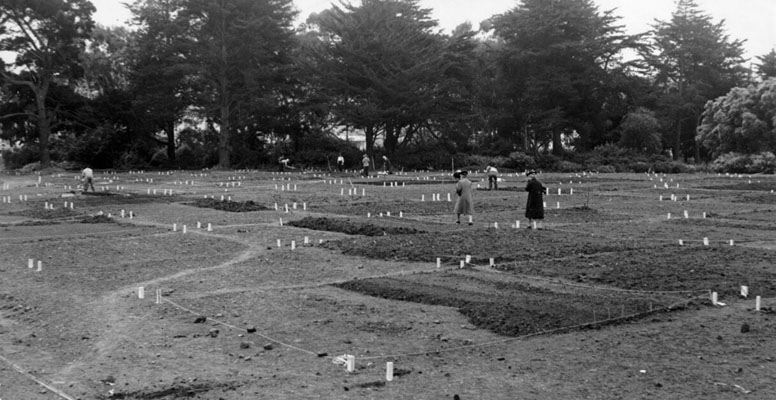
Community gardens have come and gone in Golden Gate Park over the years.  The pictures show victory gardens in the park during WW II.  The following KALW story describes a new garden where vegetables are growing communally in the park.

“San Franciscans love to garden, but a backyard is hard to come by if you live in an apartment. And the 36 city-operated community gardens have wait lists with hundreds of names on them.

That’s why the San Francisco Recreation and Park Department had to get creative on the Golden Gate Park Community Garden.

It opened last November on the northwest corner of the park, situated between busy Frederick Street and a dramatic living wall of native plants.

In order to meet the high demand for garden space, half of the 67 raised garden beds are cared for by individual households, and the other half are managed by teams of total strangers.

“Our team got together and sort of strategized on how can we bring folks together and our concept was actually one of speed dating,” says Melinda Stockmann, who oversees all community gardens for the city.

The plot sharing experiment was her brainchild. It sounds like an episode of NBC’s “Parks and Recreation,” but it’s really more like a dating show.

Stockmann led the garden buddy meet-up last August, asking questions to identify common interests and gradually pairing total strangers together. Some people got together because they wanted to plant pollinators, others found partners based on their experience level.

“It’s going to be up to those each individual teams whether they want to just put twine down the middle and straight subdivide or do they want to communally manage and all decide on their planting plan and harvest together,” Stockmann says.

One group is comprised of a retired couple and two people who had never met. They decided to use their plot for veggies and are happy sharing in the harvest together.

“When you have to have this sort of common interest in what you’re growing, you have to have compatible lifestyles,” says Melanie Manghinang, who moved to San Francisco almost two years ago. “ And just sort of getting a feel for each other’s chemistry.”

So far great relationships are growing at the community garden.

“I love the fact that it’s a shared effort and it’s a wonderful way to get to know people,” says Steven Fields, another gardener in the group.

Working with a married couple, John and Margaret Castro, has been rewarding.

“It’s like Christmas morning when I come here on the weekends and find there’s something new here,” he says.

Participants in this garden sharing program aren’t just working the earth, they’re sowing the seeds for future community garden projects.”

via Must love broccoli: A community garden plays matchmaker | KALW.


Posted in eating, gardens, people, plants | Tagged , , , , | Leave a comment

Golden Gate National Parks BioBlitz Reaches New Heights – National Geographic Society Press Room

Golden Gate National Parks Conervancy

I read this press release with delight and wondered how many species a BioBlitz would turn up in Golden Gate Park.  Wouldn’t it be interesting to compare?

“SAN FRANCISCO (March 31, 2014)—After two intensive days of exploration and documentation, the Golden Gate National Parks BioBlitz held on March 28 and 29, 2014, captured a vivid snapshot of the unique plant and animal biodiversity in the parks. Led by more than 320 volunteer scientists from across the country, thousands of amateur explorers, families and students on school field trips conducted a comprehensive inventory of the plants, insects, mammals, birds and other species that inhabit several national park sites, including Point Reyes National Seashore, Muir Woods National Monument, the Marin Headlands, the Presidio of San Francisco, Mori Point and Rancho Corral de Tierra.

Highlights:

About 9,000 people, including over 2,700 schoolchildren, participated in the BioBlitz and the concurrent Biodiversity Festival.

Over 80 species were discovered that are new to the parks’ species list, including a primitive, freshwater sponge, and sightings of 15 threatened species, including mission blue moss, were documented.

The initial scientific species count as of the 3:45 p.m. BioBlitz closing ceremony on Saturday, March 29, was 2,304, with well over 8,600 observations recorded over the course of the two-day event. Organizers expect this number to increase significantly over the next several months as cutting-edge testing of the collected samples continues.

The first-ever canopy survey of redwoods at Muir Woods provided new information about the height, age and condition of the giant trees.

The first observation of a gulf fritillary butterfly in the park occurred at El Polin in the Presidio of San Francisco, and the first-ever park sighting of a climbing salamander was in Muir Woods.

Other unusual sightings were great horned, spotted, barred and saw-whet owls; a mountain lion photographed on a wildlife camera at Rancho Corral de Tierra; and two bald eagles in the Marin Headlands.

The Biodiversity Festival at Crissy Field’s East Beach included a wide variety of music, hands-on science activities, talks, art and live-animal demonstrations. The festival showcased biodiversity across the Golden Gate National Parks and encouraged the Bay Area community to get excited about and involved in protecting and becoming stewards of the natural environment. Many visitors interacted with representatives of prominent science, nature and environmental organizations at more than 55 booths.

The BioBlitz was part scientific endeavor, part festival and part outdoor classroom. Participants combed the parks, observing and recording as many plant and animal species as possible in 24 hours. Activities included counting seals, catching insects, spotting birds, exploring and examining aquatic invertebrates and using technology to better understand the diverse ecosystems across the parks.

“Today, we discovered one of the most primitive, multicellular life forms — a freshwater sponge in El Polin. This discovery clearly indicates that this area has been a watershed for thousands of years as this gemmule — or desiccated version of a sponge — could only have survived on land if it had some access to water,” said Robert Kimsey, forensic entomologist and faculty advisor to the UC Davis Entomology Club, whose students made the discovery. “It is possible that this sponge has been in this watershed since before humans lived in the Presidio.” The recent restoration of El Polin in the Presidio of San Francisco is part of a larger effort to revitalize the Tennessee Hollow Watershed.

“BioBlitz puts a spotlight on the value of science in America’s national parks and offers a unique opportunity for the general public, especially young people, to learn firsthand how important science is in managing parks for the future,” said National Park Service Director Jonathan B. Jarvis, who joined BioBlitzers in the Marin Headlands and at Crissy Field on Saturday. “We hope that this experience will inspire the next generation to pursue a career in park science.”

“Watching scientists, students and the general public in the field exploring puts a smile on my face,” said John Francis, National Geographic’s vice president for research, conservation and exploration. “Scientists joined students and residents from the surrounding communities and celebrated their unique roles as members of the natural systems where they live. The iNaturalist app, paired with smartphones and pumped-up cell service courtesy of Verizon Wireless, allowed us to document species like never before. This enabled more real-time tracking, greater public involvement and a faster, larger species count.”

The Golden Gate National Parks BioBlitz was the eighth in a series of 10 annual BioBlitzes hosted by the National Geographic Society and the National Park Service leading up to the National Park Service centennial in 2016. The Golden Gate National Parks Conservancy and the Presidio Trust joined the partnership for this year’s event. During closing ceremonies, the BioBlitz flag was passed to Cindy Orlando, superintendent of Hawaii Volcanoes National Park, where the ninth BioBlitz will take place on May 15-16, 2015.

The first BioBlitz was held at Rock Creek Park in Washington, D.C., in 2007. The second took place at Santa Monica Mountains National Recreation Area in California in 2008. Indiana Dunes National Lakeshore was the site of the third BioBlitz in 2009; Biscayne National Park outside Miami was the 2010 site; Saguaro National Park in Tucson hosted the 2011 BioBlitz; Rocky Mountain National Park in Colorado was the 2012 host park; and the 2013 BioBlitz took place at Jean Lafitte National Historical Park and Preserve outside New Orleans.”

via Golden Gate National Parks BioBlitz Reaches New Heights – National Geographic Society Press Room.

Posted in animals, birds, science, urban ecology, wildlife | Tagged , , , | Leave a comment

Shakespeare in the Park

Here’s a lovely article about the Shakespeare Garden in Golden Gate Park.   Reminds me that I’ve been meaning to revisit this little gem.  When the rain stops  .  .  .

“An Afternoon with the Bard in Golden Gate Park

By Jeremy Dalmas

Shakespear Gatden photo by Jeremy Dalmas

In a quiet spot, just west of the bustle of the California Academy of Sciences in Golden Gate Park, sits a garden dedicated to English literature’s crowned prince: William Shakespeare. Once you make it past the entrance gate and down the worn brick path, you are transported into an English garden filled with manicured flower beds, trimmed lawns, and people escaping the noise of the city.

Joe Chmielewski is scanning a row of bronze plaques. Each is stamped with quotes from William Shakespeare’s works. He reads one from Midsummer Night’s Dream:

I know a bank where the wild thyme blows,

Where oxlips and the nodding violet grows,

Quite over-canopied with luscious woodbine,

With sweet musk-roses and with eglantine:

There sleeps Titania sometime of the night,

Lull’d in these flowers with dances and delight.

The Garden of Shakespeare’s Flowers is an enclosed nook of Golden Gate park filled only with plants mentioned in the writings of The Bard. Chmielewski is one of the park’s gardeners and he loves the flowers here.

“Along the fence there is the Eglantine roses,” Chmielewski points out. “It’s an old tea rose, so it spreads and it puts out a very nice flower. But, then you just get this brilliant rose hip behind it.”

This garden, though special, is actually not unique.

“This is one of several Shakespeare gardens throughout the country,” Chmielewski explains, “and there are several others around the world and they’re all basically outlined the same way: a 17th century classical garden.”

Cleveland, Manhattan, Vienna, and Johannesburg all have Shakespeare Gardens. Most of them were built in the early part of the 1900s. This one opened in the Summer of 1929, and there is a reason why there are Shakespeare gardens and not Mark Twain or Hemingway gardens.

Eric Anderson, Superintendent of Golden Gate Park, says Shakespeare’s work translates well to landscaping.

“He mentions plants really vividly and really in-depth in a lot of his works,” says Anderson. Anderson’s favorite plant in the garden is the cedar tree. It stretches tall above the flowers, presiding over the entire garden.

“It’s a great specimen and I suspect that it was one of the original plantings and it’s covered in Spanish moss,” says Anderson.

Lauren Sabadin says she comes to the garden often. Today she is lying on a blanket with an old book.

“I was actually just reading my poetry book and trying to draw some inspiration and do some writing,” Sabadin says.

The book she is reading from is actually the same age as the garden, filled with poems from the early 1900s. Sabadin reads me part of her favorite: “The Philosopher” by Edna St. Vincent Millet:

And what are you that, wanting you,

I should be kept awake

As many nights as there are days.

With weeping for your sake?

And what are you that, missing you,

As many days as crawl

I should be listening to the wind

And looking at the wall?

I know a man that’s a braver man

And twenty men as kind,

And what are you, that you should be

The one man in my mind?

“She has a crush on a philosopher,” Sabadin adds. Beyond inspiration, Sabadin says the garden offers her a refuge.

“It’s my escape from the bustle of the city streets,” Sabadin says. “I come to just enjoy the beauty and peace and quiet. I love to read and write and nap down here. Catch up on my sleep a little bit.”

As Chmielewski gets ready to leave, locks up a set of steel shutters that enclose a bust of Shakespeare himself. It is a unique replica of a famous statue from the writer’s home town in England. He is holding a quill and looking straight ahead. There is an inscription under the statue: “A gift to our city from the town of Stratford-upon-Avon and its former mayor Archibald Flower.”

Park Superintendent Eric Anderson says they normally they keep the statue locked away. Perhaps back in 1929, you could have valuable busts sitting out in the open. But not so these days.

In fact, if you look where there are suppose to be six plaques with Shakespeare quotes, today there are only four, and a couple blank spaces. Those two bronze plaques were wrenched off the wall in 2008, most likely stolen to be sold for scrap metal. No matter how tranquil it may seem here, we are still in the middle of 21st century San Francisco.”

via An Afternoon with the Bard in Golden Gate Park | KALW.

Posted in arts, history, people, plants | Tagged , , , , | 2 Comments

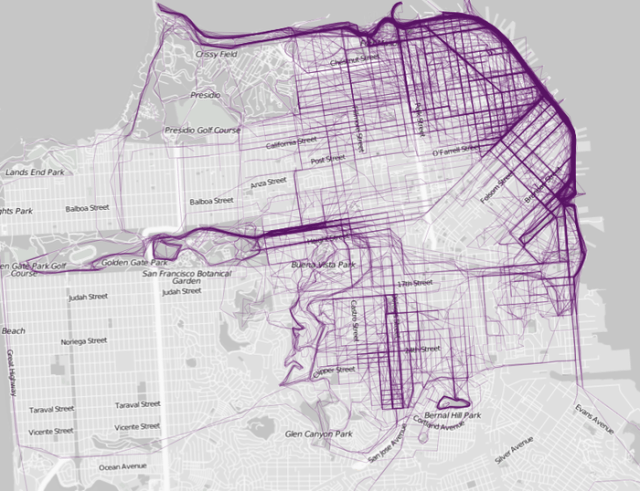
Golden Gate Park is a favorite running route.

Nathana Yau/FlowingData running map S.F.

“Nathan Yau at FlowingData created maps tracing popular running routes in 22 major cities and San Francisco is one of them.”   As a runner, I’m not surprised to see my favorite route show up bold on this map;  it follows the Panhandle and into Golden Gate Park.

But The Bold Italic website (see link below) has looked at how this map was made in more detail and discovered that it relies on “public data from an app called RunKeeper. These visualizations are only representative of people who use RunKeeper, that is people with smartphones who download exercise tracking apps: a pretty small, specific demographic of the population. That probably explains why some of the less well-to-do areas of San Francisco are coming up blank.”  I’m thinking there should be a thick network of running routes heading into the park from all directions;  surely the park is a magnet for runners within a couple of miles at least.

via Looking for New Running Spots? Check Out This Map – The Bold Italic – San Francisco.

Posted in recreation | Tagged , , , , , | Leave a comment

runaway horse causes havoc in golden gate park (Feb. 21, 1886)

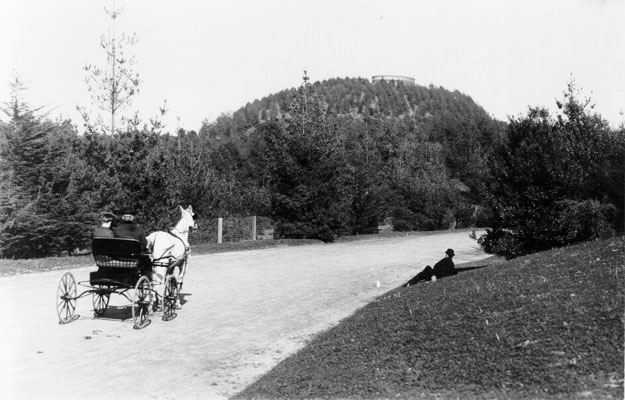
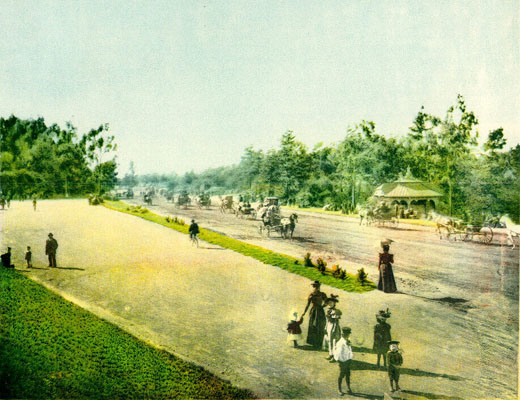
GGP.SouthDrive.SFPL.AAA-8339Looking at pictures like this one (South Drive, Golden Gate Park, probably dating to the late nineteenth century, SFPL/AAA-8339), it’s tempting to romanticize the park before the advent of the automobile.  But the following hair-raising report from the San Francisco Chronicle, Feb. 21, 1886, paints quite a different picture.

” One of the most exciting and serious runaways that ever occurred in Golden Gate Park took place there yesterday afternoon.   Miss Lillie Linnikau of 927 Golden Gate Avenue and a friend thought to enjoy the delights of an afternoon ride around the park, and accordingly hired a rig at French’s livery stable on Golden Gate Avenue, consisting of a sprightly animal and a two-wheeled phaeton.  All went serenely until the pleasure-seekers reached the corner of Stanyan and Haight streets, where the horse became very much alarmed at the Ocean Railroad dummy.  In a moment he was unmanageable, and started off at a dangerous speed, throwing both the ladies out and injuring one quite severely.

Reaching the main entrance of the park, the horse, by this time fairly crazed, turned in and tore up the avenue at a frightful pace, the cart bounding and dodging around in the animal’s rear as if hardly touching the ground.  At the place called Chickens’ Point — the mound covered with greensward, where the children play and older persons lounge — were standing the handsome family horse and double-seated phaeton belonging to Mrs. Hoadley, in which latter she was seated with the two Misses Rogers.  Seeing the great peril that threatened them in an instant, she endeavored to turn her horse to one side and give free way to the maddened runaway, but too late.  One shaft of the cart struck Mrs. Hoadley’s horse just above the breast collar and plunged into the creature’s lungs nearly eighteen inches, and snapped off like a straw.

The obstacle turned the runaway from his forward course around to the right, where was standing one of Bridge’s rigs, driven by J. King.  Mr King was more successful than Mrs. Hoadley in getting out of the way.  He gave his animal a cut with the whip that caused her to shoot ahead with a jump about twenty feet, and the passing cart caught the bind wheel, doing no other damage but spring the axle.  From this point the frenzied beast plunged right down the stairs into the small grounds occupied by seats and filled with vehicles and people.

The first obstacle encountered was a buggy occupied by Mr. and Mrs. Detrick, which was smashed into fragments in an instant and Mrs. Detrick very badly injured.  Another buggy standing near suffered a like fate, and the horses attached to both became frightened and ran away.  The mad career of the runaway came suddenly to an end in another moment by his jumping into a garden plot on the opposite side and getting so entangled in the harness that he fell and was caught.

In the music grounds there was a fearful panic.  Three mad horses were tearing around and the area was densely filled with people, but fortunately they were all subdued without anything more than some severe bruising and scratching, resulting in the rush of the crowd.

Mrs. Hoadley’s horse stood perfectly quiet amid all the excitement and the instant after the shaft struck him she bounded out of her phaeton and pulled the broken fragment out of his bleeding breast.  The animal simply trembled and cried, but still never moved and Mrs. Hoadley held a handkerchief to the wound until Mr. King returned with Dr. Teval.  As quietly as possible the ambulance kept by the Society for the Prevention of Cruelty to Animals was procured and the bleeding horse conveyed to Dr. Teval’s veterinary hospital.

Had the runaway horse proceeded twenty or thirty feet further before turning into the music ground the havoc would necessarily have been frightful, as the seats and walks all along were closely crowded with women and children and escape would have been impossible.  And had the former regulations of forbidding teams and vehicles to stand in the public grounds been in force much of the mischief that did result would have been avoided.  The authorities state that today and in the future no vehicles will be allowed in that part of the grounds.”


Posted in events in Golden Gate Park, history, safety | Tagged , , , , | 1 Comment

trees love light: photos of trees in golden gate park at the botanical garden

Buckeye_EXHIBIT_for_HMblog

A beautiful exhibit of photographs by local photographer, Steve Kane, opened in the library of the San Francisco Botanical Garden in Golden Gate Park last night and will be on view through April, 2014.   Don’t miss this one!  Using a digital camera and various software programs Kane focuses on trees in the park.  The California Buckeye  (Aesculus californica) pictured above is just one example.  To see more, visit Steve Kane’s website at    http://www.smkanephoto.com

Posted in arts, san francisco botanical garden, trees/urban forest | Tagged , , , | 1 Comment

Woodpeckers in Golden Gate Park?

Here’s a helpful article for identifying woodpeckers you may see in Golden Gate Park, especially now that winter makes them more visible (from the website Bay Nature).

Which Species of Woodpecker Can You Find in Golden Gate Park?     by Alessandra Bergamin (January 09, 2014)

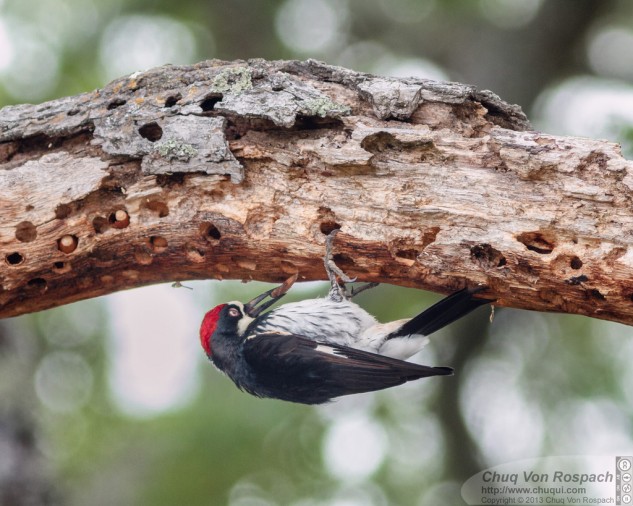
Acorn woodpecker

An acorn woodpecker working at its Granary. Acorn Woodpeckers harvest acorns and store them for lean times by drilling holes in the tree and stuffing the acorns in. This woodpecker is removing an acorn from its granary. Photo: Chuq Von Rospach.

Frank Aoyama sent in this week’s Ask the Naturalist about a bird you often hear before you see: “I hear woodpeckers in Golden Gate Park. What species live in the park?”

The downy woodpecker is the most common species in the park, says naturalist David Lukas, and can be found year round. This small, black and white checkered bird—males have a bold, red patch on the back of their head—is an acrobatic forager and commonly found in parks and by backyard feeders.

Male downey woodpecker

A male downy woodpecker. Photo: Kelly Colgan Azar.

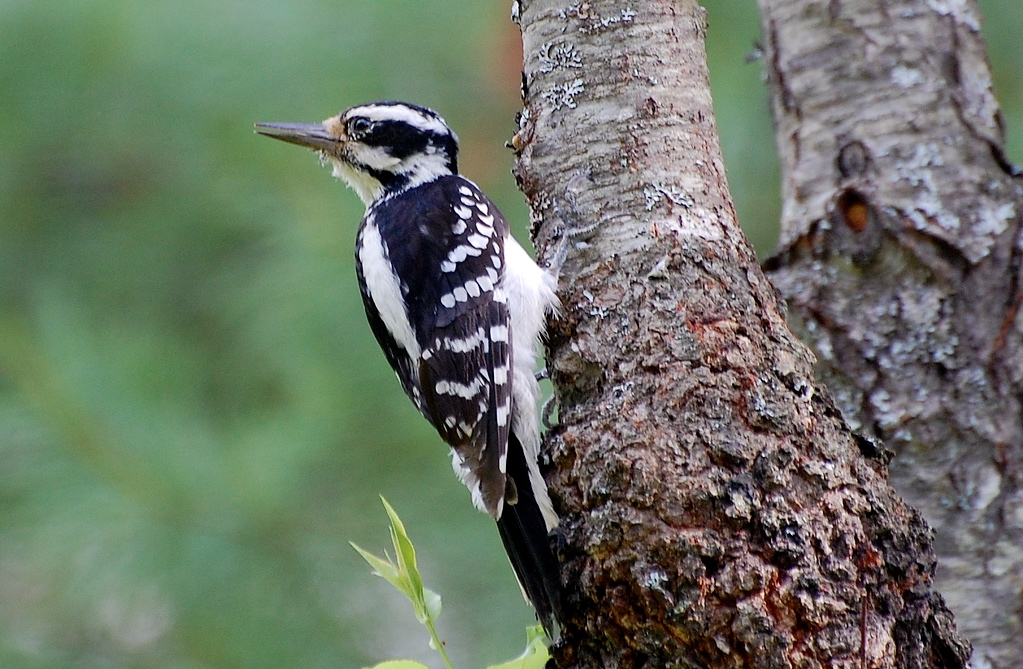
Over the past ten years, the hairy woodpecker has begun breeding in the park and can be found year round. Although larger than the downy woodpecker both species share the same coloring. The hairy woodpecker however wields a longer bill than a downy and has a more cleanly striped black-and-white head. Males also possess a patch of red towards the back of their head.

female hairy woodpecker

A female hairy woodpecker. Photo: David Maher

Northern flickers are the most common and the easiest to see in winter at Golden Gate Park, said Alan Hopkins from the Golden Gate Audubon Society. According to the Cornell Lab of Ornithology, northern flickers possess a “gentle expression and handsome black-scalloped plumage.” The undersides of the wing and tail feathers are red for those found in the West and bright yellow for those in the East. While woodpeckers can often be seen hoisted halfway up a tree, flickers prefer a diet of ants and beetles, digging them out of the ground with their slightly curved beak.

"Northern Flicker"

A northern flicker finds lunch among the ants and beetles. Photo: Mike Deal.

Nuttall’s woodpecker can be found year round in Golden Gate Park but is the least common of three. A small, black and white woodpecker, Nuttall’s is primarily found in California’s oak woodlands.

male nuttall's

A male Nuttall’s woodpecker with a insect on its tongue. Photo: Alan Vernon.

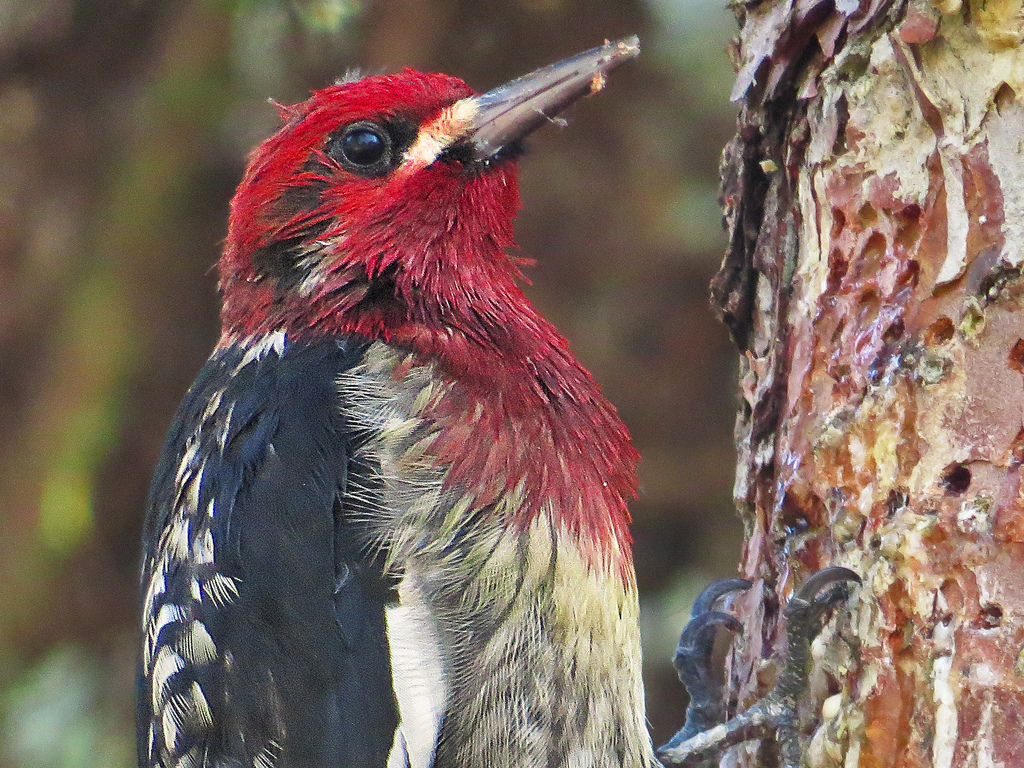
The red-breasted sapsucker is rarer and often harder to find in the park, says Lukas. Medium sized with a red head and breast, sapsuckers drill small holes in the tree bark (banksia trees are a favorite) to make the sap run. “Hippy Hill at Sharon Meadows and the Botanical Gardens are good places to look,” advises Hopkins.

red-breasted sapsucker

Red-breasted sapsucker. Photo: Richard Griffin.

The acorn woodpecker is an irruptive species that experiences huge population spikes when food is widely available. During such an irruption, their numbers will rise at the park before dropping once again. They can normally be found in the non-breeding season. “When they are in the park they are almost always found in the Oak Woodlands near Conservatory Drive or near the AIDS Dell,” Hopkins said.

acorn woodpecker

An acorn woodpecker story a found nut. Photo: Allan Hack.

“A good place to look for woodpeckers in the park is around the Chain of Lakes and the Bison Paddock,” added Alan Hopkins from the Golden Gate Audubon Society.

via Which Species of Woodpecker Can You Find in Golden Gate Park? « Bay Nature.

Posted in animals, birds, wildlife | Tagged , , , , | 1 Comment

The Very Old Hospital in Golden Gate Park

Here’s an interesting bit of Golden Gate Park history, courtesy of sfcurbed.com.

“Tucked in the parking lot of Kezar Stadium is the Park Emergency Hospital. Originally built in 1902 as the first permanent emergency hospital in San Francisco, it’s since been used as an ambulance station and offices. It was listed as Local Landmark #201 in 1991.

The city’s emergency hospital services dates back to 1872 when it was located in the basement of City Hall, but didn’t have it’s first permanent, freestanding building until the Park Emergency Hospital was built in 1902. It was designed by Newton J. Tharp, who as City Architect designed a whole slew of firehouses, schools, and the basic plan for SF General Hospital. The building was constructed by park employees and was the first publicly funded service of its kind in the country – at that time it was pretty revolutionary to have city medical services out in the neighborhoods where people lived and offer ambulance services, instead of having to schlep down to City Hall.

[Park Emergency Hospital c1902, photo via UC Berkeley via Cole Valley Alley]

The plan backfired a bit when the 1906 Earthquake and Fire struck – the hospital was almost instantly damaged, as the main entry way collapsed. The staff grabbed whatever supplies they could and opened a temporary hospital in the park tunnel near Haight and Stanyan. Doctors set up large Army tents in the field next to the damaged Emergency Hospital building and treated patients there. The building was reconstructed using stone from other buildings downtown that also collapsed.

[Park Emergency Hospital after 1906 Earthquake, photo via SF Rec & Park via Cole Valley Alley]

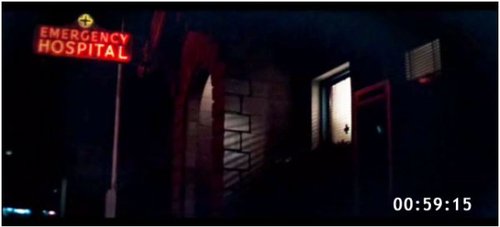
(Fun fact: the building can be seen in 1971’s Dirty Harry, when Scorpio visits the hospital after being stabbed by Harry at Mt Davidson.)

[Park Emergency Hospital in Dirty Harry, photo via Dirty Harry Filming Locations]

The emergency hospital closed in 1978, but continued to be uses as a station house for ambulance crews. It was transferred to Rec and Park in 1990 and they use it for the offices for the Natural Areas and Volunteer Programs. The whole place got a nip-tuck in 2010.”

· Local Landmark #201 [SF Planning]

· GGP Park Aid Station Renovation [SF Rec & Park]

· Park Emergency Hospital [Dirty Harry Filming Locations]

via The Landmarks: The Very Old Hospital in Golden Gate Park – The Landmarks – Curbed SF.

Posted in history | Tagged , , , | Leave a comment

people-watching in Golden Gate Park, 1888

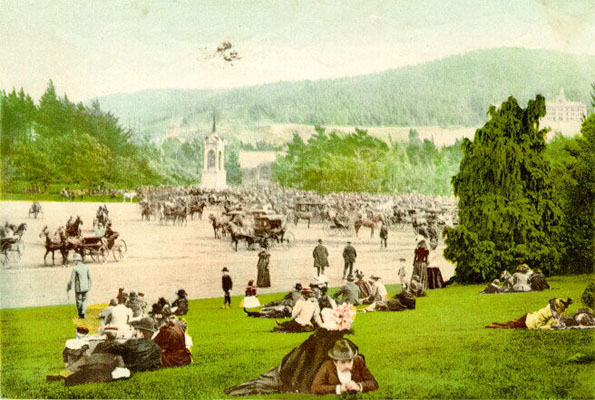
AAA-8229

People-watching is a popular, free entertainment that has been available in Golden Gate Park since it first opened to the public in the 1870s.  Here’s one observer’s report on the show that was running on Oct. 8, 1888 (San Francisco Chronicle).

“Golden Gate Park was crowded yesterday with the gayest and best of the city’s population.   .   .   .   There is hardly a public recreation ground in the country that affords as many advantages for pleasure-seekers as the Golden Gate Park of San Francisco.  Leaving the flowers, trees, music and kaleidoscopic views of rare beauty out of the question, there are plenty of other things to occupy one’s mind and eyes.

There is the young man who has borrowed his friend’s horse and who braves the galling of a humble part of his anatomy that he may be seen, admired, and mayhap adored by the hundreds of fair women who go to the park and pine and pine and pine to adore something or somebody.  The horse on which the young man bobs like the lightsome cork that marks the nibble of the finny beauty beneath the cold waters of river or bay knows the lowest thread in the youth’s trousers does but reach a half inch below his knee;  it knows his necktie has broken loose from its patent holder and has joined the wilting collar in a struggle to get over the rider’s ears;  it knows he is being turned inside out and upside down and back and across;  it knows his arms are sticking out in a wild, unromantic and unhorsemanlike manner and that everybody shares the knowledge, but it will not “whoa there, boy, whoa there.”  It dances and prances and gets the bottoms of the rider’s trousers nearer his knees and gives those who go out to see, admire and adore something worthy of fixed attention.

Then there’s the couple who have got to do their courting in public places and heavens how practice has made them perfect in it and oblivious to the fact that they furnish amusement when the horseman has passed out of sight.  With an audacity that causes the teeth of the lawnmower to grind in agony, those spoons march (that’s the word) up and down, obtruding their love-sickness on everybody and calling attention to the state to which the courtship has progressed by the easy, natural and unconcerned way in which he keeps his arm around her waist and she puts her head on his shoulder.  In every well-regulated household there is a drawer or a case or a box for spoons.  In every park there should be a lovers’ lane or adorers’ asylum, or sweethearts’ stroll or some such thing where the billing and cooing of those goslings may not offend the married men and make cynics of us all.

One has hardly time to wipe one’s glasses in order to get the last glance at that waist-containing arm before the man with the new act gets into focus.  He gets in and stays there a long while, as if loath to tear himself away from a spot where there are so many people to look at him.  Some men wear new clothes as if they were decorations of a high and rare order.  They seem to think that their suits are the only clothes in the park and would feel mortally offended if even their best friend asked them for what tailor they were doing the dummy act.  The observer cannot help seeing how the man with the new clothes gives his vest a gentle pull, administers an affectionate pat to the lapel of his coat, or adjusts the fit of the trousers by a movement not unlike that of an ophidian when getting rid of the last few inches of yesteryear’s overcoat.  The man with the new clothes is a prominent factor in the amusement of the plain, ordinary dyspeptics who go to the park for the sole purpose of finding fault with everything and everybody.  .  . ”

People-watching in the park has surely changed over time, but some things remain constant.  Stay tuned for more reports.

Posted in history, recreation | Tagged , , , | Leave a comment

Closing the park overnight

Camping in Golden Gate Park, May 29, 1906. (SFPL, Historical Photographs)

Camping in Golden Gate Park, May 29, 1906. (SFPL, Historical Photographs)

This week the San Francisco Board of Supervisors approved a long-discussed plan to close the park to the public from midnight to 5 a.m., citing vandalism and dumping as concerns.  City leaders approve overnight park closure plan | www.ktvu.com

Opponents of this decree, primarily human rights activists, say this is a thinly disguised attempt to prevent homeless people from sleeping in the park.  It’s interesting to put this debate in historical perspective.  Since the first public park opened in this country, i.e. Central Park in New York, overnight camping in parks has vexed public officials.  Partly, this problem is due to a certain duplicity in the design of parks like this.  They are meant to look and function like nature in the city, i.e. they replicate just the sort of place that is ideal for camping out.  Here is an amusing excerpt from the New York Times that illuminates the nature, and persistence, of the problem:

“Officer Meaney yesterday, while on duty in the upper portion of Central Park, espied a large bonfire blazing brightly in the woods. He approached the burning pile, and was astonished to discover a middle-aged man, apparently immersed in deep thought, standing with his back to the burning brushwood, warming his coat-tails, and seemingly unconscious of his surroundings and position. In close proximity to the bonfire was a curiously-constructed hut, built without any regard for architectural design, and composed merely of several rough-hewn logs of wood, mingled with freshly-cut branches of trees, which, being entwined around the logs, helped to support and brace them. In this romantic residence, the interior of which contained neither furniture nor bedding, the stranger had determined to reside, at least temporarily, away from the strife and busy turmoil of the great Metropolis.”  (New York Times, Dec. 28, 1877)


Posted in health and safety, history, Homeless in Golden Gate Park, people | Tagged , , , , , , | Leave a comment