sudden oak death found in golden gate park

Doug Schmidt takes samples from coastal live oak believed to have been killed by sudden oak death in Golden Gate Park. Photo: Brant Ward/The Chronicle SF

‘The number of oak trees in California that died from the virulent forest disease known as sudden oak death has increased tenfold in just a year’s time as the pathogen spread into several new parts of the Bay Area, including San Francisco’s Golden Gate Park, biologists revealed this week.

Aerial and ground surveys conducted by the U.S. Forest Service documented 375,700 new cases of dead live oak and tan oak trees over 54,400 acres of California where the pathogen is known to exist. That’s compared to 38,000 dead trees covering 8,000 acres a year ago.

The sudden increase in deaths is believed to have been caused by two years of abnormally high rainfall followed by this year’s dry weather.

The pattern is one that scientists at the UC Berkeley Forest Pathology and Mycology Laboratory foresaw last year when the deadly microbe was detected in woodlands and residential areas throughout the Bay Area. The area of infection expanded even more this year, said Matteo Garbelotto, the forest pathologist who heads the lab.

Sudden oak death, discovered in Mill Valley in 1995, exists in forests and wildlands in 14 California counties and in Curry County, Ore. It kills big oak trees and the smaller understory tan oaks, which have been ravaged in portions of Big Sur, Jack London State Park in Sonoma County, China Camp State Park in Marin County and the Marin Municipal Water District watershed lands near Mount Tamalpais. Scientists fear the pathogen could one day wipe out all of the state’s live and tan oaks.

The disease, known scientifically as Phytophthora ramorum, has 107 susceptible host plants. Infected California bay laurels are the most effective spreaders of the deadly microbe, but such common garden ornamentals as camellias and rhododendrons can also spread the pathogen to oaks.

Samples from California bay laurels and other host plants taken by volunteers around the Bay Area show that the pathogen’s spores are virtually everywhere in the hills of Burlingame and other parts of the Peninsula, and the infection has spread farther into residential areas of the East Bay hills, and Napa and Sonoma counties.

The microbe was even found in neighborhoods on the outskirts of Santa Cruz and, most surprising of all, in a cluster of three trees near Middle Lake, in the southwest corner of Golden Gate Park, near Sunset Boulevard.

The source of the San Francisco infection, which has yet to kill any trees, is a mystery given that there are no nurseries nearby spreading the disease like there were several years ago when the pathogen was last detected in the park near the AIDS Memorial Grove, Garbelotto said.

“The area doesn’t have a lot of oaks, so I’m not worried about oaks there, but I’m worried about other plants being infected and, of course, people carrying it on their shoes,” Garbelotto said. “It’s puzzling that we found it there because it’s a totally urban environment, and I really didn’t expect it. It shows how complicated and adaptable this organism is.”‘

via Explosive growth in sudden oak death – SFGate.

Posted in trees/urban forest | Tagged , , | 1 Comment

native plant strikes again

MIKE KOOZMIN/THE S.F. EXAMINER
9-20-201

“Three San Francisco cops remain on disability after suffering “severe” reactions to poison oak during a Sept. 9 scuffle with a tree-branch-wielding homeless man in Golden Gate Park, police said Thursday.  The incident erupted about 9:15 a.m. when transient William Deegan, 39, became violent with a park ranger who approached him in a forested area near Transverse Drive. The ranger was reportedly trying to cite Deegan for illegally camping in the park. During a struggle, police said, Deegan allegedly struck and wounded the ranger with a tree limb.  Police officers who were called to the scene also had their hands full. The transient struck one of the officers in the head with a log, Richmond Police Station Capt. Sharon Ferrigno said.  The ranger and cop were treated at the scene for their head injuries. However, the stitched-up cop couldn’t simply return to his beat, police said, as he and two of his colleagues were exposed to poison oak while wrestling Deegan to the ground.”

via Cops out sick after Golden Gate Park skirmish exposes them to poison oak | Mike Aldax | Crime | San Francisco Examiner.

Poison Oak is a hazard for anyone who uses Golden Gate Park, not just the homeless and the park police.  And it surely wasn’t included in the original planting plans for the park.  But it has been growing in the park for a long time.

Poison Oak in Golden Gate Park, 1954, SFPL

And it IS a native plant (unlike the Himalayan blackberry and English Ivy that also grow rampantly in the park).  In recognition of this, there’s a magnificent specimen of Poison Oak (properly identified, pruned and kept in check) in the California section of the Botanical Garden.  And at this time of year, it turns deeply red and looks quite beautiful!

Poison Oak in the Botanical Garden/photo by Heath Massey

Posted in fall foliage, health and safety, plants, san francisco botanical garden, urban ecology | Tagged , , , , , , | 1 Comment

Tell the difference between honey bees and bumble bees

A reader has pointed out that the bee I photographed in Golden Gate Park was probably a bumble bee, not a honey bee.  I posted the photo last week in a blog about Golden Gate Park honey.   That started me wondering how many varieties of bees there actually are in the park?!  In any case, here’s an article to clear up the bumble/honey confusion, thanks to another, much more insect-knowledgeable blogger and photographer (Alex Wild).  I hope I will recognize a bumble bee next time I see one in GG Park!

via How to tell the difference between honey bees and bumble bees – MYRMECOS – Insect Photography – Insect Pictures.

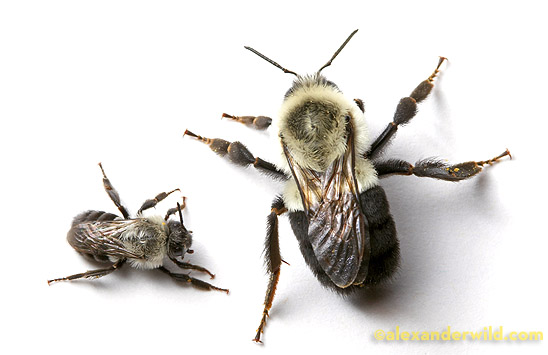
Honey bee on the left; bumble bee on the right.

“If one taxonomic error is repeated in the media more than any other, it is the inability to distinguish between honey bees, Apis mellifera, and bumble bees, about 250 species in the genus Bombus. Such errors are frustratingly common for insects that should be easy to recognize. Here, for example, is a recent story that mistakes a bumble bee for a honey bee http://www.stuff.co.nz/environment/5754656/Keepers-keen-to-keep-close-tabs-on-bees, and here is one that does the opposite http://westranchbeacon.com/2011/08/the-flight-of-the-bumble-bee-why-are-they-disappearing/. Even the New York Times has stepped in this equivocation.

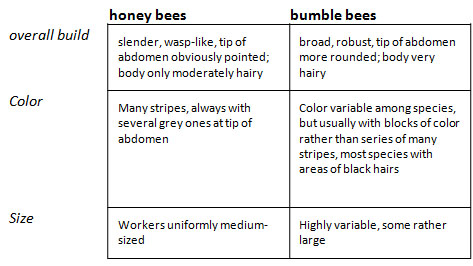
Both honey bees and bumble bees are among the most abundant flower-visiting insects in the northern hemisphere. How do we tell the difference? I’ve made a chart:

Bumble bees vary greatly in size, but they tend to be furry and relatively pudgy. These two bees are sisters from the same nest.

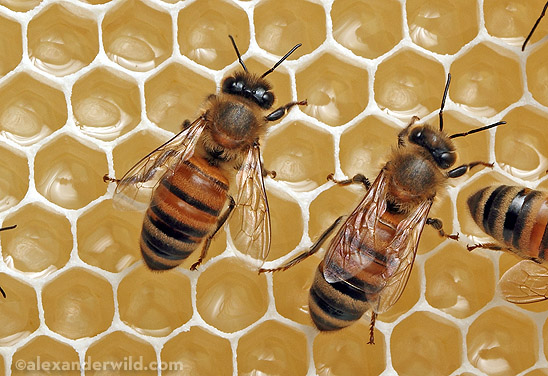
Honey bees are slender and more wasp-like in appearance, bearing a stronger, more obvious pattern of stripes.”

Honey bees

Posted in urban ecology, wildlife | Tagged , , , , , | 1 Comment

a bumble bee in the dahlia garden (not a honey bee!)

Did you know that you could be spreading Golden Gate Park Honey on your breakfast toast these foggy mornings?  Disadvantaged bees make it;  they have been rescued and relocated to a rooftop near Golden Gate Park out by Ocean Beach.  The bees harvest nectar from eucalyptus, lavender, thyme and other bee-attractive plants in the nearby park.  The nonprofit organization Habitat for Honeybees maintains the hives and captures, bottles and sells the honey online: http://habitatforhoneybees.org/buy-our-honey.html  It’s also available at select locations in the city, such as Angelina’s Cafe in the Richmond or Bi-Rite Market in the Mission.

Feral bees swarm when a hive gets too large or overcrowded  .  .  .   a natural process in the countryside, resulting in new colonies and perpetuating the species.  But in the city bees often swarm or attempt to relocate in inconvenient places like attics or playgrounds.  Local bee-keepers are on call to remove  swarms and bees are actually easy to move when they are swarming, i.e. before they start to build a new hive, because when they aren’t defending a hive they are less likely to sting.  Habitat for Honeybees maintains hives for rescued bees throughout the Bay Area and is soliciting volunteers to host a hive, preferably in a large garden or near a park where the bees can forage.  So maybe we can look forward to a taste-off between Golden Gate Park Honey and .  .  .  other park varietals?

Posted in eating, urban ecology, wildlife | Tagged , , , , , , , , , | 2 Comments

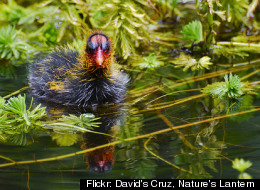
American Coot Chicks Caught Bobbing Around Golden Gate Park PHOTOS, VIDEO

“Another amazing wildlife sighting in Golden Gate Park, brought to you by the craziest-looking baby birds weve ever seen.Nature photographer extraordinaire David Cruz snapped images of adorable American Coot chicks bobbing around the parks North Lake.SCROLL DOWN FOR PHOTOS, VIDEOThese beautiful babies wont stay so colorful forever, though. American Coots grow up to be grey-feathered adults with only a small mark left of their eccentric childhoods.Take a look through the slideshow below to see the amazingly colorful birds before its too late:”

via American Coot Chicks Caught Bobbing Around Golden Gate Park PHOTOS, VIDEO.

Posted in birds, wildlife | Tagged , , , , | 1 Comment

coyote pups In golden gate park

coyote pups in golden gate park (May,2012)

“Although coyotes have been in Golden Gate Park since 2007, the Huffington Post reported last April that the animals were becoming more agressive in order to protect their young. Now we have the pictures to prove it.Cruz, however, doesnt just photograph coyotes. Golden Gate Park is filled with rare, exotic, endangered and beautiful animals in their natural habitat and not just bison!.Check out some of the magnificent animals that can be found around Golden Gate Park below, including the endangered California Coast Quail, the Red Shoulder Hawk, and the iridescent Allens Hummingbird, courtesy of David Cruz:”

via Coyote Pups In Golden Gate Park And Other Adorable San Francisco Wildlife PHOTOS.

Posted in birds, people, urban ecology, wildlife | Tagged , , , , , , | Leave a comment

San Francisco mayor renames road for Nancy Pelosi

Another renaming in Golden Gate Park this week, as reported in the S.F.Chronicle:

‘Mayor Ed Lee has renamed a major road coursing through Golden Gate Park to honor U.S. House Minority Leader Nancy Pelosi.

Lee and other city officials participated in a ceremonial renaming of Middle Drive East to Nancy Pelosi Drive on Monday. The mayor says the road was renamed to celebrate Pelosi’s 25 years of public service to San Francisco.

The Democratic lawmaker represents California’s 8th Congressional District in the U.S. House of Representatives, which includes most of San Francisco including Golden Gate Park.

Lee says the former House Speaker’s leadership has been crucial to preserving public lands and parks, and protecting the San Francisco Bay and surrounding environment.

The road leads to some of the park’s most famous destinations, including the National AIDS Memorial Grove, California Academy of Sciences, Botanical Garden and Japanese Tea Garden.’

via San Francisco mayor renames road for Nancy Pelosi.

Posted in people | Tagged , | Leave a comment

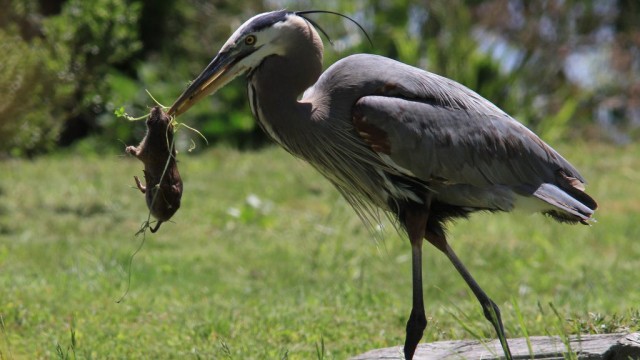
heron watching in golden gate park

“Its a sight to behold: an elegant four-foot tall heron slowly stalking across the field above the Big Rec baseball diamonds in Golden Gate Park. Suddenly, from a motionless stance, it strikes out and nabs an unsuspecting pocket gopher, swallowing it whole. If youve seen it happen, you wont soon forget it, and if not, this is a prime time for heron sightings. Why? Because up at Stow Lake, they have nests full of hungry mouths to feed.

Great Blue Herons are solitary birds for most of the year, but when mating season arrives in the spring, they pair off and build nests close to one another. Assuming they were successful the previous year, the same pair will often mate year after year, raising chicks in saucer-shaped nests that range from 1.5 to 4 feet across. Nests used over and over like those at Stow Lake tend to be on the larger end of the size scale.

On Saturday morning, volunteers at San Francisco Nature Education had a series of spotting scopes set up just to the right of Stow Lakes boathouse, trained on Heron Island’s towering treetops. The scene was action-packed. Adult herons swooped through the air, chasing one another away from their nests, and every so often the chicks could be seen between tree branches strutting around their nests. Observers estimate the four nesting pairs produced six chicks, which hatched in early April and are now about six weeks old.  .  .  .

Herons can be seen in Golden Gate Park year-round, though individuals are thought to come and go. This year’s chicks and their parents should be visible at Stow Lake’s Heron Island until mid-late June, but if you want the benefit of San Francisco Nature Education’s naturalists and spotting scopes at your disposal, don’t miss the final “Heron Watch” program on Saturday, May 19. Founder Nancy DeStefanis first started documenting the birds’ nesting behavior at Stow Lake in 1993, and now runs a series of interpretive bird walks, field trips, and observation sessions to educate school kids and locals about birds and local ecology.”

To learn more about the herons in Golden Gate Park, see:   Heron Spotting in Golden Gate Park | KQED QUEST.

Posted in birds, people, urban ecology, wildlife | Tagged , , , | 1 Comment

coyotes (again) in golden gate park

‘Sightings in Golden Gate and other San Francisco parks have increased, and Animal Care and Control is advising all residents to remember that they are not only wild animals, but potentially dangerous as well.

coyote in golden gate park, photo by David Cruz

Although coyotes have been in Golden Gate Park since 2007, Animal Care and Control believes that the animals feel particularly threatened right now because it’s pup season. Mother coyotes are most likely defending a den of pups in the area.

Haley Bratton told the San Francisco Chronicle that she frequents Golden Gate Park with her two large pit bulls and regularly sees coyotes near the trails. Last Thursday, however, was not her normal walk in the park when one came within three feet of her, growling and gnashing its teeth.

“Every step we took backward, he took two forward,” she said.

On Tuesday, the Recreation and Park Department announced that it will close trails near JFK Drive. The trails nearest to the north and middle lakes and the bison enclosure will be off-limits to all dogs, possibly until August. Joggers will also be cautioned against visiting the area.

Even if you can’t check out the coyotes for yourself, take a look at a few pictures of the beautiful animals by David Cruz.’

via Coyotes In San Francisco: Sightings In Parks Result In Closed Trails (PHOTOS).

Posted in wildlife | Tagged , , , , | 1 Comment

central park, new york (notes): diagnostic lab for an 843-acre patient

Ms. Nelson, lab coordinator for Central Park's natural environment, brews "compost tea" by steeping leaves and wood chips in a 100-gallon container. (photo: New York Times)

It’s always interesting to see what’s going on in the mother park! This is from today’s New York Times:

‘On a recent morning inside a nondescript laboratory building in the middle of Central Park, Tina M. Nelson was watching for signs of trouble. Wearing a cobalt-blue lab coat, Ms. Nelson, who bears the unwieldy title of soil, water and ecology laboratory coordinator for Central Park, ground up a soil sample from the Conservatory Garden with a large mortar and pestle. She then used a 3.5-cubic-centimeter soil scoop to gently add a bit of the earth to a crucible before placing it into a kiln to burn off the organic matter. “We haven’t looked at this area for a little while,” she said.

Ms. Nelson is, quite simply, the diagnostician for every aspect of Central Park’s natural environment. She tests the soils to see if there is too much nitrogen here, too little potassium there, and also monitors the park’s bodies of water. Her intimate knowledge of the park’s 843 acres — whether there has been an outbreak of curly-leaf pondweed on the Harlem Meer, for instance, or a brown patch of grass at the Sheep Meadow — helps landscapers decide what steps to take to maintain their assigned zones  .  .  .  .

“The conservancy’s maintenance of the park is so much more than mowing and raking,” said Douglas Blonsky, president of the Central Park Conservancy, the nonprofit group that manages the park for New York City. “To do it right means knowing the park at a very fundamental level.”

Much the way a sculptor uses a block of marble, the landscape architects Frederick Law Olmsted and Calvert Vaux carved groves and meadows, ponds and waterfalls, onto the surface that is Central Park. The conservancy, similarly, employs a range of tools to make those landscapes resplendent. While fertilizers are applied judiciously, the park’s landscapers in recent years have turned to more natural remedies.

One of the most widely used is Ms. Nelson’s “compost tea,” a rich concoction made by steeping composted leaves and wood chips drawn from “the Mount,” the park’s giant compost heap near Fifth Avenue and 103rd Street, in a 100-gallon container. “We add starches and sugars — I don’t want to give away the recipe — and heat it,” she said. “We brew it like a big, stinking pot of tea.”

The liquid is then diluted with 400 gallons of water and sprayed on the seven major lawns twice a year, as well as on flower gardens and newly planted trees.

On a recent day, wisps of steam rose from the top of the compost pile. Ms. Nelson is responsible for ensuring its health, too, and frequently sticks a thermometer, attached to a long pole, into its belly. “When it reaches 120 to 130 degrees, we need to turn it over,” she said.

Ms. Nelson, who holds a degree in wildlife and fisheries conservation from Louisiana State University, has run the park’s soil lab for five years. Hydrating herself with an occasional sip of water from a beaker, she moves soil samples through a process called segmented flow analysis, in which the respective amounts of nitrogen, potassium and phosphorous are determined.

“We’re looking for the levels of nutrients,” she said. “Our ideal range for phosphate is 40 to 60.”

She also keeps tabs on the park’s wildlife, trying, when it is possible, to fight nature with nature. In the summer, to combat aphid infestations along the park’s shorelines, she releases ladybugs purchased in gallon containers. The ladybugs eat the aphids, sap-sucking insects that are the bane of gardeners.

“It’s very effective,” Ms. Nelson said. “You see thousands and thousands of ladybugs flying away and covering your hands. It’s really fun.”

More challenging is the algae that can appear on the park’s half-dozen lakes and ponds, all of which are man-made. While the park’s landscapers avoid spreading fertilizer near shorelines, the water runoff from streets and sidewalks can overload lakes with nitrogen and phosphorous during heavy rains, leading to blooms of algae.

Two to three times a week, from March to September, Ms. Nelson tests the water in places like Turtle Pond, the Lake and Harlem Meer, measuring temperature, pH and dissolved oxygen levels.

The Harlem Meer, in particular, has struggled with filamentous algae, which resembles a green wooly mat and competes with plants for nutrients. Ms. Nelson periodically dispatches an algae harvester on the Meer. A small barge with pontoons, the harvester uses a conveyor belt to scoop up the algae. Once the algae was tamed, however, curly-leaf pondweed, an invasive perennial, moved in. “Nature abhors a vacuum,” Ms. Nelson said.

At Turtle Pond, she has gone out in waders to rake filamentous algae by hand. The Lake, at 72nd Street, has its own troubles, with an excess of blue-green algae. Still, Ms. Nelson is against treating the park’s bodies of water with chemicals. “Absolutely not,” she said. For now, she added, aerating lakes and ponds with sprinklers is the safest way to restore oxygen and increase the population of largemouth bass, yellow perch, catfish and sunfish.

Ms. Nelson’s detailed understanding of the park’s ecology can sometimes be burdensome. On weekends she likes to visit the park with friends: a favorite picnic spot is the Great Hill, near 106th Street on the west side. But downshifting to a more leisurely mode is not easy.

“If I see phragmites in a water body, or people feeding bread to ducks and geese, I think, ‘Oh, I should do something about that on Monday,’ ” she said. When ducks rely on humans for food, especially if it is non-nutritious bread, they can develop a disease called angel wing, she explained, and eventually lose their ability to fly.

“One of my friends says it’s like walking with an off-duty police officer,” she said. “I can’t stop looking.”’

via In a Central Park Laboratory, Providing the Diagnosis for an 843-Acre Patient – NYTimes.com.

Posted in recycling, urban ecology | Tagged , , | Leave a comment