mystery bird in the park | Science | guardian.co.uk

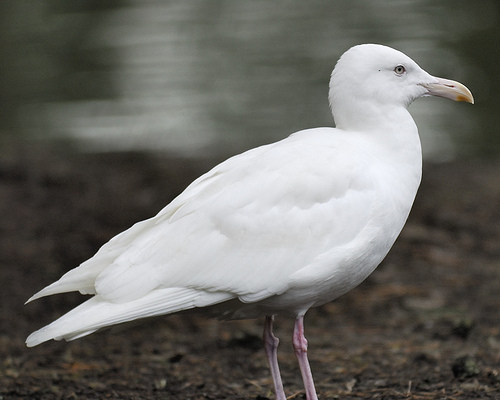
Mystery Bird photographed at Golden Gate Park, San Francisco, CA, USA. Image: Joseph Kennedy, 21 December 2010.

Here’s a fun challenge from the UK!  The bird is in Golden Gate Park: “This beautiful North American mystery bird is quite special when compared to its brothers and sisters — how?

Complaints about yesterday’s mystery bird being ‘too easy’ are being met with a much more difficult mystery bird today! This beautiful North American mystery bird is rather special when compared to its brothers and sisters. Can you name the species and tell me what is so special about this individual?

About the Daily Mystery Bird:

The Rules:

1. Keep in mind that people live in 24 different time zones, and some people are following on their iPhones. So let everyone play the game. Don’t spoil it for everyone else by identifying the bird in the first 24 to 36 hours.

2. If you know the bird’s identity, provide subtle hints to let others know that you know. Your hints may be helpful as small clues to less experienced players.

3. Describe the key field marks that distinguish this species from any similar ones.

4. Comments that spoil others’ enjoyment may be deleted.

The Game:

1. This is meant to be a learning experience where together we learn a few things about birds and about the process of identifying them (and maybe about ourselves, too).

2. Each mystery bird is usually accompanied by a question or two. These questions can be useful for identifying the pictured species, but may instead be used to illustrate an interesting aspect of avian biology, behaviour or evolution, or may be intended to generate conversation on other topics, such as conservation or ethics.

3. Thoughtful comments will add to everyone’s enjoyment, and will keep the suspense going until the next teaser is published. Interesting snippets may add to the knowledge of all.

4. Each bird species will be demystified approximately 48 hours after publication.

You are invited to review all of the daily mystery birds by going to their dedicated graphic index page.”

via Today’s mystery bird for you to identify | Science | guardian.co.uk.

Posted in wildlife | Tagged , , | Leave a comment

a wildlife photographer shares twilight adventure in golden gate park

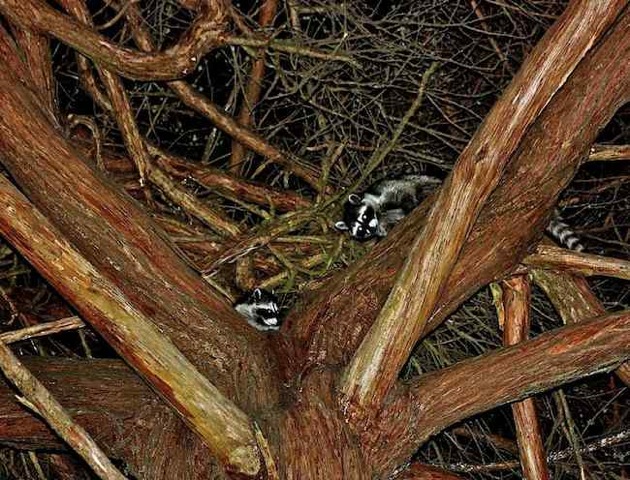
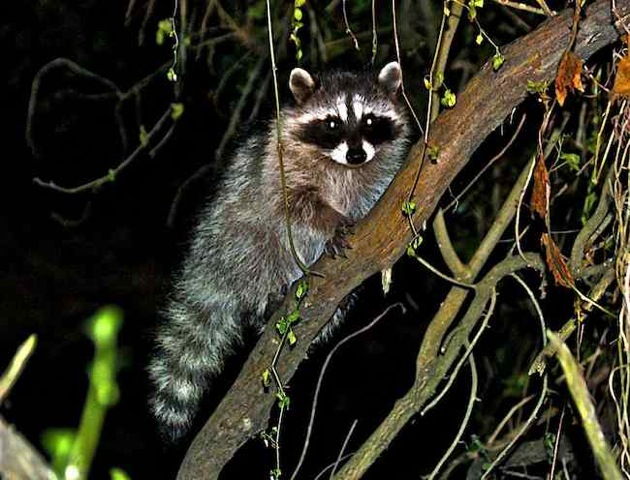
Janet Kessler took this delightful photograph of a raccoon in Golden Gate Park for an exhibit at the main San Francisco library last summer.  The following is her description of capturing these elusive animals on film  .  .  .

“I had been invited to put on a photographic wildlife exhibit at the main library — what an honor!  As I began preparing the photographs for the show, I realized that I really needed more animals — more animals that everyone would know about.  For starters, I decided that I needed a shot of a raccoon. Raccoons normally come out after dark, so I roped my husband Jack into coming with me, because, also, I would be visiting unknown parts of the park. We had an early supper and headed out well before dark: me with my camera, and Jack with a powerful emergency flashlight which we bought years ago for, well, not exactly this kind of activity, but it was the best we had. I had no special nighttime photography equipment — the emergency flashlight would have to do.

Jack also carried his brand new iPhone — it can do anything. We started walking in the park, not knowing anything at all about raccoons, just relying on hope. Jack wanted a little more guidance — he didn’t want to stay out all night, and we couldn’t decide on where to find raccoons. So, as we walked, he looked up “raccoon” on the internet. Of absolute relevance, but a complete surprise to us, was that raccoons live in trees. Come on, give me a break! We argued this, back and forth, but finally decided to “look up” as we walked — “just in case” — maybe we would see something. As it got darker, I eventually noticed a denser area up in one of the trees. I looked and looked, and decided, without really being able to see anything, that this might  be a raccoon way up there, 75 feet above the ground.

So, we settled down and waited — until Jack had had enough and said it was time to go. After all, there were unsavory fellas roaming around, too close for comfort, and they were even looking at us. He did not like it. But I felt safe with him, and decided we needed to stay a little longer — I think my enthusiasm and sense of adventure may have overpowered him. We decided to sprawl out on the ground at the base of the tree,  to avoid neck-cramps. Here we enjoyed looking up into the tree branches — the way we all have when we were little.

We had arrived in the park at 6:00pm, and now it was 10:00pm, when slowly we began to notice movement. Ahh, something was happening. The movements occurred infrequently at first, but slowly, ever so slowly, there was more. And then, YES, we saw a raccoon tail — you could barely make out the stripes, but they were there!  Yes, this would be my chance to take a raccoon photo. The raccoon was still high up in the tree, so we remained in our prone positions so as not to cause alarm. There was more movement. And then we noticed something very strange. That tail over there couldn’t possibly be connected to that raccoon, could it? Noooo — there were two raccoons! We could feel our excitement mounting.

photograph by Janet Kessler

The raccoons were still high up in the tree when, oh no, could it be? We now counted three of them!!  It is at this time that we got up. My husband shined the light on the raccoons and I tried taking photos as they all slowly made their way down the tree trunk. A flashlight hardly produces enough light for taking photos, but we were able to get some fairly decent shots. After reaching the ground, the mom moved off, as did the larger of the cubs. But the smallest, the runt, actually turned around and came back to examine us from a high log on the ground. Hi there! The shutter of my camera kept getting stuck because of the lack of light, but we did get the photos I wanted, which I am including here.

photograph by Janet Kessler

We went home that evening, not only with a few raccoon photos, but also with an adventure to remember and a story to tell!  Golden Gate Park at Twilight!”

Here’s a link to Janet Kessler’s website:   http://www.urbanwildness.com/urbanwildness.com/Index/Index.html

Posted in people, wildlife | Tagged , , , | 6 Comments

riding the blades: golden gate park’s dutch windmill

Pranks and stunts, close calls and tragedies have become part of the lore of Golden Gate Park over the years!  Here’s a report of some incidents involving the Dutch Windmill! (courtesy of Woody LaBounty; posted in The Ocean Beach Bulletin)

This “old newsreel footage from the 1920s .  .  .  [a] depiction of ‘annual cleaning’ of the 50-foot-long blades seems to be farcical, but the prancing around with a hanky a hundred feet off the ground is no joke.

The windmills were erected not as picturesque curiosities, but as working apparatus to pump up aquifer water for irrigation purposes. A city-paid windmill keeper had to furl and unfurl sails on the wings, often in high winds or stormy weather. It was a dangerous job. On April 5, 1906, windmill keeper John L. Hansen was carrying out his duty of securing the great blades for the night when he fell off the upper platform.

Hansen died from a fractured skull after landing on the lower platform 50 feet below.

Beyond accidents, the windmill attracted suicides. Hansen’s successor as keeper, Heliodor Hammerstrom, reported in 1920 that in his tenure no less than 25 people had climbed and leaped off the Dutch Windmill.

None of this history stopped Miss Velma Tilden from taking a bet to ride the blades. A resident of 528 25th Ave., Tilden was known as “a taker of dares for many a thrilling stunt on sea or land.” As part of a publicity campaign by the American Legion for former servicemen out of work, Tilden agreed in November 1921 to get a box of candy for every rotation she hung on. Strapped to a blade, the young lady did 25 rotations in a stylish hat and stole.”

via Before Now – Riding Golden Gate Park’s Dutch Windmill | The Ocean Beach Bulletin.

Posted in events in Golden Gate Park, history, people | 1 Comment

golden gate park after dark?

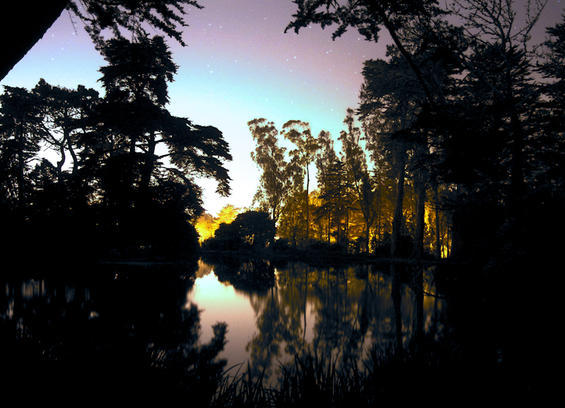
golden gate park at night (by photographer Chris MacArthur, SF Weekly)

Marie Winn’s delightful book,  Central Park in the Dark: More Mysteries of Urban Wildlife (New York:   Farrar, Straus and Giroux.  2008) begins: “The first time I walked through the Ramble at night I was terrified.  I had been there in the daytime often enough;  that thirty-seven acre wilderness in the heart of central Park is where I first became a birdwatcher. But the very features that enchanted me by day — the winding paths, the thicket of trees blocking out the city in all directions, the rock formations cropping up out of nowhere, the secret coves, the rustic bridges and sylvan streams — all looked grotesque and menacing in the darkness  .  .  .

.  .  .  That was many years ago.  Today the things that once made my heart start pounding are full of possibility.  That rustling in the leaf litter could be a white-footed mouse;  the odd yips and yowls — squabbling raccoons.  Now I recognize the particular rocks and trees that cast ominous shadows on the path.  Of course I keep my wits about me walking through the park at night, but not more than I do during the day.  You learn to be jungle-smart living in New York.”

Curiosity and fascination with the mysteries of nature lured Marie Winn and her band of “nature lovers”  into the “wilderness” of Central Park after dark beginning in 1995 and they found amazing things going on  .  .  .  creatures and events that would never be seen in daylight  .  .  .  “owls flying off to hunt, bats calling unheard as they circle at the water’s edge, spiders spinning elaborate webs, slugs embracing, cicadas unfolding their lacy green wings, hawks falling asleep in concealment, large, colorful moths arriving from the mysterious dark to feed on tree sap.”

Reading these tales of adventure make me wonder about wild nightlife in Golden Gate Park.  Do we have bats, a moth tree that comes alive in the dark, mating slugs?  Where do the birds sleep?  I’m reminded of a trip I took once to the Pantanal, the world’s largest wetland which extends into parts of Brazil, Paraguay and Bolivia and is teaming with wildlife.  One night, on a night hike, our guide pointed his flashlight beam out at a nearby marsh. Hundreds of pairs of yellow eyes shown up at us out of the dark grasses  .  .  .   Yacare Caiman (Caiman yacare)!

What wildlife would we startle out of the thickets of Golden Gate Park in the night?  I’m guessing owls, raccoons, lots of rodents, bats  .  .  .  maybe a coyote?

For more photos Golden Gate Park at night by Chris MacArthur:  http://www.sfweekly.com/slideshow/golden-gate-park-at-night-30643829/

Posted in arts, wildlife | 2 Comments

magnolia walk: precocious blossoms harbingers of spring

learning about magnolias in the botanical garden

Take a magnolia walk in the San Francisco Botanical Garden in Golden Gate Park this month!  Yesterday afternoon, on a docent-led tour we learned many interesting facts about the magnolias in this world-renowned collection, recently listed as the 4th best in the world (the first three being in China).  Some Magnolia species are native to North and South America, but 80% come from Asia.  The Asian varieties are the precocious-flowering ones,  i.e. the flowers emerge before the leaves, in a  Dr. Seuss-like effect featuring gnarly branches conspicuously festooned with  incongruous-looking, often outsized blossoms in shades ranging from bright pink to waxy white.

Magnolia is a very old genus, perhaps as old as 100 million years?!  The flower is primitive by botanical standards, with sepals and petals indistinguishable from one another and therefore called “tepals.”  Inside the cup of the flower a mass of stamens, bearing the pollen, surrounds a column of pistils.  Beetles, a very old form of insect life (older than bees!), have traditionally pollinated magnolias;  they crawl around on the stamens, eat the pollen and munch on the tepals.  Song birds eat the magnolia seeds, which are produced in cone-like fruits.  The seeds and fleshy arils are a good food source for migrating birds.

The name, Magnolia, honors a French physician-botanist, Pierre Magnol (1638-1715), who is credited with planting the first specimen of Magnolia in the first botanical garden in France (in Montpellier).  The oldest magnolias in the SFBG collection date to between 1937 and 1957, planted by Eric Walther who was then director of the arboretum.  He introduced seventeen species of magnolia into the garden during his tenure.

The evergreen Southern magnolia, Magnolia grandiflora, native to the southeastern United States, has dark green, glossy leaves that have a brownish, hairy underside, giving the tree a two-toned effect.  These trees can vary quite a bit in size, but some can become grand indeed, reaching as much as 90 feet in height.  This is the most commonly cultivated magnolia world wide.  The large, white blossoms are showy at their peak, but, to my mind, this tree is less striking in bloom than the marvelous Asian varieties in their bare-branched, precocious blooming state.

This is peak viewing time for the magnolias in the park.  Ask for a handout for “The Magnolia Walk” at the entrance kiosks to the SFBG, and you will receive a free map with all the magnolia locations and information about the trees’ history and characteristics.

Posted in plants, san francisco botanical garden, trees/urban forest | 1 Comment

flashback to 1971: 156,000 march to protest the vietnam war

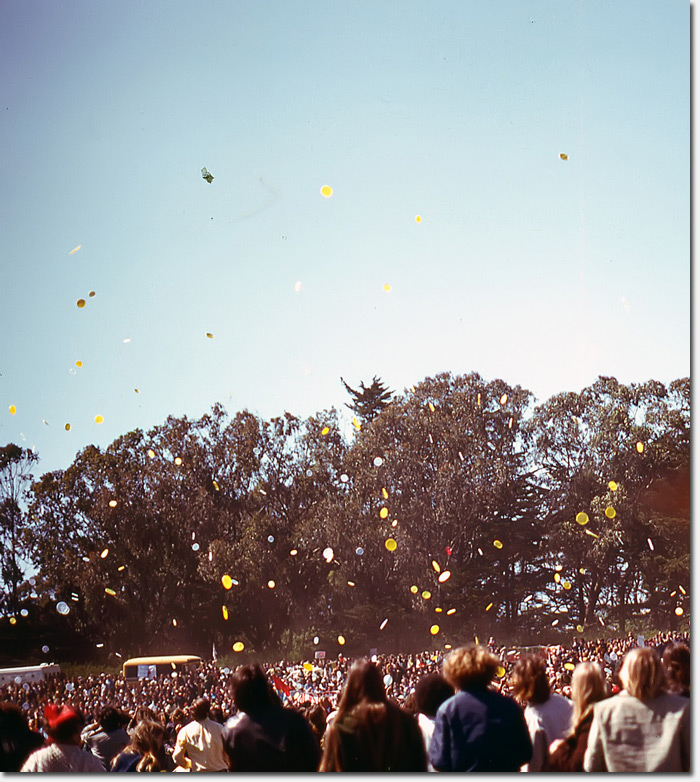
speedway meadow, golden gate park, april 24,1971

This news flashback is from http://richmondsfblog.com/

“In this month’s issue of The Richmond Review newspaper, the above photo was featured, which shows thousands of citizens .  .  . in protest against the Vietnam War  .  .  .

The photos were taken by Saul D. Feldman, who participated in the protest and captured these photos.

According to the UC Berkeley Library of Social Activism, the rally took place on April 24, 1971. While 200,000 people held a rally on the Mall in Washington DC, around 156,000 simultaneously marched here in San Francisco. It was the largest such rally to date on the West Coast.

The procession began at the Civic Center and made its way up Geary Boulevard, finishing up at Speedway Meadow in Golden Gate Park. Live music was played and people flew frisbees and coffee can lids in the park, which you can see in one of the photos below.”

via Flashback to 1971: 156,000 march to protest the Vietnam War | Richmond District Blog of San Francisco (richmondsfblog.com).

Posted in events in Golden Gate Park, history | Leave a comment

bowling on the green with shakespeare and friends


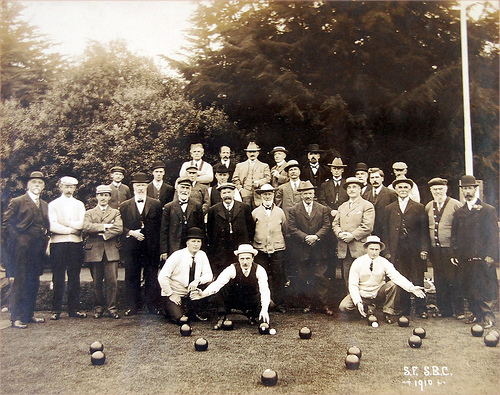
the san francisco lawn bowling club in golden gate park, 1910 (all men back then!)

“To sleep: perchance to dream: ay there’s the rub;

For in that sleep of death what dreams may come

When we have shuffled off this mortal coil

Must give us pause.  .  .”

In this passage from Hamlet’s famous soliloquy, Shakespeare’s use of the term “rub” likely derives from lawn bowling.  A rub is a bump or uneven patch in the smooth surface of the bowling lawn which interferes with the ball’s intended arc.

In Shakespeare’s day (1564-1616) lawn bowling was a popular game in Britain.  Perhaps the most famous story about the game from that time involves Sir Francis Drake, who was reportedly bowling in Plymouth on July 19, 1588 when word came that the Spanish Armada had been sighted.  According to legend he cooly observed that “there was plenty of time to finish the game and thrash the Spaniards too.”  Which he did.

In San Francisco the Lawn Bowling Club dates to 1901.  At that time the sport was very popular among Scottish immigrants in the U.S.  No doubt the Scottish connection came into play when, in 1902 or thereabouts,  John McLaren, then superintendent of Golden Gate Park, found a patch of ground near the Sharon Building, for a bowling lawn.  Today, the San Francisco Lawn Bowling Club operates three bowling lawns in roughly the same spot.

The club offers free bowling lessons on Wednesdays at noon.  No advanced reservations required and it’s great fun!  Bill Campbell, Club Instructor, is a gentleman of the old school, soft-spoken and dignified but with a twinkle and lots of anecdotes.  If Wednesday noon won’t work, you can call and arrange another time for an introductory lesson:  (415) 487-8787.

The game is deceptively straightforward.  Each player has a set of four matched bowls, each weighing about three pounds.  The object is to roll the bowls so they come to rest as close as possible to the jack, a small white ball tossed out between 75 and 120 feet from the bowling plate.  The bowls are unevenly shaped, which causes them to curve gently in one direction as they lose momentum.  So, to get close to the jack you have to aim to the left or right, depending on whether you are bowling forehanded or backhanded.  It’s not that easy!  Form and follow-through are important.  The condition of the lawn is a factor.

Play is governed by old-fashioned rules of etiquette and sportsmanship.   A game begins with courtesy handshakes all around.  The bowling mat is placed precisely on the lawn and replaced just so on the rail after each round.  Divots should be repaired immediately and meticulously so as to preserve the lawn for other bowlers.   These touches, not to mention the “whites” that players sometimes wear (for tournaments), lend the game an air of decorum that seems a hold-over from another era.  Very much in keeping with the decorous, nineteenth-century setting that the park provides!


Posted in people, recreation | Leave a comment

the bicycle girl: lights, bells and whistles

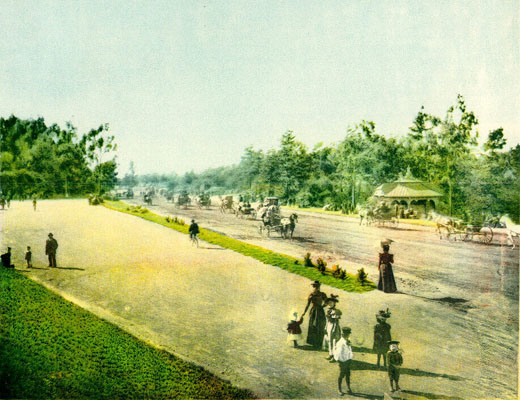
(from Picture Collection, The Branch Libraries, NYPL; Astor, Lenox and Tilden Foundations)

This illustration shows the bicycle path from Prospect Park, Brooklyn, to Coney Island in 1896.  Bicycling had become such a popular sport nationwide by the end of the century that cities were hard pressed to control the traffic.  Many municipalities passed ordinances regulating bicycle speed, requiring lights at night and horns or bells for safety.  In Golden Gate Park bicycles were barred from certain roads in 1886.  Some special paths were built for bicyclists, but they protested that they should be allowed the same freedoms on the roads that were extended to riders of horses and carriages. (Raymond Clary, The Making of Golden Gate Park:  The Early Years, 1865-1906 p.74-76)  I never cease to wonder at how much has changed in our great urban parks since their inception, yet how much remains the same!

The following poem, published in the San Francisco Examiner on Dec. 8, 1895, gives a sense of what women bicyclists were up against in the nineteenth century.

The Bicycle Girl

The Bicycle Girl, oh, the Bicycle Girl

With a spinnaker skirt and a sleeve like a furl;

Such a freak on the wheel, such a sight on the tire

I am certain I never will love or admire.


Her leggings are brown and her hat is the same,

“I say there, old man, can you tell me the name?”

But this is absurd, for I never will like

A girl who goes whizzing about on a bike.


The Bicycle Girl, oh the Bicycle Girl,

She wears on her forehead a dream of a curl

And the sound of her bell and the hum of her wheel

Is enough to make any man’s cranium reel.


The Bicycle Girl, oh the Bicycle Girl,

She has lips like a ruby in settings of pearl;

And why did she smile as she lightly spun by?

Does she think I could love her?  No, never, not I.


It’s foolish, I know, though I never have tried,

Confound it, I really believe I could ride.

For the Bicycle Girl, oh, the Bicycle Girl

She has tangled my heart in her mystical whirl.


Posted in arts, recreation | 1 Comment

a spicy spin through the park?

In My Park Book, published in 1898, Annie Nathan Meyer gleefully recorded the joys of spinning through Central Park, New York on her bicycle in the latter part of the nineteenth century.  Among the pioneers of women’s cycling, she learned to ride in Central Park, deriving great satisfaction from “the spice and freedom [of] doing something in the face of society’s frown.” Having “invented a perfectly satisfactory wheeling costume, made over from a discarded skirt,”  she enjoyed on long spins through the park with her husband, prominent New York physician Alfred Meyer.  They often chose to ride in the early morning hours “before the advent of the watering cart”  and “the parade,”  i.e. the throngs of well-dressed folk strolling along the park’s paths later in the day, some of whom viewed bicycling as an unladylike pursuit.

Annie Meyer’s little book celebrating Central Park is one of my inspirations for starting this blog on Golden Gate Park. She wrote so movingly about being in the park at that time, seeing deer “gravely meditating but a step from the cobblestones of the avenue  .  .  .  the whir of the partridge burst[ing] from the ground  .  .  sunlight filtering through the quivering birches .  .  .  the odor of the moist, warm earth.”

In the chapter on cycling in the park, she recounts how the first women cyclers felt obliged to ride skillfully, “for a woman to have been seen wobbling helplessly about, or trying to run up a score of broken lamp-posts, would scarcely have conduced to popularize the sport for her sex.”  But, for her, “a Nature-lover who has always sat at her feet — the wheel is merely a delightful means of getting there”  .  .  .    unlike some of her friends, who “have an entirely different theory of wheeling (incidentally they have a different theory of life in general).  To them the wheel is an end in itself;  its charm lies solely in swift riding.”

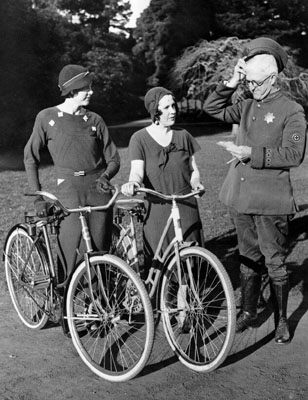
Whatever the motivation, women took up bicycling in large numbers, until it became unremarkable to see them riding. But the following picture, from the San Francisco Public Library historical photograph collection, is from 1933 and presents a puzzle.  It carries the following inscription on the back:

“A tremendous revival of bicycle riding by men and women of all ages has San Francisco traffic police somewhat non-plussed. Much of the riding is in picturesque Golden Gate Park, and the job of keeping cyclists off equestrian paths, out of the way of automobiles and on the right side of the bicycle path, is more trouble than restoring 10 kids, lost at the playgrounds to their parents. Miss Sally Emerson and Miss Jean Williams insist upon knowing why Park Policeman Arthur Dolan arrested them–and he is hard put to explain the wording of the ancient ordinance.”

Hmmmm?

Golden Gate Park, 1933: "Miss Sally Emerson and Miss Jean Williams question Park Policeman Arthur Dolan as to why he arrested them"

Posted in history, people, recreation | 3 Comments

environmental history of golden gate park?


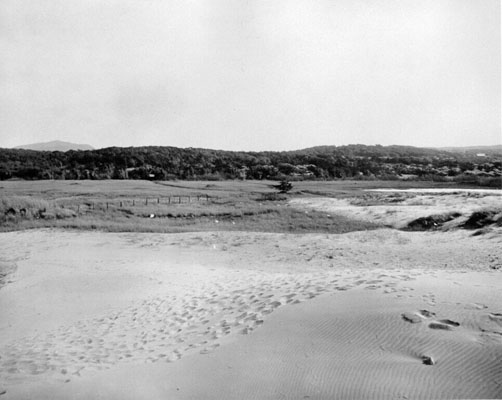
golden gate park - sand dunes - n.d. (sfpl historical photograph collection)

What is “environmental history?”  The working definition is:  “a branch of scholarship that focuses on studying the interaction between human culture and the environment over time.”  By that measure, an environmental history of Golden Gate Park would logically start in 1870 at the inception of the park (which is definitely a product of human culture!) and explore environmental changes associated with the park over the past 140 years.  Since, by 1870 the San Francisco peninsula had already witnessed considerable environmental change due to human presence, a truly thorough environmental history of the park (as a site) might begin with an analysis of what the area was like before the arrival of humans, or at least before the arrival of settlers of European descent.  But the fact is, the history of the park proper has really only unfolded since 1870.  And the park and the city of San Francisco have grown together.   Which is why most historians have focused on the cultural aspects of the park’s history, i.e. on the people who have shaped it, on the park as a work of art, a cultural phenomenon, in the context of city politics, etc.

Yet framing the history of the park in terms of environmental history raises so many interesting questions that have not been addressed!  Starting with the most basic:  how have soil, water and air quality changed in and around the park?  How have the topography and the hydrological patterns changed and what are the environmental consequences of those changes?  How has the the composition of wildlife changed (both in the park itself and in the surrounding environment)?  When did certain populations start to decline in and around the park (quail?) and what environmental changes precipitated those declines?  Have new species appeared and thrived?  When did the first english and cape ivy appear in the park and what were the major factors that contributed to their flourishing?  When did the first signs of aging appear in the park’s urban forest (did those cypresses, pines and eucalyptus thrive normally, planted on sand dunes with only a thin layer of topsoil)?

It would be fascinating to chart the environmental history of Golden Gate Park over its first 150 years.  Wouldn’t it be eye-opening to see a GIS map of the park over that time, with layers for topography, soils, water, vegetation, wildlife and cultural changes in and around the park  .  .  .  a visual inventory of environmental change over the past 150 years?!  What important insights might be gained from such a history, lessons that could help us in planning for the park’s future in an era when we are increasingly concerned about environmental impacts!

But what a challenging project;  so much of this history has been lost!   What this exercise really shows is that we could be developing a baseline environmental inventory of the park right now, at this point in its environmental history, so we at least have the environmental picture of it today.  Then we could base future planning on sound environmental data.

Posted in history | 5 Comments