a grizzly story: bear pit long gone!

This bear pit was formerly located at the west end of what is now the National AIDS Memorial Grove in Golden Gate Park.  It’s one of the more colorful “lost” sites in the park;  one that lives on in civic memory though I imagine few San Franciscans would want to see it resurrected.  The pit originally housed a famous Grizzly Bear named Monarch, who was the model for the bear on the California state flag.  According to Raymond Clary, who wrote about Monarch in The Making of Golden Gate Park:  The Early Years, 1865-1906, the great bear was captured in the wilds of the Ojai Valley in Ventura County by a hunting party sent by William Randolph Hearst.

The story of Monarch’s capture is grizzly indeed!  In May of 1889 Hearst commissioned an expedition to obtain a live bear for the menagerie planned for the park.  It took six months of camping in the mountains, building and baiting traps, before the hunters succeeded in capturing a very large bear.  But it was no easy task to extricate him from the trap and get him back to San Francisco!  After letting the bear sit in the trap for two days (to calm him down?!), the captors tried making a noose from chains, but the bear’s strength was so great that four men holding the chains were unable to hang on.  Finally, “after hours of struggle,” they managed to secure all four limbs and lash the bear to a roughly constructed sled so he could be hauled down the mountain, where a strong cage was made to transfer the bear by wagon and railroad boxcar to San Francisco.

The bear didn’t actually take up residence in the park until 1894, when he was exhibited at the Midwinter Fair.  When the fair closed, a permanent iron cage was constructed, with bent bars over the top to prevent escape. Monarch the bear lived in captivity until 1911.  After his death his body was preserved through taxidery and displayed at the Academy of Sciences for many years.

Posted in "lost" golden gate park, history, wildlife | 2 Comments

herons return to stow lake

The herons are returning to nest in the stand of trees on the little island in Stow Lake, in front of the boat house.  Last weekend I saw five of them, seemingly inspecting their nests and assessing necessary repairs.  With their unique ungainly grace, they are truly marvelous to watch!  How they manage to construct secure housing for chicks on those spindly-looking branches is a wonder! Apparently this rookery dates to 1993, or so.  By 1995 it had become locally famous, as this 1995 article written by Katherine Seligman recounts.

http://www.sfgate.com/cgi-bin/article.cgi?f=/e/a/1995/07/09/METRO13846.dtl

From the higher vantage points on the slopes of Strawberry Hill there are good views of the nests, especially with the aid of good binoculars.  Males and females construct the nest together and then take turns sitting on the eggs.

a great blue heron approaches nest (photo by sharon osberg, wildworldfoto.com)

Posted in wildlife | 1 Comment

hippie hordes turned on, tuned in, dropped out . . . jan. 14, 1967

I found this delightful article on line, commemorating the gathering that ushered in the Summer of Love in Golden Gate Park.  A beautiful tribute to the park in the 60s, an era that many of us can vividly recall!  This past weekend the sun was dueling with the fog in Sharon Meadow, but the sound of bongo drums in the air reminded me  .  .  .

“.  .  .  on Jan. 14, 1967, the Human Be-In — the peaceful gathering that provided a prelude to the Summer of Love and the era of the rock festival — unfolded, with none of the authority clashes that would mark so many major rock concerts of the 1960s.

In fact, there were just two park rangers on horseback to police the crowd of 25,000 or so stoners who convened in Golden Gate Park. Officially known as “A Gathering of the Tribes for a Human Be-In,” the event was organized not as a protest but a celebration. “Bring the color gold, photos of personal saints and gurus … children … flowers … flutes … feathers … banners, flags, incense, chimes, gongs, cymbals,” instructed the organizers.

Performers included the Grateful Dead, Quicksilver Messenger Service, Big Brother and the Holding Company, the Jefferson Airplane, Sir Douglas Quintet and jazz trumpeter Dizzy Gillespie. Allen Ginsberg, who’d recently called for a “mass emotional nervous breakdown in these States once and for all,” chanted. Acid guru Timothy Leary, making his first appearance in San Francisco, unveiled his “Turn on, tune in, drop out” routine. Underground legend Owsley Stanley delivered thousands of hits of White Lightning, his most potent brand of LSD to date, along with dozens of turkeys, which provided hundreds of sandwiches.

The MC for the day was an ex-Marine drill instructor everyone knew as Buddha. Even the Hells Angels, later infamous for their violent behavior at Altamont, played nice, tending to lost kids and guarding the sound system after generator power was mysteriously cut.”

Watch Scenes From the Human Be-In

via Hippie Hordes Turn On, Tune In, Drop Out at the Human Be-In — Twisted Tales – Spinner.

Posted in events in Golden Gate Park, history | Leave a comment

a walk in the park with charlie

Charlie Eckberg, a volunteer City Guide, leads a free walking tour in Golden Gate Park on Friday mornings, starting at 9:30 a.m. at the entrance to the Japanese Tea Garden.  A gifted story-teller, Charlie leads a tour that is like a treasure hunt!  Following him through the Japanese Tea Garden, around Stowe Lake and up Strawberry Hill yesterday morning, our group found a living dragon (bamboo) and a secret Buddha in the Tea Garden, stones from a Spanish Monastery (folly of William Randolph Hearst) lining the shoreline of Stowe Lake and remnants of Sweeny Observatory on top of Strawberry Hill (to name just a few!).

With a notebook of historic photographs under his arm, Charlie brings the park’s quirky history to life, pointing out clues to the past that would normally go unnoticed and telling colorful stories about historic figures like Makoto Hagiwara, long time steward of the Tea Garden, who invented the fortune cookie and park commissioner William Stow, who succeeding in getting his namesake lake built only after lengthy feuding with William Hammond Hall, the park’s designer.

A retired firefighter and fifth-generation San Franciscan, Charlie sort of grew up in the park, feeding “pink popcorn” to the ducks (a Golden Gate Park delicacy still sold at the Stow Lake Boathouse!) and watching for the first cherry blossoms in the tea garden each spring.  He is kind of a treasure himself!

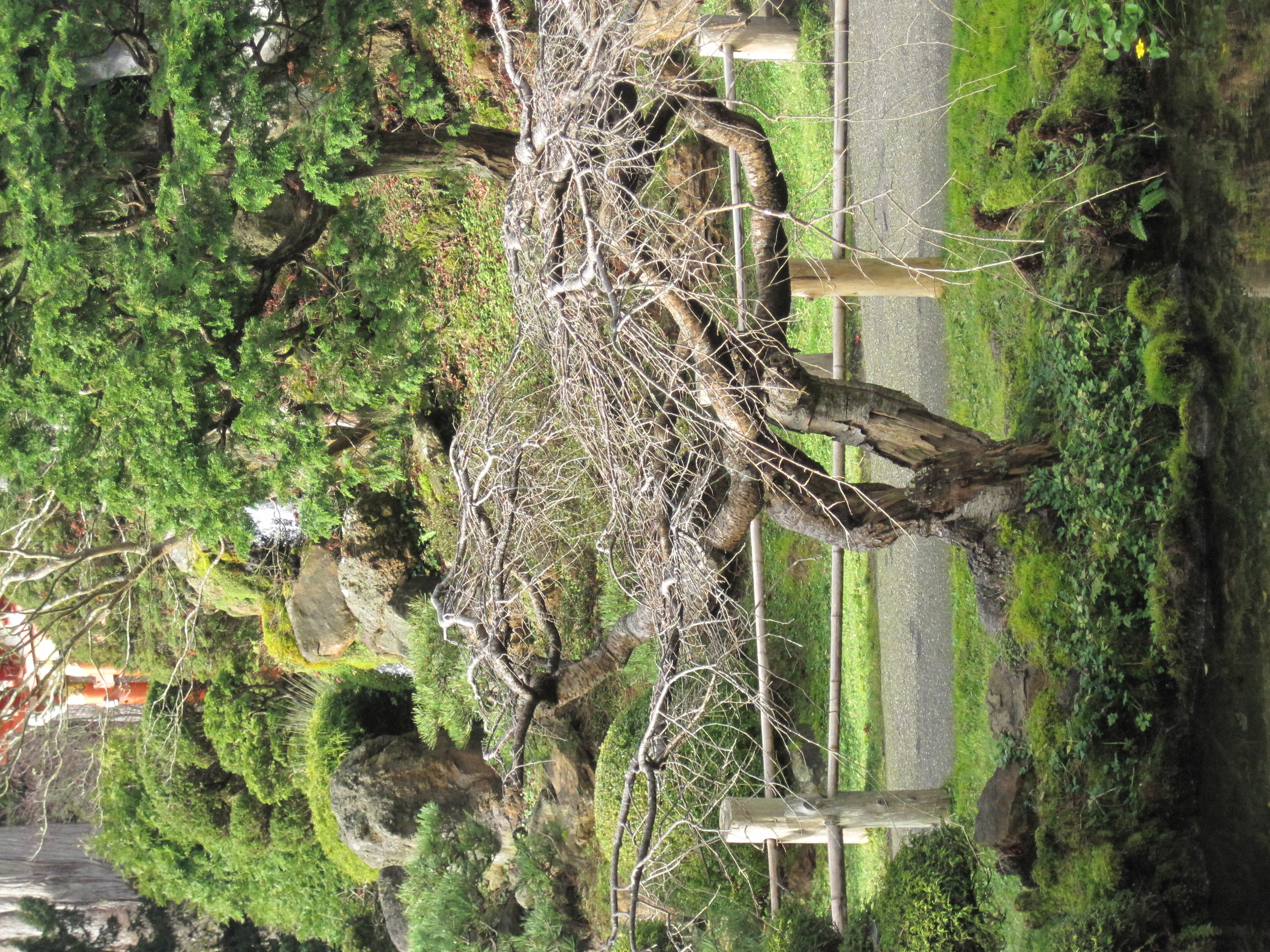
this dwarf cherry tree in the tea garden is the first to bloom in the spring

For a list of the various walking tours offered in Golden Gate Park by the Parks Trust (now in partnership with the City Guides), visit Parks Portal on line and click on the icon for Tours:

http://www.parksportal.com/

Posted in people | 2 Comments

from greenhouse to garden in golden gate park nursery

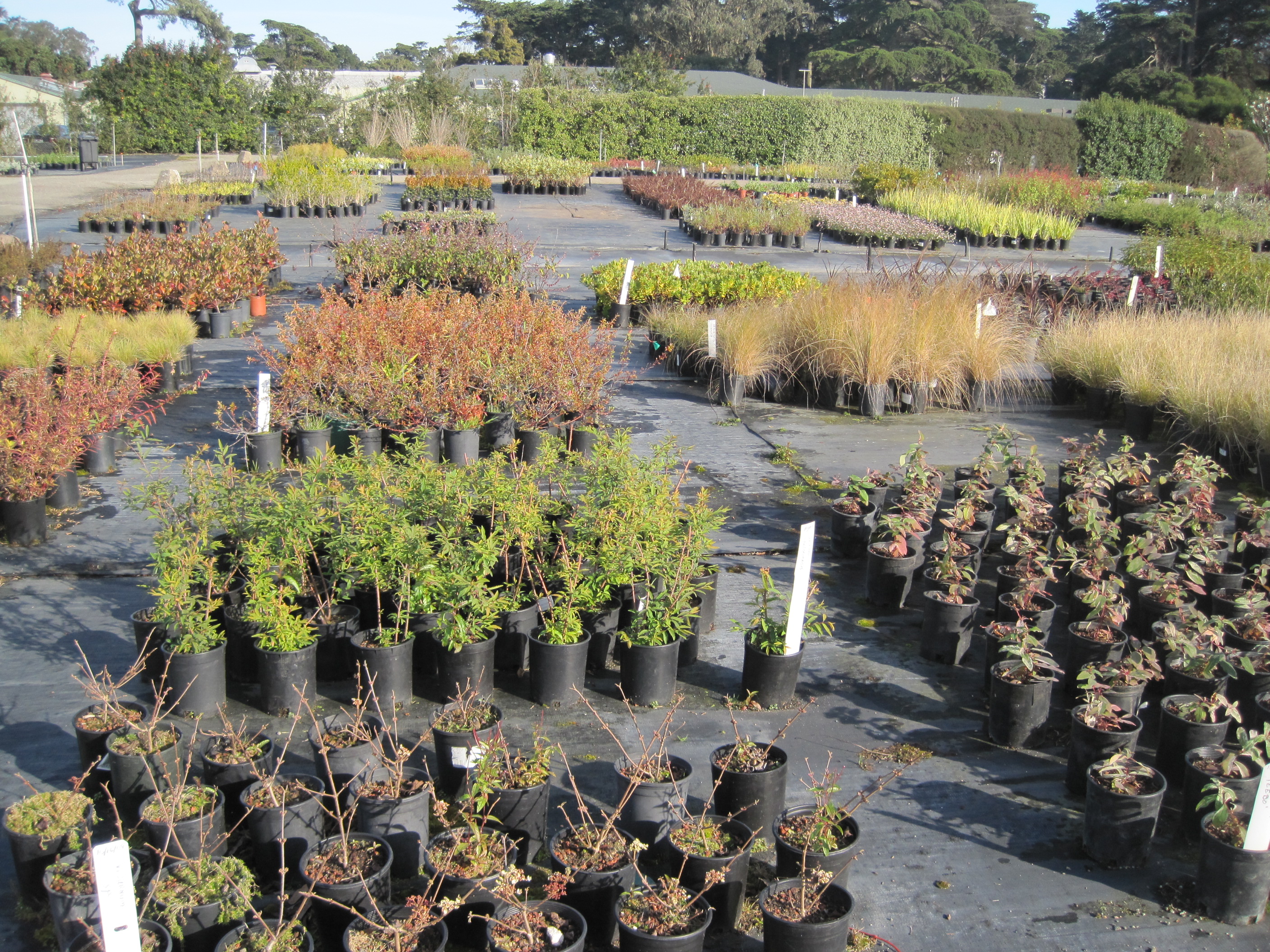
Carolyn Adams loves her job!   She works at the plant nursery in Golden Gate Park, overseeing the propagation and nurture of more than 800 species of plants that are used to fill in the blanks in parks throughout the city.  The place is like a candy shop for city gardeners, with the delectable choices arranged in neat rows and box formations showing off the different flavors.  Something for every taste:  exotic, familiar, tall, spreading, spicy or bland.

golden gate park nursery: pick your flavor!

The plants are started from seed or vegetative cuttings, which Carolyn gathers on hunting expeditions in Golden Gate Park.  Then seedlings sprout in flats in one of the greenhouses.

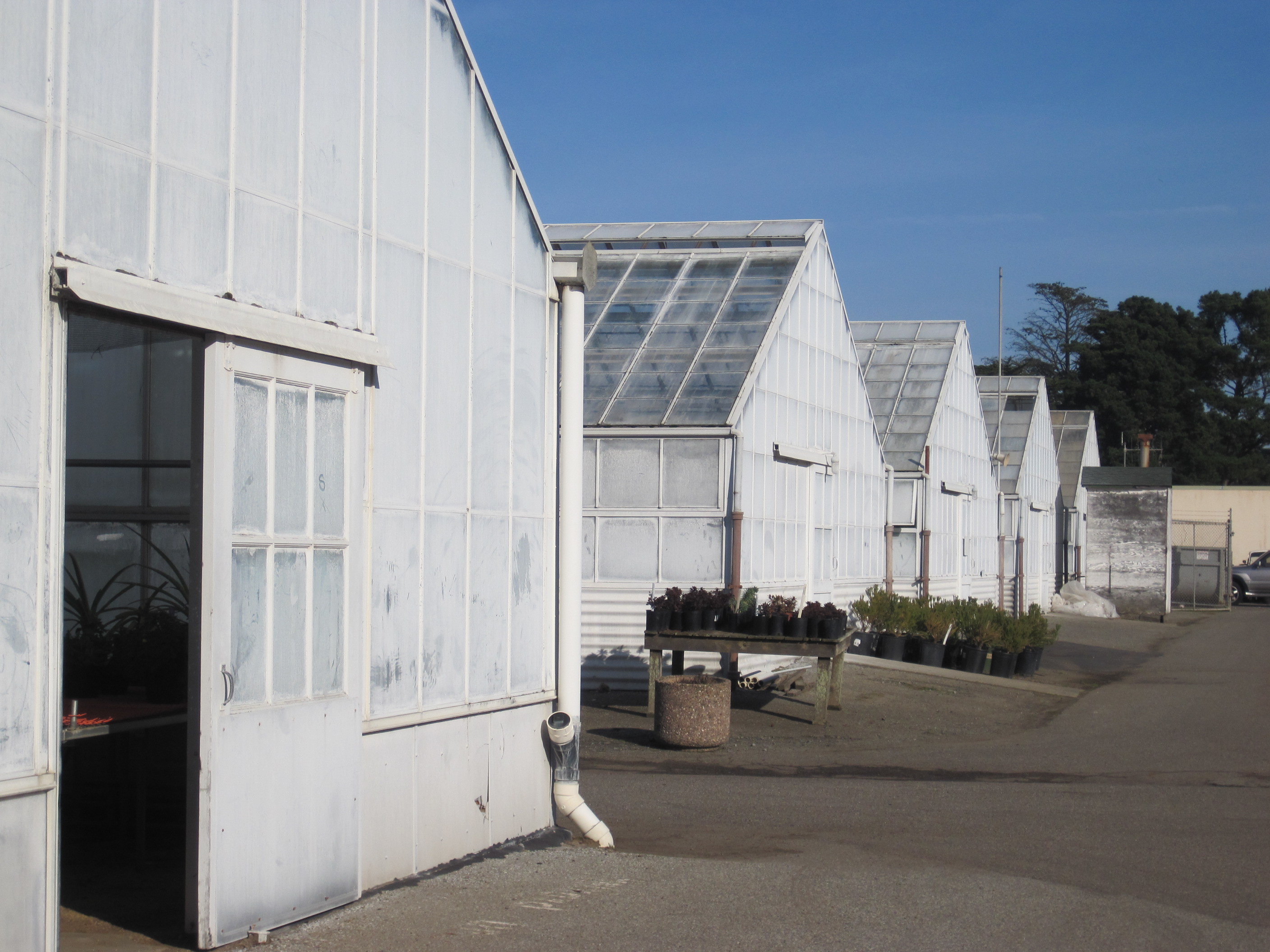
there are eight green houses and three shade frames (open-air, covered by shade cloth)

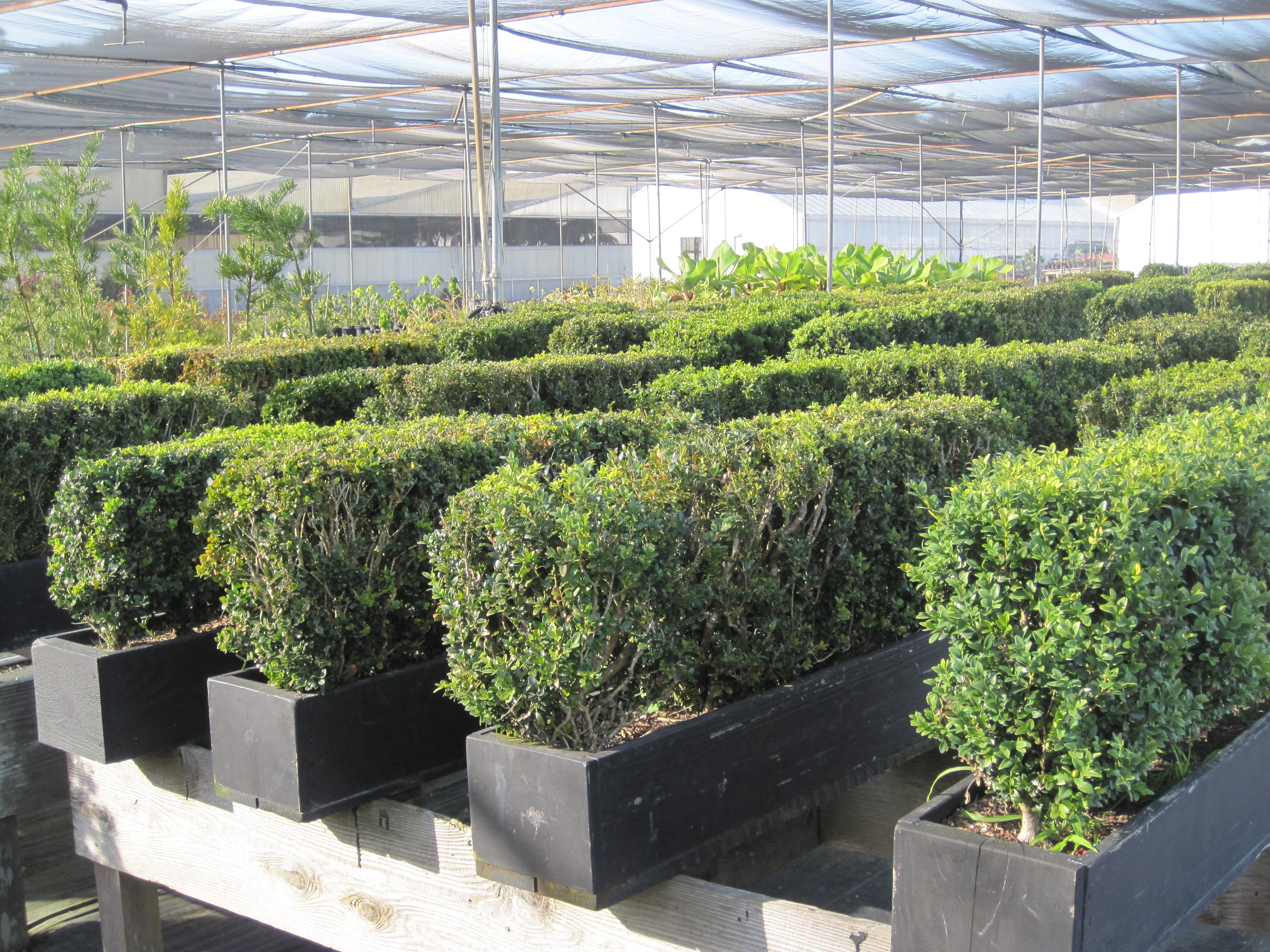
Once rooted, they are transferred to rose pots or tree tubes (long, narrow tubes that afford room for tree roots to grow).  Then hardened off in a cold frame and finally transferred to one-gallon pots.  City gardeners can come and browse among the orderly pots, or pre-order what they want and the order will be assembled on a palette for pick up.  Carolyn updates the plant inventory weekly;  between 1200-3000 plants go out every week!  The nursery also supplies potted azaleas for the desks of supervisors in City Hall and flower arrangements for special city events (hundreds of poinsettias for the holiday season!).  There are potted trees (some 30 years old!) and boxed hedges that are trucked out to adorn the stages at special events, such as Opera in the Park or Hardly Strictly Bluegrass.

box hedges lined up and ready

A huge, on-site compost pile supplies the basic material for the potting medium used to grow the plants, mixed with sand, peat and pearlite in different formulas depending on requirements of various plants.

How satisfying it must be to watch the plants germinate and grow, and then to see the results in parks and public open spaces throughout the city!  Carolyn has been in this job for about five years;  before that she worked at Heron’s Head Park in India Basin, clearing out tons of debris and weeds to make way for the habitat restoration that is now such a success there.  A different kind of project but also pretty satisfying, and a great public service.  Thank you Carolyn!

Posted in people, plants | 3 Comments

common sense standards for a historic park?

Regardless of whether or not Golden Gate Park is officially listed on the National Register of Historic Places, guidelines developed by the National Park Service for historic properties that are listed on the National Register could be useful in debates about how to manage this historic San Francisco park as a cultural resource.

THE SECRETARY OF THE INTERIOR’S STANDARDS FOR THE TREATMENT OF HISTORIC PROPERTIES

“The Secretary of the Interior’s Standards for the Treatment of Historic Properties are common sense principles in non-technical language. They were developed to help protect our nation’s irreplaceable cultural resources by promoting consistent preservation practices.

The Standards may be applied to all properties listed in the National Register of Historic Places: buildings, sites, structures, objects, and districts.

The Standards are a series of concepts about maintaining, repairing and replacing historic materials, as well as designing new additions or making alterations. They cannot, in and of themselves, be used to make decisions about which features of a historic property should be preserved and which might be changed. But once an appropriate treatment is selected, the Standards provide philosophical consistency to the work.

There are Standards for four distinct, but interrelated, approaches to the treatment of historic properties–preservation, rehabilitation, restoration, and reconstruction.

Preservation focuses on the maintenance and repair of existing historic materials and retention of a property’s form as it has evolved over time. (Protection and Stabilization have now been consolidated under this treatment.)

Rehabilitation acknowledges the need to alter or add to a historic property to meet continuing or changing uses while retaining the property’s historic character.

Restoration depicts a property at a particular period of time in its history, while removing evidence of other periods.

Reconstruction re-creates vanished or non-surviving portions of a property for interpretive purposes.”

via TPS Standards and Guidelines.

Which approach would be best for Golden Gate Park?  Or is it possible that each of the four approaches might be useful at some point in a large park like this with such a long and rich history?

dunes in golden gate park, viewed from strawberry hill, 1880 (San Francisco Historical Photograph Collection, SFPL)

Posted in history | Leave a comment

registering a historic landmark in california

What would it take to “officially” designate Golden Gate Park a historic landmark?  The process begins at the state level;  historic landmarks must be registered by a state first and then they may be considered for national historic landmark designation (a process managed by the National Park Service).  In California the Office of Historic Preservation is under California State Parks.  Here is a summary of that program:

“The State Historical Resources Commission has designed this program for use by state and local agencies, private groups and citizens to identify, evaluate, register and protect California’s historical resources. The Register is the authoritative guide to the state’s significant historical and archeological resources.

The California Register program encourages public recognition and protection of resources of architectural, historical, archeological and cultural significance, identifies historical resources for state and local planning purposes, determines eligibility for state historic preservation grant funding and affords certain protections under the California Environmental Quality Act.

Criteria for Designation

Associated with events that have made a significant contribution to the broad patterns of local or regional history or the cultural heritage of California or the United States (Criterion 1).

Associated with the lives of persons important to local, California or national history (Criterion 2).

Embodies the distinctive characteristics of a type, period, region or method of construction or represents the work of a master or possesses high artistic values (Criterion 3).

Has yielded, or has the potential to yield, information important to the prehistory or history of the local area, California or the nation (Criterion 4).”

via California Register.

Posted in history | Leave a comment

frozen in time?

Frozen in time?  If Golden Gate Park were to be given historic-landmark status, the Stow Lake boathouse could be included in the designation. (Examiner file photo)

via Entire Golden Gate Park might be deemed historic | San Francisco Examiner.

What would it mean to designate Golden Gate Park a historic landmark?  What are the pluses and minuses of such a designation?  Given how much the landscape has changed and how many features have been added since the park was created in the nineteenth century, what would be the rationale for “freezing it” in its present form?   Which parts of the park are most important historically?   Can we privilege one period of its history over another?  It looks like a lively debate is brewing around these and other questions of historic authenticity in the park.

Posted in history | 1 Comment

exotic fall foliage

linden leaves carpeting the great lawn in the botanical garden (Dec. 16, 2010)

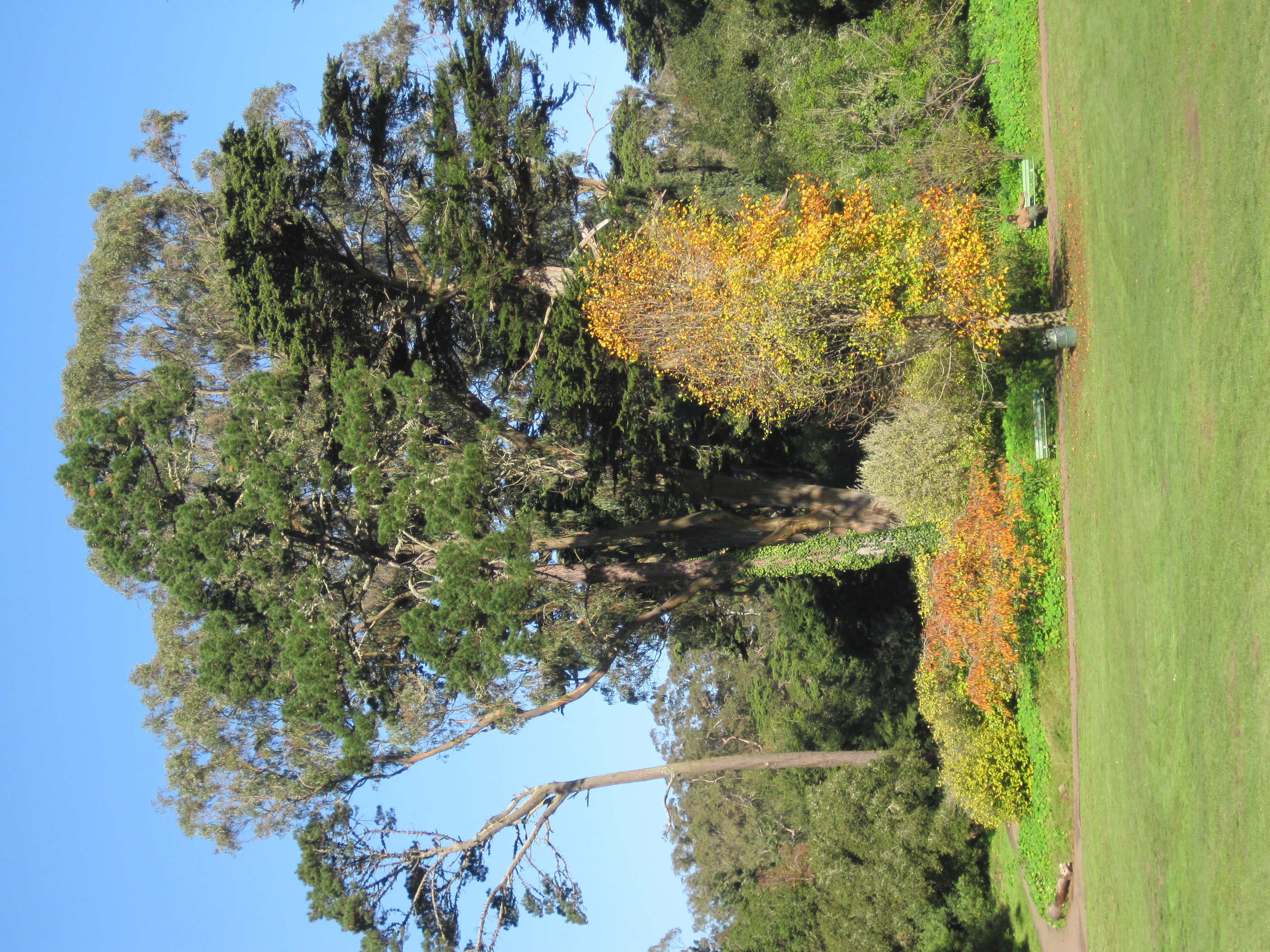
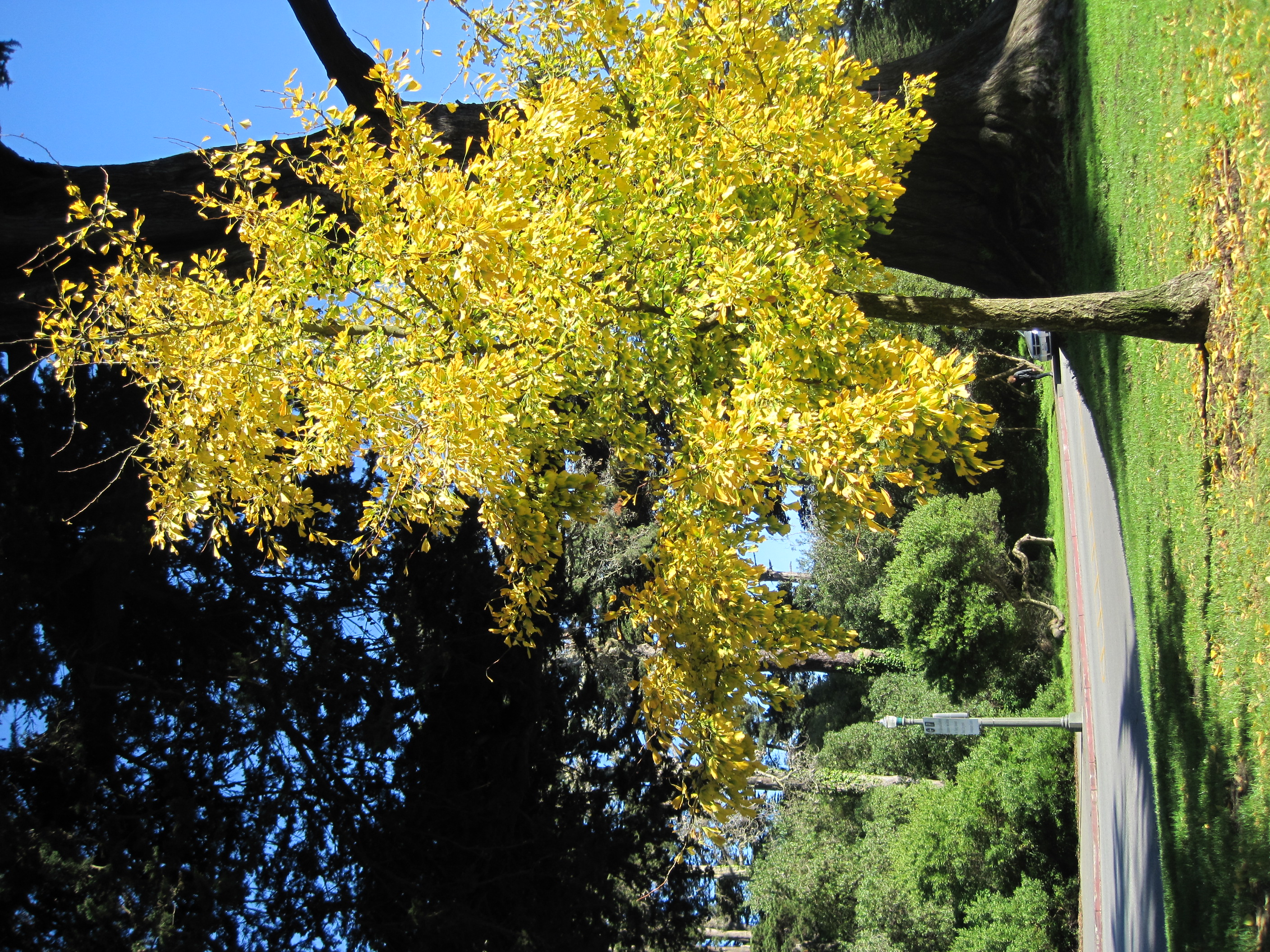
Walking in the park yesterday, I noticed brilliant flashes of fall color still decorating the park  .  .  .  in mid December!   Are these trees confused?!  It’s so late!  Then I had a revelation:  these flames of color throughout the park are all species from far away places where the climate is very different.   Here, in San Francisco, we normally wouldn’t have such brilliant displays of fall color.  Maybe some russet grasses but nothing like the flaming golds and oranges that we get from Lindens (Tilia cordata), which originate in Europe or Tulip Trees (Liriodendron tulipifera), which are native to the eastern U.S.  or Ginkgos (Ginkgo biloba), which probably originated in China but are no longer found in the wild at all.

We import fall color here, like we put artificial snow on our lawns at Christmas. Golden Gate Park is an exotic stage set and these trees put on a show for us each fall.  It’s an extended run some years, because they are, indeed, somewhat confused.  The climate here is not what they are programmed for; can’t rely on a cold snap every year in October, to signal that it’s time to turn.  But this year we did have a cold snap, in late November, and they got the message.  A stellar production this year!

tulip tree near the conservatory of flowers (Dec. 16, 2010)

gingko on Martin Luther King Jr. Drive (Dec. 16, 2010)

Posted in fall foliage | 1 Comment

great horned owl

“The Great Horned Owl (Bubo virginianus) was first seen in the Virginia colonies, so its species name was created from the Latinised form of the name of this territory (originally named for Queen Elizabeth I, the “Virgin Queen”). The first published description was made in 1788 by Johann Gmelin. Great Horned Owls are sometimes known as Hoot Owls, Cat Owls or Winged Tiger.

Description: Great Horned Owls can vary in colour from a reddish brown to a grey or black and white. The underside is a light grey with dark bars and a white band of feathers on the upper breast. They have large, staring yellow-orange eyes, bordered in most races by an orange-buff facial disc. The name is derived from tufts of feathers that appear to be “horns” which are sometimes referred to as “ear tufts” but have nothing to do with hearing at all. The large feet are feathered to the ends of the toes, and the immature birds resemble the adults. Females are 10 to 20% larger than males.

Size: Length 46-63.5cm (18-25″) Wingspan 91-152cm (36-60″) Weight 900-1800g (32-63.5 oz)

Habits: Activity generally begins at dusk, but in some regions, may be seen in late afternoon or early morning. Both sexes may be very aggressive towards intruders when nesting.

Voice: Great Horned Owls have a large repertoire of sounds, ranging from deep booming hoots to shrill shrieks. The male’s resonant territorial call “hoo-hoo hoooooo hoo-hoo” can be heard over several miles during a still night. Both sexes hoot, but males have a lower-pitched voice than females. They give a growling “krrooo-oo” or screaming note when attacking intruders. Other sounds include a “whaaa whaaaaaa-a-a-aarrk” from disturbed birds, a catlike “MEEE-OWww”, barks, hair-raising shrieks, coos, and beak snapping. Some calls are ventriloquial. Most calling occurs from dusk to about midnight and then again just before dawn.”

via Great Horned Owl – Bubo virginianus – Information, Pictures, Sounds.

Posted in wildlife | 2 Comments