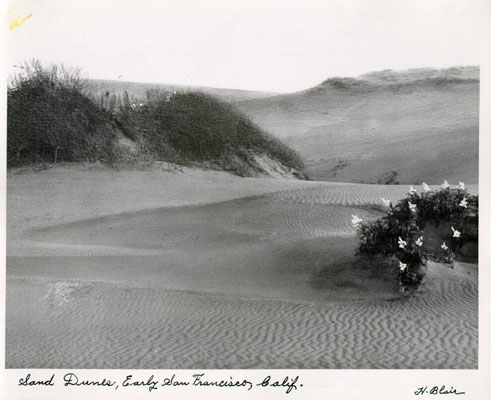
horses and the founding of golden gate park

photograph from the SFPL historic photograph collection

A horse actually played a key role in the founding of Golden Gate Park.  The story goes like this:

In the early 1870s, faced with the daunting task of establishing a vegetative cover on the sand dunes that had been set aside for the park, the young engineer in charge, William Hammond Hall, tried some techniques for dune stabilization that had been developed in Europe.  The method involved covering the dunes with planting mat and then seeding a combination of grasses, shrubs and trees.  The expectation was that the grasses would take hold in the planting mat and their roots would help keep the sand in place, forming a medium in which shrubs and trees would germinate and grow.  It was a method that essentially tried to replicate the processes of natural plant succession.  In the first experiments on the dunes of Golden Gate Park, Hall used species that had worked in France, a combination of maritime pines (Pinus nigra) and yellow broom (Cytisus spp.),  but these species failed to thrive.  So Hall and his colleagues tried adding some native lupines, which they noticed grew well locally.  The lupine proved more successful in the San Francisco coastal environment, but the pines and broom grew poorly and were soon choked out by the lupine and drifting sand.

At this point a horse saved the day.  Hall and some of his men were camped on the dunes and noticed that a horse, corralled on the sand, was scattering its feed of whole, wet barley.  By chance it rained and the scattered barley sprouted very readily, quickly covering the patch of sand with a green carpet.

This gave Hall the idea of adding barley to the seed mix they were using.  It worked to stabilize the dunes through the summer and the following winter, allowing the larger plants more time to establish themselves.  The dune stabilization was off and running!  In December 1872 and January 1873, Hall’s crew scattered a mix of barley, lupine, maritime pine and Albizia over an area of 100 acres.  And they established a nursery to give some trees a head start before planting them out in the stabilized dunes.

The rest is history!  Thanks to that horse!

(this information is from Building San Francisco’s Parks, 1850-1930, by Terence Young (pp. 84-87)
Posted in history, plants, urban ecology | Tagged , , , , , | Leave a comment

horse stable to open in central park

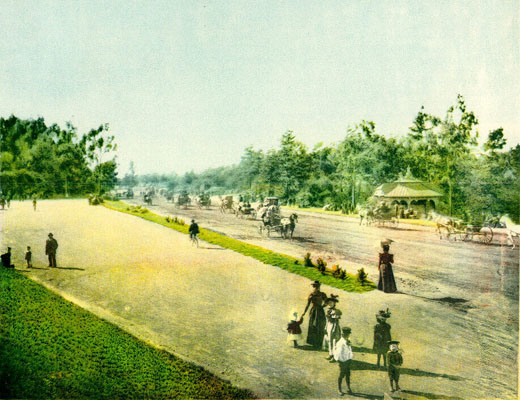
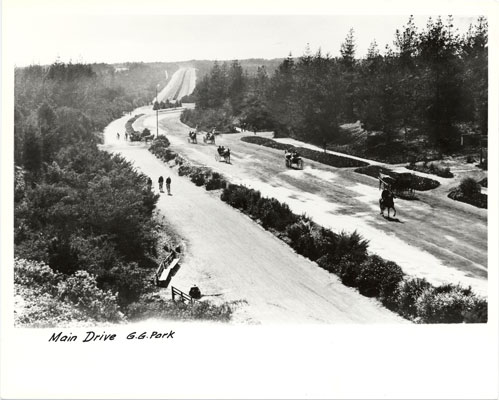
horses and bicycles on main drive, golden gate park, n.d. (photo from SFPL historical photographs collection)

The following excerpt is from a recent article in the New York Times:

‘Central Park is laced with bridle paths and dotted with pastures, and its plants were once fertilized with manure. But though carriage horses trot through it, police horses occasionally patrol it, and wooden steeds gallop around the carousel, horses have not called the park home for more than 100 years.  This summer, they will return.  The Central Park Conservancy has, since last year, been overseeing the construction of a stable in the park, and it is now set to welcome its first two residents.  .  .  .

“We just thought it was really important to keep an equine presence in Central Park,” said Adrian Benepe, commissioner of the parks department, who said it was his idea to build the barn. Mounted officers are effective at crowd control, and their high visibility may be a deterrent to crime, he added.

“The park was built with bridle paths,” Mr. Benepe added. “It’s historically part of what happens in Central Park, and has over the past 150 years.”  Mr. Benepe said this might be a first step to a more expansive vision; the department announced on Tuesday that it was accepting proposals for a privately run riding center in the park.’

via Horse Stable to Open in Central Park – NYTimes.com.

This article reminds me that there’s nothing quite like a horse to evoke the nineteenth-century nostalgia that underlies our great, urban nature parks! And made me think about the absence of horses in Golden Gate Park lately. In fact, horses were a common sight on designated equestrian paths in Golden Gate Park until the Golden Gate Park stables closed in 2001, after being in operation since 1938.   For now San Franciscans have only ghostly memories of romantic carriage rides and sedate trots through the park.  But it seems that horses may return to the Golden Gate Park Stables before too long.  Local equestrians have plans to renovate the facilities.   For more information on the history of the stables and plans to reopen them:

http://www.golden-gate-park.com/horse-riding.html

http://www.bayareabarnsandtrails.org/sfr.html

golden gate park via horse and carriage, n.d. (photo from SFPL)

Posted in "lost" golden gate park, history, recreation, wildlife | Tagged , , , , | Leave a comment

chicken point: a long-forgotten story involving chickens and coyotes

view from the cliff house to outside lands, 1865 (photo source: http://www.sfimages.com/history/GGPark.html)

In The Making of Golden Gate Park:  The Early Years, 1865 – 1906, Raymond Clary recounted some fascinating anecdotes from the early history of Golden Gate Park.  Many of them have long been forgotten.  One story that caught my eye recently was about Chicken Point, a small hill that used to exist where JFK Drive now intersects Middle Drive.  It was called Chicken Point because it was occupied by an old man who lived there in a rude shack and kept chickens and geese to eke out a livelihood.  The birds roamed freely during the day and the old man rounded them up each evening into some ramshackle pens he had constructed to protect them from coyotes.  According to Clary’s account, one evening in 1871 the old man fell while rounding up his flock and broke his leg.  He was taken to the hospital and was frantic with worry about the safety of his flock in his absence.  To ease his mind, William Hammond Hall, who was then superintendent of the nascent park, appointed one of his crew to stay in the old man’s shack and mind the chickens until he returned from the hospital.  (Clary, p. 14).

I find this story so evocative of the tentative early years of the park, when Hall and his men were struggling to establish some vegetative cover on the barren sand dunes.  It must have seemed perfectly appropriate that an old man would be living a marginal life there, raising chickens.  Perhaps it was harder to imagine, in those days, the verdant, forested landscape that we now take so much for granted!

Posted in "lost" golden gate park, history, people | Tagged , , | 2 Comments

perils of the park: man beaten in early morning attack

"Perils of the Park" National Police Gazette, 19 October 1878

Lately there have been reports of some violent incidents in Golden Gate Park, fueling official discussions about possibly restricting use of the park at night.  This echoes for me a long journalistic tradition, commencing in the nineteenth century, focusing on the perils of public parks  .  .  .  a genre exemplified by the above illustration from the National Police Gazette, published in 1878 (referring to Central Park in New York).  I’m reminded that from their inception public parks have been perceived as places of alternating “sunshine and shadow”  .  .  . potentially both delightful and dangerous  .  .  .  perhaps embodying a kind of primordial dichotomy.

The following article from the SF Examiner is indeed shocking, but I wonder whether the park is actually a more violence-prone place than other parts of the city.  Or is it just that this kind of incident plays on some visceral predisposition to experience a shiver of fear in the deep, dark woods  .  .  .  ?

“A 33-year-old man was beaten to the point of memory loss Tuesday in yet another alarming assault in Golden Gate Park during the early-morning hours, police said.

The victim said he was knocked unconscious and could not remember what happened, telling cops he’d been attacked sometime between midnight and 2 a.m., spokesman Officer Albie Esparza said.

A passerby found the beaten victim and brought him to the Safeway on La Playa Street in the Richmond district, where cops were called, Esparza said.

He was transported to San Francisco General Hospital with non-life-threatening injuries. He described the suspect as a white man in his 40s with a pony tail, Esparza said.

The attack was the latest in a string of brutal violence in Golden Gate Park that led to calls for an overnight closure of the park, where transients are known to live.

Just past midnight Friday, thieving thugs pistol-whipped and stabbed a 50-year-old homeless man and set fire to his tent in the park, police said. The attack occurred in the area of Transverse Drive and Martin Luther King Jr. Drive.

There have been no arrests in either case.

Last month, The San Francisco Examiner reported that a plan to close Golden Gate and McLaren parks at night had stalled with the change in mayoral administration.

As one of his final pieces of legislation, Mayor Gavin Newsom in December called for the two parks to be closed between 1 a.m. and 5 a.m. daily. The plan was in response to a rash of violence and vandalism in Golden Gate Park, including the fatal stabbing of a transient, the mauling of a park visitor by a dog belonging to a homeless camper, and the destruction of 32 rose bushes and three holes at a golf course.

The park crimes reinforced the idea that “nothing good happens at Golden Gate Park in the middle of the night,” Recreation and Park Department Director Phil Ginsburg said.

Currently, visitors can be in the park at any hour, but it is against the law to sleep there. However, that law has not eliminated camping by homeless people, according to police. If the park was officially closed, cops could bring campers or loiterers to jail on trespassing charges.”

via Man beaten in Golden Gate Park early-morning attack | Mike Aldax | Crime | San Francisco Examiner.

Posted in "lost" golden gate park, events in Golden Gate Park, health and safety, people | Tagged , , | 1 Comment

urban ecology: how native ants are faring in golden gate park

California gray ant, formica spp. (photo from UC IPM: http://www.ipm.ucdavis.edu/)

Have you been worrying about the health and safety of native ants in Golden Gate Park?  I recently realized that maybe I should be paying more attention to these small creatures.  This epiphany occurred after I read a scientific paper published in 2008 in the journal Urban Ecosystems, co-authored by Kevin M. Clarke, Brian L. Fisher (California Academy of Sciences) and Gretchen LeBuhn.  The authors begin by observing that “ants are an integral part of almost every terrestrial ecosystem, including urban environments.”  And they note that urban parks harbor a variety of ant species and may play an important role in maintaining biodiversity in the face of rapid urbanization at a global scale.  But which characteristics of urban parks best support ants and which ants are thriving in these park environments?  Do invasive Argentine ants outnumber native ant species in San Francisco’s urban parks?  With these questions in mind, the authors surveyed 24 protected natural areas within urban parks in San Francisco “including mosaic, scrub, herbaceous and forest habitats.  .  .  .  The data provide[d] insights into the distribution and abundance of ant fauna in San Francisco natural areas, as well as which characteristics of parks have the most influence on ant community composition.”

They found considerable species diversity in the areas surveyed.   “A total of 2,068 ant individuals representing 15 species were collected.”   They also found that “there was little or no impact of the Argentine ant on native ants.”

As far as landscape characteristics, they found that “natural area size and shape were not important in explaining variations in overall ant species richness and abundance  .  .  .   with many smaller natural areas harboring ant populations that are just as diverse and robust as larger areas.”  But the type of vegetative cover did appear to affect ant populations.   “A regression analysis revealed that urban forests [such as those found in Golden Gate Park] reduced ant richness and abundance.”

So, what does this study signify for Golden Gate Park?   It seems unlikely that we will start removing trees in Golden Gate Park to provide better native ant habitat.  But this study clearly illustrates (for me, at least) the complexity of urban ecology and how difficult it is to create and maintain habitat that maximizes species diversity, a measure of ecosystem health.  It makes me wonder about other efforts at habitat restoration, targeting more charismatic fauna, such as birds or butterflies in our parks.  Do we fully understand the ecological ramifications of these efforts?

I don’t know the answer to these questions, but I really appreciate this study of ants because it seems like the right direction.  I would love to see more of this kind of scientific research to help us better understand the habitat value of urban parks like Golden Gate Park and the relationship between native and invasive nonnative species in urban parks.

Here’s a link to the full article:  http://www.univet.hu/users/pszabo/teaching/oak/2_adag/urban_ants.pdf

Posted in urban ecology, wildlife | Tagged , , | 3 Comments

the vigor of weeds: got to admire them!

Annual bluegrass/ Poa annua

Working at the San Francisco Botanical Garden nursery, repotting native plants for the past few weeks in preparation for the annual plant sale, I’ve noticed a miniature battle going on in the pots.  It’s actually the same battle that goes on in my garden and in the lawns of the park.  It’s all about territory!  Which plants get to have the pot (or the wide open spaces of the park?)  .  .  .  the precious seedlings we plant and root for, or the hardy opportunists that leap into the voids around the edges and try to take over?

I think you have to admire the vigor of weeds!  The weed I seem to be pulling most often this month is a little annual bluegrass, Poa annua.  This is one of the most common weeds in California, happily takes over gardens and fields, golf courses and roadsides.  Although it originated in Europe, it has spread around the world.  It reproduces by seeds and thrives in disturbed areas;   treats any patch of bare earth, no matter how small, as an opportunity.   In fact, large areas of “green space” in our parks, when you look closely, consist mainly of this so-called weed.

Maybe we should learn to love it?

Posted in plants, san francisco botanical garden, urban ecology | Tagged , , , | 1 Comment

great horned owl chicks wow birdwatchers

owl chicks in golden gate park (photo by Janet Kessler)

The following is excerpted from an article by Katie Worth in the San Francisco Examiner (4-9-11):

“In the mottled light behind the trunk of a pine tree, four poofs with eyes huddle together. And they’re watching.  Those poofs are in fact baby great horned owls, and for the last few weeks, they’ve been watching — and being watched by — a growing number of birders, gardeners, joggers and the occasional lucky tourist.

The nest is high in a pine tree on Strawberry Hill, the waterfall-laden lump of an island in the middle of Stow Lake  .  .  .  The nest is one of two that are common knowledge among Golden Gate Park birdwatchers; the second is near the buffalo paddocks.

Golden Gate Audubon Society member Dan Murphy, who leads San Francisco’s annual Christmas bird count, said it’s possible there are a handful of other great horned owls in the park that haven’t been spotted by birders. However, the species is territorial enough that there’s not room for many in the park.

Murphy says all of the babies are unlikely to survive. Many die in their first year, sometimes being pushed out of the nest by their larger siblings or mother if food is scarce.  “As long as there’s plenty of food, the younger ones will probably survive,” he said.  There once were also barn owls and screech owls in the park, he said, but they haven’t been spotted in a long time.”

Read more via Great horned owl chicks a hit with birdwatchers | Katie Worth | Local | San Francisco Examiner.

Posted in urban ecology, wildlife | Tagged , , , | Leave a comment

botanical garden: california section prime time

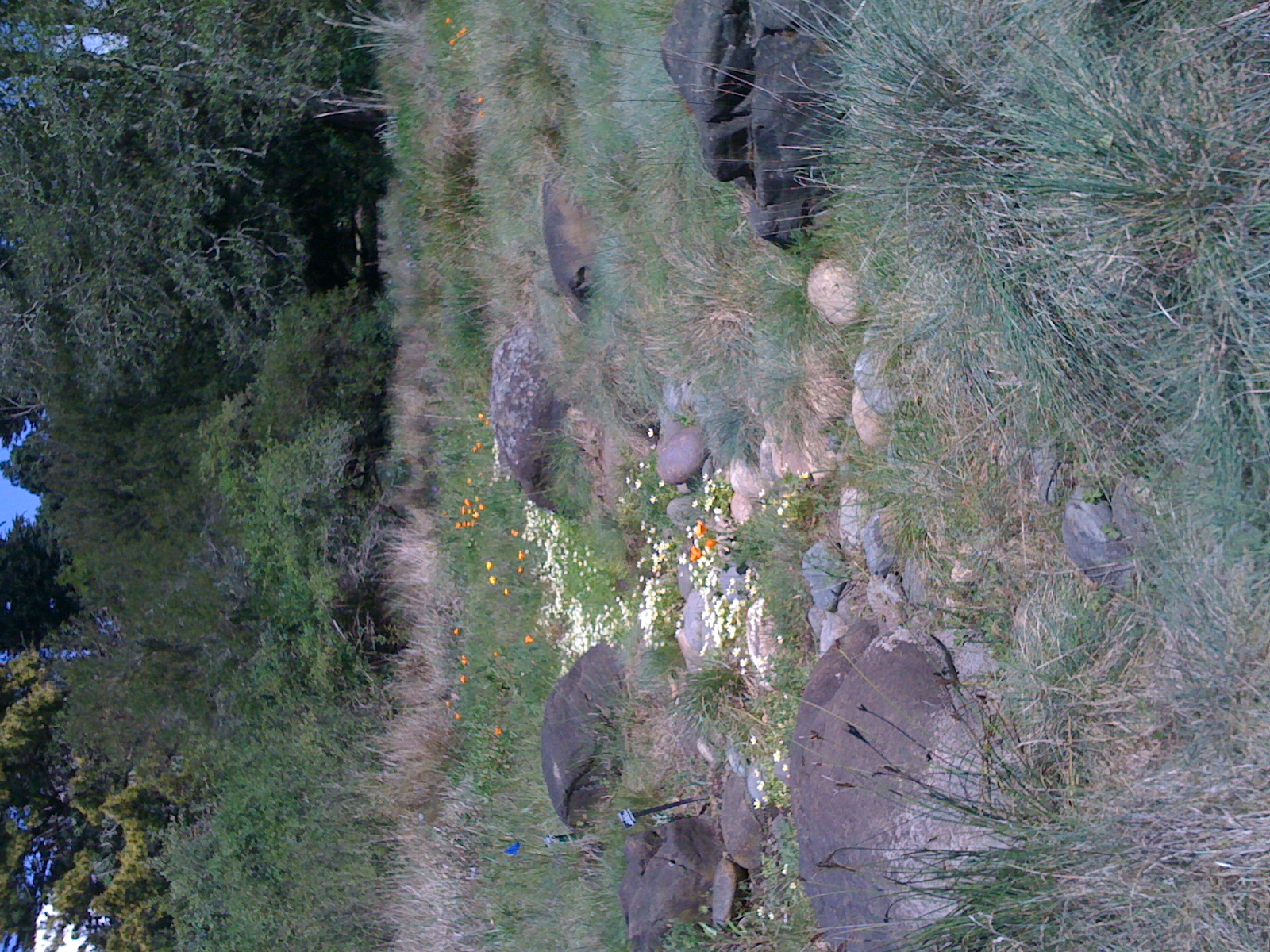
california poppies backed by ceanothus in the botanical garden, california section

The next couple of weeks are going to be prime time for California wildflowers in the Botanical Garden in Golden Gate Park.  You can wander through drifts of irises and poppies, with backdrops of ceanothus and currant  .  .  .  a magical melding of the Sierra Foothills and the grasslands of the Northern California coast.  The show has started!  Don’t miss it!

Posted in blooming, san francisco botanical garden | Tagged , , , | Leave a comment

golden gate park’s skating ‘mayor’

skaters in golden gate park (photo from sfcitizen.com)

One of the wonderful things about Golden Gate Park is how it accommodates so many people following their particular passion, whether it be sailing a model boat, swing dancing, bird-watching  .  .  .  the list is so long!  Here’s a story written by Peter Hartlaub from SFGate about David Miles Jr., who discovered a passion for roller skating in the park in 1979 and has kept at it ever since:

‘Known in the park as “The Godfather of Skate,” “The Sk8father” and “The Mayor of Golden Gate Park,” Miles is part activist, part teacher, part mediator and always party central.

Miles says he didn’t set out to be the shepherd of the Bay Area roller skating scene.  “I never saw myself as the leader of anything,” he says. “I never really wanted to do this stuff. I wanted to come out and have fun.”

But by the end of the summer of 1979, he says the city was already moving to ban skaters in the park. While others wanted to fight the power, Miles says he thought “maybe we can work with these guys.” That started three decades of diplomacy and peaceful but persistent activism that continues to this day.

Miles was instrumental in starting the Golden Gate Skate Patrol, which for years provided first aid to park skaters, and helped satisfy city concerns about order on the streets. He’s currently in a decades-long fight to get the Sunday closure of John F. Kennedy Drive in the park extended to Saturdays. Miles also tends the plot of land known as “the Skatin’ Place,” a patch of pavement surrounded by trees a couple of hundred yards west of the Conservatory of Flowers along Kennedy Drive.  .  .

On an exceptionally sunny Wednesday afternoon, there are a handful of skaters circling an oval painted on the glass-smooth asphalt, and several more sitting on the grass or benches watching. A few dancers do synchronized steps in the center, shaking to an Earth, Wind & Fire remix coming from an amplifier that Miles wheeled out earlier in the day. The numbers are evenly split between traditional roller skaters and people with in-line skates, with a wide range of age but most looking as if they’re in their 30s or older.  .  .

Carla Dometrius, a teacher in San Francisco, discovered Miles and the Skatin’ Place about four years ago.  “I’ve rarely missed a Sunday since then,” she says.  She points out the diversity of the skaters, which include men and women of all ages, races, sexual orientations and walks of life.  “I probably wouldn’t get a chance to be hanging out with all these great people if they didn’t have skates on their feet,” Dometrius says.

Bob Watts, a San Francisco pediatrician known among skaters as “Dr. Bob,” whose skating history dates back to the disco era, dances in a tight yellow T-shirt with some other regulars. He says skating “is very good for your soul,” and credits Miles with keeping people involved and excited about the scene. “He’s our shining light and he helps keep our scene going,” Watts says.’

David Miles Jr. (photo from SFGate, 4-5-11)

via SFGate:  David Miles Jr. reigns as park’s skating ‘mayor’.

Posted in people, recreation | Tagged , | Leave a comment

california lilacs: brilliant shades of blue!

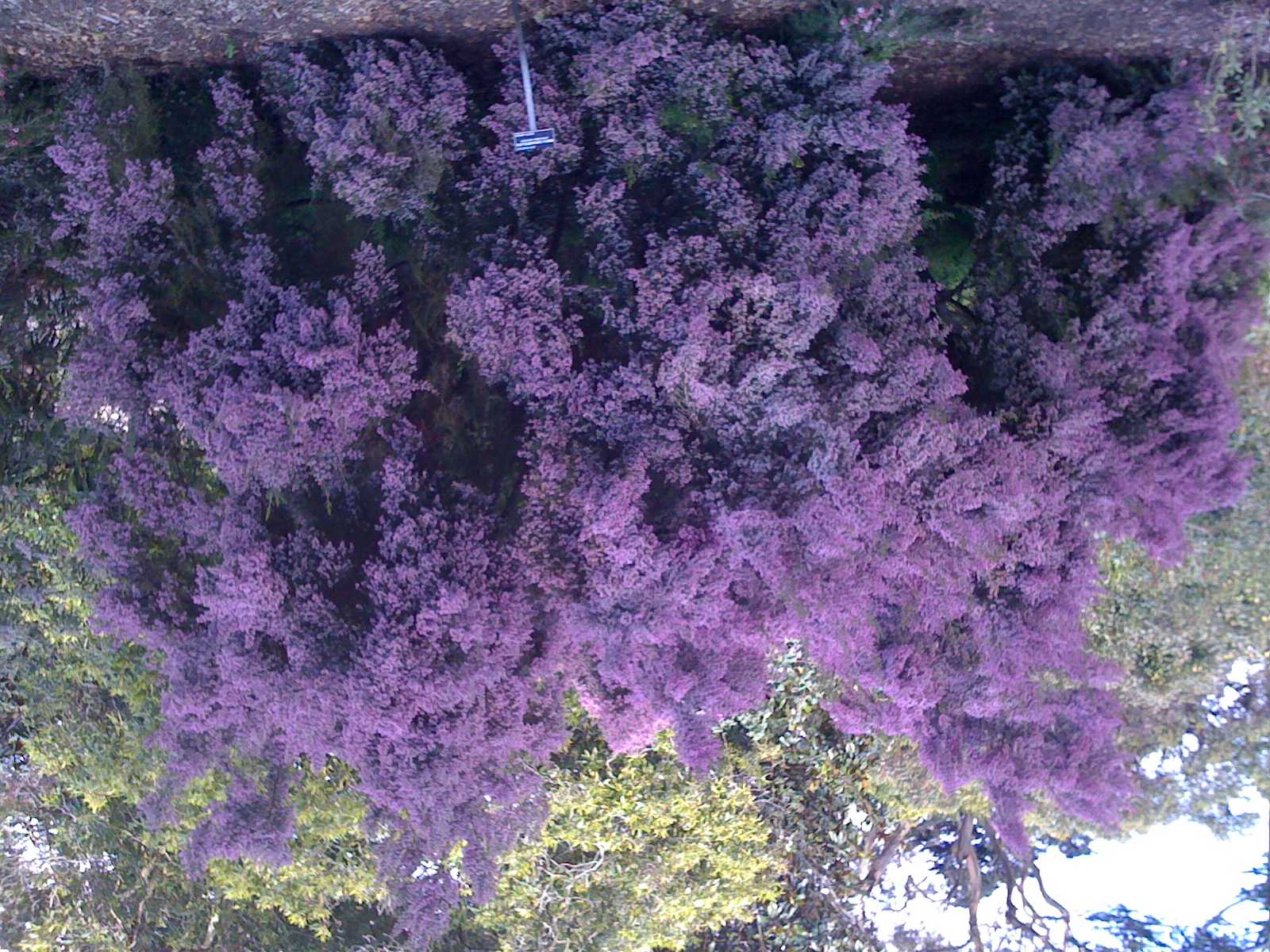
ceanothus blooming at the edge of the great meadow, san francisco botanical garden, 2-28-11

Ceanothus plants are brilliantly blooming throughout Golden Gate Park right now.  The Ceanothus genus, of which there are 50-60 species ranging from low-growing shrubs to small trees, belongs to the buckthorn family (Rhamnaceae).  These iridescent blue-flowering plants stand out from their surroundings, whether in backyard cultivation or growing wild on California hillsides. Some specimens are so completely covered in blue flowers, they look as if an entire can of paint had been deployed to shocking effect!

Besides providing visually striking accents in the landscape, ceanothus plants have traditionally been put to many uses.  According to the book:  Ceanothus, by David Fross and Dieter Wilkin (Timber Press, 2006, pp. 14-20), Native Americans in California derived soap and shampoo from the flowers of these plants growing in the wild, which contain natural saponifiers.  Leaves and roots yielded remedies for a variety of ailments.  And colonists on the east coast brewed tea from Ceanothus americana (also leaves and roots) during the Revolutionary War, in lieu of English tea.

The first introduction of Ceanothus americanus to Europe occurred in 1713, but this east-coast species, with its small, white flowers, did not immediately become popular among European gardeners.  The brilliant-blue flowering Ceanothus caeruleus, from Mexico, elicited more enthusiasm when introduced to Europe in 1818, but failed to thrive in harsher climates. In the early nineteenth century a series of hybrids were developed, combining the hardiness of the eastern Ceanothus americanus species with the bright, blue flowers of the Mexican species.  Most of this cross breeding occurred in Belgian and French nurseries before 1830, producing a line that the French continued to develop throughout the nineteenth century, but which has for the most part disappeared today.

California Ceanothus was first collected by a Russian expedition in 1816, but when an English expedition in 1837 brought back seeds of the California species Ceanothus thyrsiflorus, these seeds, in the hands of the Royal Horticultural Society of England, spread to gardens throughout Europe.  Subsequent expeditions introduced more species of Ceanothus from the west coast of North America to European collections throughout the nineteenth century.  In the twentieth century growing recognition of the richness of California flora led many nurseries here to collect, grow, hybridize and sell Ceanothus.  In the later twentieth century, spurred by new interest in California native plants, botanical gardens in California have “selected, evaluated and introduced both garden hybrids and selected clones of Ceanothus from the wild.”

What a complicated and fascinating horticultural genealogy for this group of plants commonly known as California lilac!

Posted in blooming, plants, san francisco botanical garden | Tagged , | 2 Comments