outside lands festival continues tradition in golden gate park

The tradition of holding rock concerts in Golden Gate Park began with the Great Human Be-in held at the Polo Fields on Jan. 14, 1967.  A record crowd of 20,000 people attended that historic event (some put the number closer to 30,000) and the entertainment included The Grateful Dead, Jefferson Airplane, Quicksilver Messenger Service, Country Joe and the Fish, poets Alan Ginsberg, Gary Snyder, Lawrence Ferlinghetti  .  .  .  and much more.

The Outside Lands Music Festival (returning to Golden Gate Park for a fourth year this weekend, August 12-14) is sort of  like the Human Be-in on steroids (or LSD?).  Attendance at the first Outside Lands Concert, in 2008, was 130,000 people, boosted by the headlined band, Radiohead!  In 2009 and 2010 attendance was smaller, around 85,000.  This year there’s an impressive line-up of bands;  here’s the web site for the full schedule:

http://www.sfoutsidelands.com/

And here’s a preview from SPIN, the online music magazine:

“victory lap performances by some of 2011’s biggest touring bands — Arcade Fire, Black Keys, Muse — plus SPIN faves like Arctic Monkeys, MGMT, Big Boi, and the Joy Formidable.  .  .  [and] 10 wide-ranging SPIN recommendations. Check them out, listen to their music, and watch their videos!”

Preview by Peter Gaston

CLICK HERE TO BEGIN: 10 Must-Hear Artists at Outside Lands Fest | Park Rangers | SPIN.com.

Posted in arts, events in Golden Gate Park | Tagged , , | Leave a comment

urban evolution right under our noses

by Carl Zimmer, New York Times, July 25, 2011

‘Dr. Munshi-South has joined the ranks of a small but growing number of field biologists who study urban evolution — not the rise and fall of skyscrapers and neighborhoods, but the biological changes that cities bring to the wildlife that inhabits them. For these scientists, the New York metropolitan region is one great laboratory.

White-footed mice, stranded on isolated urban islands, are evolving to adapt to urban stress. Fish in the Hudson have evolved to cope with poisons in the water. Native ants find refuge in the median strips on Broadway. And more familiar urban organisms, like bedbugs, rats and bacteria, also mutate and change in response to the pressures of the metropolis. In short, the process of evolution is responding to New York and other cities the way it has responded to countless environmental changes over the past few billion years. Life adapts.

The mice are the object of Dr. Munshi-South’s attention. Since 2008, he and his colleagues have fanned out across the city to study how the rise of New York influenced the evolution of the deer mice.

On this day in Highbridge Park his students, Mr. Cocco and Mr. Harris, spread a blue tarp on the forest floor, while Dr. Munshi-South walked to an orange flag planted in the ground. He picked up an aluminum box sitting next to the flag and pushed in a door at one end. At the other end of the box crouched a white-footed mouse. It gazed back at Dr. Munshi-South with bulging black eyes.

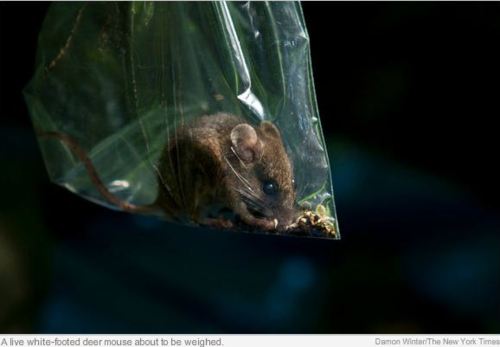
The researchers inspected 50 traps laid the day before and found seven mice inside. They plopped each mouse out of its trap and into a Ziploc bag. They clipped a scale to each bag to weigh the mice. Dr. Munshi-South gently took hold of the animals so his students could measure them with a ruler along their backs.

Dr. Munshi-South and his colleagues have been analyzing the DNA of the mice. He’s been surprised to find that the populations of mice in each park are genetically distinct from the mice in others. “The amount of differences you see among populations of mice in the same borough is similar to what you’d see across the whole southeastern United States,” he said.

White-footed mice live today in forests from Canada to Mexico. They arrived in the New York City region after ice age glaciers retreated 12,000 years ago. In the past few centuries, as their forest home became a city, they survived in New York’s patches of woods. (House mice, which New Yorkers battle in their apartments, arrived with European settlers.) Research by Dr. Munshi-South and his colleagues suggests that New York’s white-footed mice, which occupy isolated patches, are adapting to life in the city.  .  .  .

On a recent afternoon, James Danoff-Burg and Rob Dunn were clambering around in a narrow Broadway median on the Upper West Side. Dr. Danoff-Burg, a biologist at Columbia University, was digging up plastic cups from the ivy. Dr. Dunn, a biologist from North Carolina State University, was five feet in the air, crouched on a bough of a Japanese maple.

“New one! New one!” Dr. Dunn shouted over the traffic. He and Dr. Danoff-Burg were surveying the median for species of ants. Dr. Dunn had spotted Crematogaster lineolata, an ant species that he and Dr. Danoff-Burg had never found before in this particular urban habitat.

From his backpack, Dr. Dunn pulled out an aspirator, a rubber tube connected to a glass jar. Holding one end of the tube over the ant, he sucked it in. Instead of going into his mouth, the insect tumbled into the jar. (One hazard of urban evolutionary biology, said Dr. Dunn, is having your aspirator mistaken for a piece of drug paraphernalia.)

Dr. Danoff-Burg, Dr. Dunn and their colleagues chose to study the medians of Broadway to see how human activity alters biodiversity. In this artificial city, there is no environment more artificial than these medians, which sit on fill that was poured on top of subway tunnels. The scientists have found a blend of ant species, some that have been here since before the city existed, and others that have arrived more recently, hitching rides on ships, planes and trucks. The most common ant Dr. Danoff-Burg and Dr. Dunn encounter is the pavement ant (Tetramorium caespitum), which came from somewhere in Europe.

Biologists find a mixture of native and non-native in all the life forms they study in New York, from the trees in Central Park to the birds of Jamaica Bay. The biodiversity of New York today is the result of extinctions, invasions and adaptations. Manhattan was once home to 21 native species of orchids; today they’re all gone. In the current issue of Global Ecology and Biogeography, a team of scientists surveyedplant biodiversity in New York and 10 other cities. They found that 401 native plant species have vanished from New York since 1624, while 1,159 remain. New York’s native flora is vulnerable to extinction today in part because it was well adapted to the closed forests that once stood where the city is now.

Newcomers and Natives

As native species became extinct, new ones came to the city. As a major point of entry to the United States, New York is where many of North America’s invasive species first arrived. Some introductions were intentional. Starlings were brought to Central Park in 1890, for instance, as part of a project to bring every bird mentioned in Shakespeare to the United States. But most introduced species slipped in quietly.

Many non-native species quickly died out, but some fit comfortably into the city’s wildlife, and others wreaked havoc — first in New York and then beyond. New York was the port of entry for Dutch elm disease, chestnut blight, Asian longhorned beetles and other threats to trees across the country.

As the invaders adapted to New York, they put extra pressure on native species, competing with them for space and food. Recent research by the Brooklyn Botanic Garden found that American bittersweet vines are dwindling away within a 50-mile radius of New York City, outcompeted by Oriental bittersweet. At the same time, the two species are interbreeding, producing hybrids. “It’s a double-whammy,” said James D. Lewis, a plant ecologist at Fordham University.

Yet many native species still hold on. Dr. Danoff-Burg and Dr. Dunn were surprised to find that 9 out of the 13 ant species living in Broadway’s medians are native. Once the medians were built, the native species rushed in along with the invaders and created an ecosystem.

Dr. Danoff-Burg and Dr. Dunn are trying to figure out what controls the balance of native and new species in New York. They don’t understand why some medians have more biodiversity than others, for example. On natural islands, biodiversity tends to increase with the size of the islands. Dr. Danoff-Burg and Dr. Dunn find no such correlation in the medians on Broadway. They also have to determine how native species of ants are coexisting in such close quarters with invasive species.

New York, in other words, is an evolutionary experiment — one that some scientists find fascinating to observe. “It’s some new thing emerging around us,” Dr. Dunn said.’

via New York – Empire of Evolution – NYTimes.com.
Posted in plants, urban ecology, wildlife | Tagged , , , , | 3 Comments

New York Moves to Stop Foraging in City’s Parks

A recent article in the New York Times about foraging in city parks is food for thought.   People collect mushrooms in Golden Gate Park (Google “picking wild mushrooms in golden gate park).  Not sure what else.  Here’s what’s going on in N.Y. parks:

Leda Meredith, right, who wrote a book about eating locally on a budget, leads tours in Prospect Park about foraging.

“Maybe it is the spiraling cost of food in a tough economy or the logical next step in the movement to eat locally. Whatever the reason, New Yorkers are increasingly fanning out across the city’s parks to hunt and gather edible wild plants, like mushrooms, American ginger and elderberries.

Now parks officials want them to stop. New York’s public lands are not a communal pantry, they say. In recent months, the city has stepped up training of park rangers and enforcement-patrol officers, directing them to keep an eye out for foragers and chase them off.

“If people decide that they want to make their salads out of our plants, then we’re not going to have any chipmunks,” said Maria Hernandez, director of horticulture for the Central Park Conservancy, the nonprofit group that manages Central Park.

Plants are not the only things people are taking. In Prospect Park in Brooklyn last week, park rangers issued four summonses to two people for illegal fishing. Although officials say such poaching is not widespread, park advocates say taking fish and turtles for food is not uncommon, and some have reported evidence of traps designed to snare wildfowl.

Foraging used to be a quirky niche, filled most notably by “Wildman” Steve Brill, who for years has led foraging tours in the Northeast, including in Central Park. (He now sells a foraging app, too.) But foragers today are an eclectic bunch, including downtown hipsters, recent immigrants, vegans and people who do not believe in paying for food.

Even those who would never dream of plucking sassafras during a walk in the park can read about it. The magazine Edible Manhattan has an “Urban Forager” column (as does The New York Times’s City Room blog). And the current issue of Martha Stewart Living features a colorful spread about foraging on Ms. Stewart’s property in Maine — but at least all those plants belong to her.

While it has long been against the rules to collect or destroy plants in the city’s parks, with potential fines of $250, the city has preferred education to enforcement. “It’s listed in the prohibited uses of the parks, and the simple reason is that if everyone went out and collected whatever it is — a blackberry or wildflower — the parks couldn’t sustain that,” said Sarah Aucoin, director of urban park rangers for the Department of Parks and Recreation.

Officials have not gone as far as posting signs in Central Park that foraging is prohibited, for fear they would serve as arrows pointing to the most delectable areas. Ms. Hernandez of the park conservancy would take a reporter on a tour of edible plants only on the condition that their locations not be revealed.

For their part, regular foragers — especially those who write and teach about the practice — say that they are sensitive to the environment and that they focus on renewable items like leaves and berries. Besides, they say, much of their quarry comes from invasive species that squeeze out native plants.

“You’re almost doing the ecosystem in the park a favor by harvesting them,” said Leda Meredith, who wrote “The Locavore’s Handbook: The Busy Person’s Guide to Eating Local on a Budget,” which includes a chapter on foraging. Ms. Meredith, who leads tours in Prospect Park, says 70 percent of the plants she collects are nonnative and invasive.

“Japanese knotweed is very invasive, and it’s in season in April,” she said. It can be used like rhubarb, she added.

Marie Viljoen, a garden designer who writes the foraging column for Edible Manhattan, argued that parks officials were overstating the problem. “It’s a little alarmist to think that a park is going to be mowed down like a herd of deer went through,” she said.

Parks officials counter that they are more worried about the novices and say that certain plants, like American ginger and ramps, are especially vulnerable since they are yanked out, root and all. Park managers point out, too, that there are programs to weed out invasive plants.

Then there is the danger of poisonous and toxic plants. “Not everyone knows how to use these herbs and spices,” Ms. Hernandez said.

Some natural areas outside New York City accommodate foragers. Sandy Hook in New Jersey, which is part of the federal Gateway National Recreation Area, limits the harvesting of beach plum fruit, berries and mushrooms to “one quart container per person, per day,” said John Harlan Warren, a spokesman for the recreation area.

In New York’s state parks, the attitude seems more relaxed as well. “It’s illegal, but the occasional blueberry picker is not hauled away in handcuffs,” said Tom Alworth, deputy commissioner for natural resources for the State Office of Parks, Recreation and Historic Preservation.

Aside from issuing summonses, the city has not taken any recent legal action. It did go after Mr. Brill for foraging in Central Park once before: he was arrested in the mid-1980s, and it turned into a public relations debacle for the parks department. The charges were later dropped.

After appearing on television talk shows and receiving sympathetic news coverage, Mr. Brill was actually hired by the department as a naturalist and led foraging tours for a few years. He has since continued his tours privately, and says he is tolerated by Central Park’s rangers. “They usually wave at me,” he said.

Even some fellow foragers look askance at Mr. Brill. One of his tours in 2009 attracted 78 people, an all-time high. “I see him as the vaudeville showman of foraging,” Ms. Viljoen said. “I get nervous when I see that many people storming the park.”

via New York Moves to Stop Foraging in City’s Parks – NYTimes.com.

Posted in eating, guerilla gardeners, plants, urban ecology | Tagged , , , | Leave a comment

fly fishing lessons in Golden Gate Park

Here’s another fantastic opportunity to ‘get away from it all’ right here in Golden Gate Park this summer, at the historic Angler’s Lodge.  To see what this idyllic spot looks like, follow the link to the ABC news clip at the end of this post:

“If you’re looking for something different to do this upcoming weekend, you might try the casting pools at Golden Gate Park. Free fly fishing lessons will be offered on Saturday at what is usually an overlooked, historic spot in San Francisco.

Across the street from the Golden Gate Park buffalo and next door to the San Francisco Police Department’s stables, just follow the signs to a little slice of peace and beauty that sparkles like a gem.

The Angler’s Lodge and Casting Pools are a 1938 WPA project, build for the Golden Gate Angling and Casting Club.

Armando Bernasconi, 89, wasn’t there then, but he has been for the last 30 years and now he comes every day to keep watch at the lodge’s entrance.  He’s known as The Godfather, and he says not much has changed in the last three decades.

“Pretty much the same, it’s pretty much the same” Bernasconi says.

Club historian Tripp Diedrichs says the club started at Stow Lake in 1933.

“They had a facility where there was a tiny platform where two people could cast at the same time,” Diedrichs said, “and people would go there and wait their turn to be able to practice their casting.”

The club later convinced the city to build the lodge and ponds.

“If you look very closely, you can see a lot of this was hewn by hand,” said Diedrichs.

Inside the lodge are floor-to-ceiling lockers filled with the stuff of fish stories. The club has 500 members, but the ponds are also open to the public.

The ponds are internationally known, one of the few urban places to practice and learn. Club president Tom Gong learned at the ponds and now teaches others.

“Some people prefer what is known as a fast rod,” said Gong. “In that case, the rod bends almost only in the tip. Other people, all the way down, toward the grip.”

National tournaments also put it on the map, and yet many San Franciscans don’t realize it’s right in their backyard.”

via Free fly fishing lessons to be offered at Golden Gate Park | abc7news.com.

Posted in history, people, recreation | Tagged , , | 1 Comment

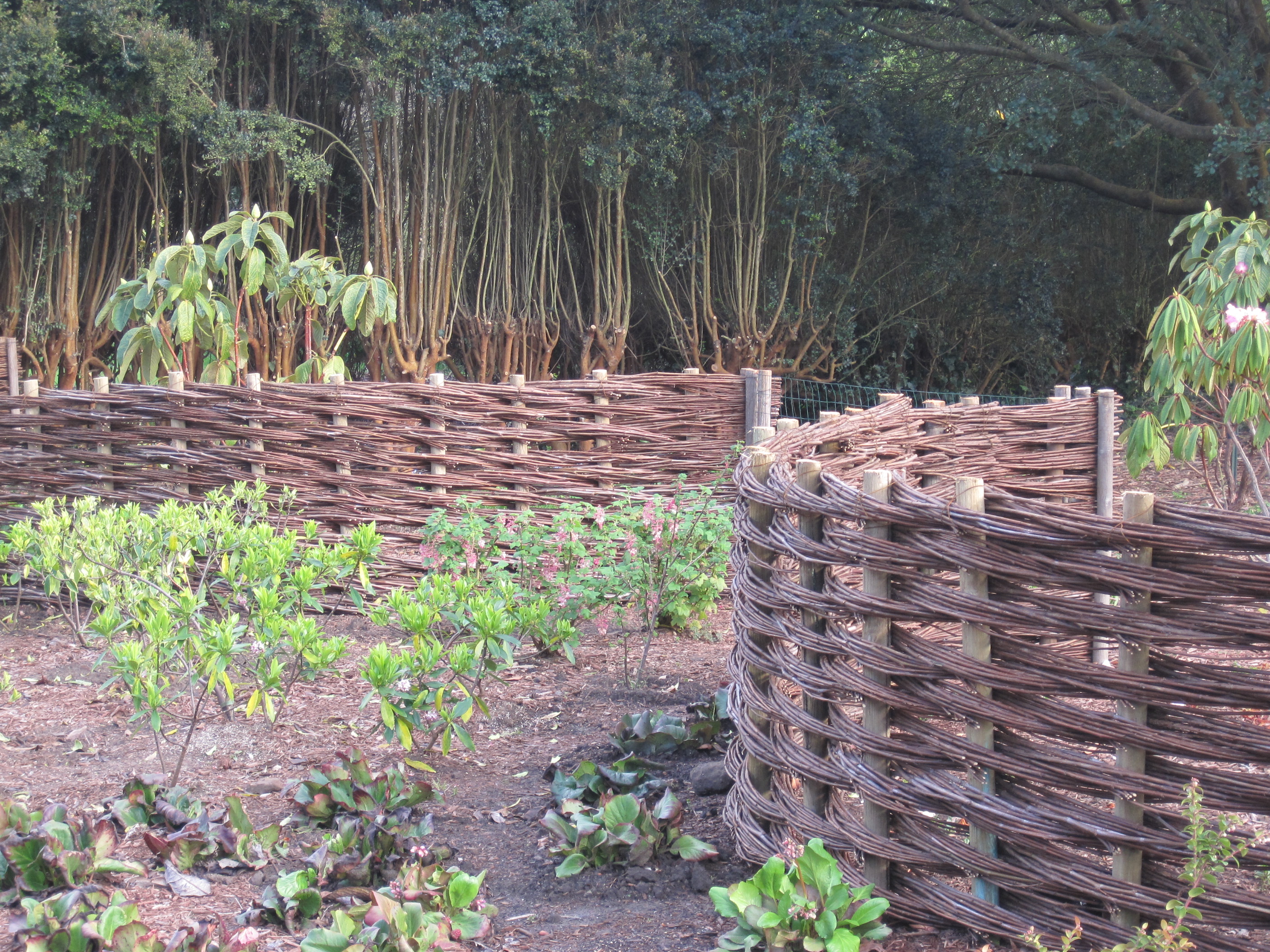
artful fence at the entrance to the rhododendron dell

Posted in arts | Tagged | 1 Comment

in city parks, fancier noshing?

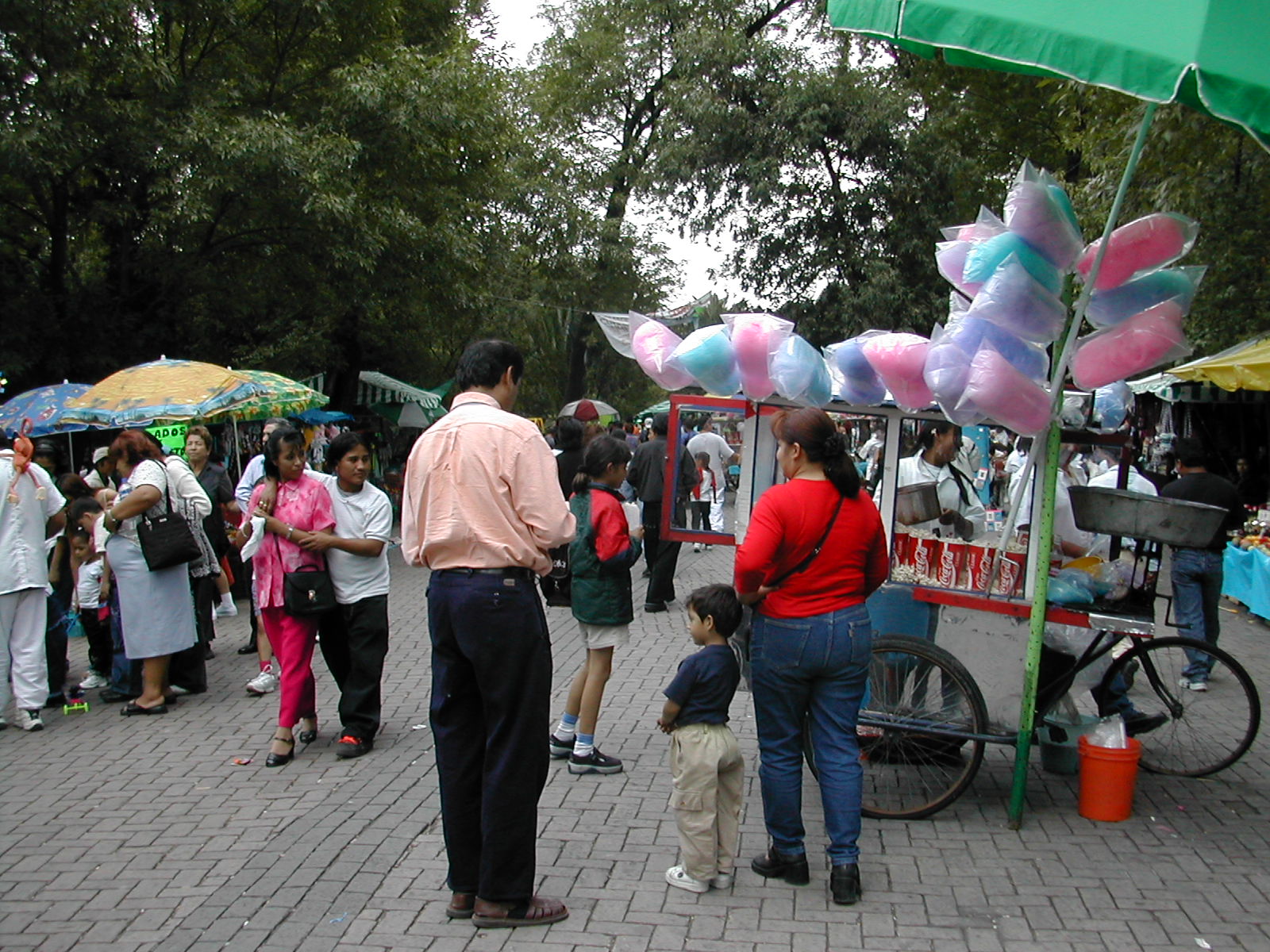
food vendors in Chapultepec Park, Mexico City

Could it be that New York City parks are poised to surpass San Francisco parks in gourmet food offerings?  The following article, from the New York Times, hints at what foodies in New York have to look forward to.  This reminds me of many happy hours I spent eating my way through Chapultepec Park in Mexico City, pictured above.  Read on  .  .  .

“Yearning to soar above its tired, rote roster of hot dogs and pretzels, the New York City Department of Parks and Recreation put out a call five months ago for the food vendors of New York ‘to propose your most inventive, exciting food idea,’ adding, ‘whatever the idea, we want to see it.’ .  .  .

The response was not overwhelming: the department received 58 applications to sell food in some 50 locations that were made available. But the invitation provoked enough interest for the department to designate vendors in eight locations who plan to field trucks and carts selling everything from kimchi fried rice and epicurean grilledcheese sandwiches to organic ice cream and ginger slushes.  .  .  .

Some of the food will be available Wednesday by the department headquarters at 64th Street and Fifth Avenue, when 15 concessionaires, new and previously approved, will assemble for a media event open to the public from 11 a.m. to 2 p.m.

The department has so far designated only these few new specialty vendors ‘because there were no bids for some locations, and because some bids just didn’t measure up,’ said Betsy Smith, the department’s assistant commissioner for revenue and marketing.

Street food has proliferated on city streets, but deployment in the parks has been slowed because applicants must wend their way through the city’s cumbersome contract-approval process requiring background checks and verification of the vendors’ financial resources.

The application ‘is very difficult, beyond the skills of many cart holders,’said Sean Basinski, director of the Street Vendor Project, a nonprofit advocacy group. ‘It’s not designed to attract immigrant street vendors. You need a Harvard M.B.A. to fill it out.’

His group believes that ‘the process should be democratized,’ he said, ‘and some of the burdensome requirements for application should be done away with.’

Ms. Smith said the department has ‘done a lot of hand-holding, trying to walk people through the process,’ and has held educational sessions for would-be concessionaires. She acknowledged, though, that the department could do more, ‘and going forward, we are going to focus on fewer locations and do more outreach for each one,’ she said. ‘We have to go out and drum up business.’

Despite the constraints of mobility, some vendors will offer a degree of complexity in their food. Li’l Purple Yam will serve its Noritaco, a sheet of nori seaweed painted with rice flour and pan-fried until it has become a crunchy taco shell. It is topped with kimchi fried rice and a salad of mountain yam, green mango, papaya, jicama and watercress.

Currently some 400 concessions, many of which sell food, bring in $42 million in revenues to the Parks Department from 5,000 properties under its jurisdiction (3,000 are parks, and 2,000 of those have names).

Hot-dog carts pay a minimum of $600 a year in low-traffic locations, but the new specialty carts will pay from $15,000 to $150,000 a year in five-year contracts (the most expensive, outside the Metropolitan Museum of Art, require $158,122). Currently there are 25 specialty carts and trucks in the parks.

The push for better food is in part a response to changing demographics and greater food sophistication. Mr. Benepe said parks are busier than ever, with more families staying in the city rather than moving to the suburbs, and immigrant groups enjoying parks that were once lightly used.

‘All these forces have come together,’ he said, ‘and when you have more visitors and families in parks, you have an increased interest in food.'”

via In City Parks, Fancier Noshing – NYTimes.com.

Posted in eating, recreation | Tagged , | 1 Comment

managing the urban forest in golden gate park

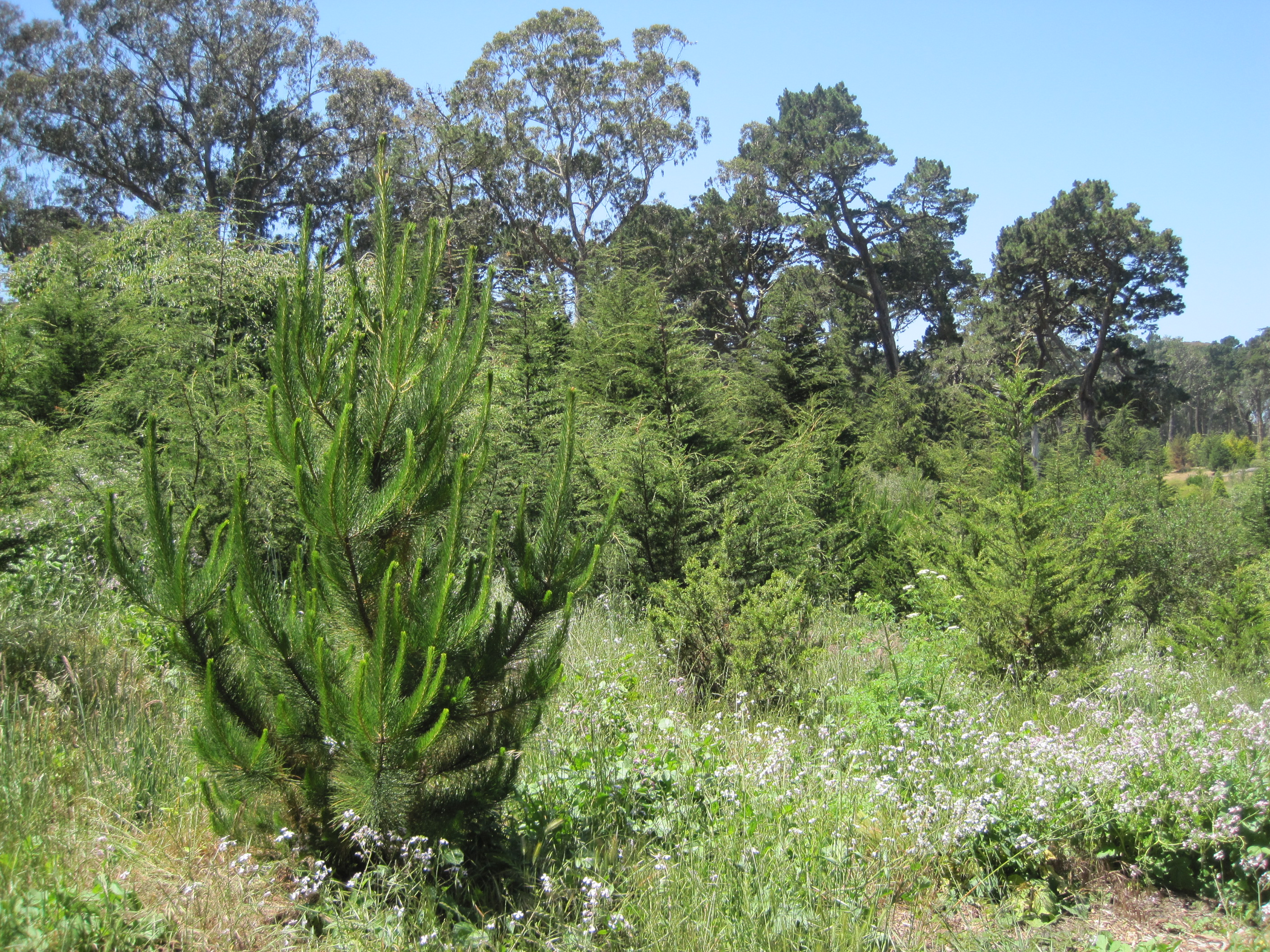
reforestation in golden gate park, 6-15-11, photo by heath schenker

Standing near the intersection of Transverse Drive and Middle Drive West in Golden Gate Park, looking downhill towards Elk Glen Lake, I am surrounded by urban forest, no hint of the city in sight.   The air is warm and smells pungent today, like a forest should!  A red-tailed hawk is circling overhead.  Tall, jagged Monterey cypresses, feathery Eucalyptus and top-loaded Monterey pines stand out against the sky.  These are the “big three,” the trees that have provided the skeletal structure for this miraculous urban forest since it was established in this unlikely location in the nineteenth century.  Many of the grand, old original trees remain, although nearing the end of life.  The old Monterey pines (particularly susceptible to pine pitch canker) are going first.

The job of caring for, and renewing, this remarkable urban forest requires special knowledge, experience and dedication.  We are lucky to have a crew of urban foresters in the park who fit this bill!  In front of me, in the foreground (pictured above), is a new forest “plantation,” being managed by the forestry division in the park.  To the untrained eye this baby forest might not look like much, but with a bit of squinting and imagination it’s not too difficult to envision what it will look like in fifty years or so, when the trees have grown in, adapted to local growing conditions and are properly thinned out.

The techniques used by the forestry division today in Golden Gate Park have evolved in many ways since William Hammond Hall’s experiments with growing trees on these sand dunes.   But the basic approach that he adopted, through trial and error, has stood the test of time.  Like in the nineteenth century, growing conditions are harsh, with challenging soil and strong, salty winds blowing off the ocean.  Some types of trees do better than others in these conditions.  As Hall demonstrated, it is wise to build on successes and learn from experience.

Although some basic conditions remain the same, managing a 150-year-old forest is different from planting one from scratch.   When a large old tree dies in this forest today, it not only creates a gap that must be filled in, but its absence affects all the trees around it, which have grown accustomed to its presence.  Often nearby trees will also weaken or fail without the support or shelter afforded by the missing tree.  So forest management involves assessment of the condition of standing trees, as well as fallen ones.  Sometimes weakened old trees must be removed for public safely before they fall down on their own and this may create sufficient room for reforestation.  Areas selected for new forest plantations must be large enough to give young trees the sun and water they need without too much competition from older trees.  But shelter is also important, as wind is a harsh environmental factor in this park.  Planting new sapplings thickly, sheltering them from the wind and salt air by surrounding them with shrubby thickets, then thinning the plantations once they are established yields the desired result.  But the process takes a long time and requires a lot of patience.

William Hammond Hall accomplished a miracle of sorts when he started this urban forest on the sand dunes of the Outside Lands against the odds and in the face of expert opinions.  Sometimes it may seem like those were the “good old days,” but don’t think he had an easy time of it!  I recently read a report of the Board of Park Commissioners from 1886, entitled “The Development of Golden Gate Park, and Particularly The Management and Thinning of Its Forest Tree Plantations,” which was clearly aimed at critics of the process used to establish the park’s forest, and a bid to win support (and funds!) to thin some overgrown plantations.  The report includes a statement by Wm. Hammond Hall explaining that four times as many trees were planted as could grow to maturity, with the expectation that this would give young trees much needed support and protection from the elements, and that thinning would be a necessary part of the process.  He also defended the planting of temporary wind breaks consisting of quick-growing and hardy evergreen trees, that would be removed, or thinned, once the tree plantations had matured.  Frederick Law Olmsted wrote a letter, included in the report, supporting the methods Hall used to establish the park trees and affirming that “it was essential to the successful growth of the designed masses of foliage of the Golden Gate park, that its trees should be planted as closely as they were [and] .  .  .  equally essential to the growth in a healthy way of such masses that, as the trees advance in size, their number shall be greatly reduced.”  And John McLaren also weighed in with a letter calling for thinning stands of trees which, “unless they receive immediate attention .  .  .  will be past recovery.”

So it seems that questions regarding the management of trees in Golden Gate Park are time-honored and perhaps inevitable.  But as we take up these questions, we should beware of missing the forest for the trees!

Posted in history, plants, trees/urban forest | Tagged , , , , | Leave a comment

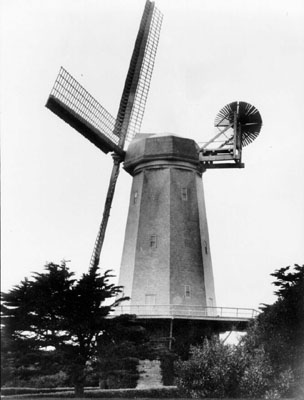
murphy windmill stub on the verge of renovation

Murphy Windmill, n.d., SFPL Historic Photograph Collection

“During the next month neighbors of the Murphy Windmill in Golden Gate Park can watch workers finally cast the old stub’s fourth, fifth and sixth floors.

A large crane installed the windmill’s eight main posts during the weekend and now the sheathing, doors and windows will take about a month to construct. If all goes according to plan, the cap and blades from the Netherlands will be ready for assembly as early as mid-August.

The 105-year-old windmill is the younger of two in the park and sits boarded up about 300 yards from Ocean Beach. It was initially used to pump water that irrigated the park, but after decades of neglect, the windmill fell into disrepair.

For about 10 years Campaign to Save the Golden Gate Park Windmills has worked with The City to raise about $4 million for the restoration of the windmill. Paula March, a former consultant with the campaign, said the road to renovation has had several kinks including a bad economy, too many cooks in the kitchen and contracting roadblocks.

“But I think when the public sees what an incredible machine that it is, people will be blown away,” March said.

The 100-year-old, Colonial New England-style cottage next to it has been vacant since 2003. The caretakers of the windmill used to live in the two-story home.

Rec and Park is working on a $900,000 project to restore the cottage and then turn it into a restaurant.

The Northern Dutch Windmill in Golden Gate Park has had a cosmetic restoration and the blades can occasionally be seen turning.”

via Murphy windmill stub on the verge of renovation | Kamala Kelkar | Local | San Francisco Examiner.

Posted in history, infrastructure | Tagged , | 1 Comment

the old beach chalet in golden gate park

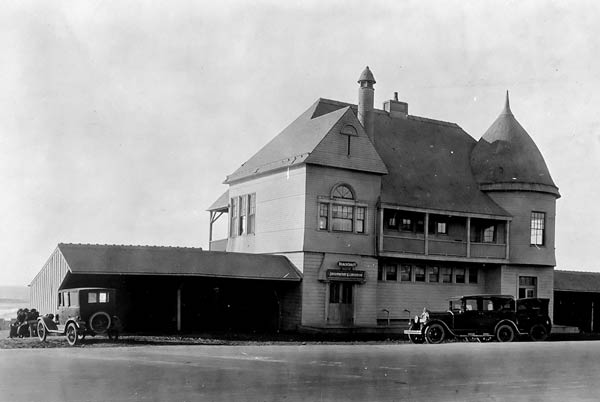
The Original Beach Chalet was built in 1892 on the west side of the Great Highway across from Golden Gate Park. - Jesse Brown Cook Scrapbooks, BANC PIC 1996.003, UC Berkeley

The current Beach Chalet in Golden Gate Park dates to 1925.  It’s a building in the Spanish Colonial Revival style and one of the landmark historic structures in the park.  Few people know that there was another Beach Chalet, predating the the current building, on the other side of the Great Highway.  The fascinating history of the older Beach Chalet (now lost) is recounted by John Freeman on the Outside Lands website:  http://www.outsidelands.org/old-beach-chalet.php

Here’s an excerpt from that story:  ‘As Golden Gate Park developed in the 1870s, most of the landscaping and public structures were concentrated at the eastern end, near Stanyan Street. There were dirt roads leading out to the western end of the park and Ocean Beach, but little planting and no public structures for those who took carriage or bicycle rides to see the surf. There was the Cliff House on the bluff, and at its base, a roadhouse called the Seal Rock House, and next door the Ocean Beach Pavilion for dancing. All these early building were more associated with entertaining adults than providing genteel recreation for families.

In November 1891, the Park Commission let contracts for $8,000 to construct a building designed by architect William O. Banks to serve as shelter from the wind, provide bathrooms and changing rooms for bathers, and offer observation decks to watch the waves on one side and the developing park on the other. As the San Francisco Chronicle said, “it will be an elegant addition to the few structures which at present relieve the monotony of sand dunes.”1

The new “House on the Beach” opened on Sunday, March 20, 1892. The building was described as “a two-story structure having steep roofs with ornamental gables in Queen Anne style.” There were towers at each end of the building, one of which contained a staircase leading to the second or “observation” floor. “This is divided into a large lounging room, a reading room and toilet and dressing room for women,” the Chronicle noted, making no mention of facilities for the men. One can only assume men were also provided a room for changing into their woolly swimming attire. The newspaper description continues:

The entire seaward side of the building is utilized as an observation platform and supplied with basket-shade chairs, stools, etc. On the landward side between the towers is located another platform, also well equipped with chairs. The building is designed especially for accommodation of ladies with children who wish to avoid the crowds at the Cliff House.2

The building was flanked at each end by low sheds for visitors to store carriages or bicycles during their visit.

In the early years, there was no clear identity for “The House on the Beach;” it was sometimes also called “The Observatory.” By 1895, there were newspaper references to Chalet Beach at the end of Golden Gate Park, and the building there seemed to have developed a permanent identity, but not a firm foundation. The Beach Chalet got little notice in the press, except for the annual reports to the Park Commission, which listed revenue from food concessions at the Chalet and Sharon Lodge at the Children’s Playground in the same category. The Chalet served “approved” refreshments, not alcoholic beverages, since that would be out of character for a building “designed especially for ladies with children.”

After the 1906 earthquake, the Chalet was mentioned in the park superintendent’s report on damage to structures in the park, and $2,000 was requested for unspecified repairs, most likely to stabilize the foundation. The location of the structure provided wonderful views and a comfortable place to get out of the wind; yet a building situated on the beach was constantly subject to the encroaching waves, especially during winter storms.  .  .  .

In the third week of January [1914], a major storm worked its way down from Vancouver, sinking ships and destroying beach and harbor structures all along the Pacific Coast. Amazingly, thousands of people braved the wind and rain to journey to Ocean Beach, as the San Francisco Chronicle reported, “to watch the work of destruction that is being done by the heavy seas […] that have been pounding against the embankment along the seawall end of Golden Gate Park.” The Chronicle continued:

Aside from the magnificent sight furnished by the heavy surf, interest centered in the heroic struggle which is being made to save the Park chalet from the hungry sea. Last night it looked as though the chalet was doomed. The breakers have eaten away the sand embankment up to the very walls of the chalet, and a number of the balcony supports have been washed out. Unless there shall be an immediate abatement of the storm and the high seas the chalet will be destroyed.4

Crowds turn out to see if the original Beach Chalet can survive a winter storm and eroding Ocean Beach, 1914. - Courtesy of Jack Hudson Collection

The structure survived that particular storm, but eventually the building proved no match for the location too close to the ocean.  When the new Beach Chalet was completed in 1925, the older structure was moved to 24th Avenue, between Irving and Judah, given a new first floor with a large meeting hall and renamed the Sunset District Boy Scout Hall.  It remained in use for community and club meetings, occasional church services and a nursery school until 1958 when it was destroyed by fire.  For the complete story see:   The Odyssey of the Original Beach Chalet – Western Neighborhoods Project – San Francisco History.

Posted in "lost" golden gate park, history | Tagged , , | 1 Comment

a labor of love: mapping central park’s trees

Ken Chaya, left, and Edward Sibley Barnard are admirers of a black tupelo in Central Park that is one of 150 or so trees in Central Park that survive from the era of its creation nearly a century and a half ago. (photo from the New York Times, May 31, 2011)

This article from today’s New York Times tells of two friends who have spent two years putting together a map of the trees in Central Park, New York.   Of the approximately 23,000 trees in the park, only about 150 remain from the era when the park was first designed and planted (mid nineteenth century).  Wish we had a map like this for Golden Gate Park!  What a great gift to the public!

“Ken Chaya and Edward Sibley Barnard are not like most people. Spend two hours walking the oxygen-infused oasis with this pair as quirky as the Quercus prinus (chestnut oak), and it’s as if all of your senses are on steroids.

You smell the fresh wintergreen scent of a sweet birch branch split open. You pick up a crusty pod from the Kentucky coffeetree and taste the molasses-like jelly inside (but not the seeds, which can be toxic if they are not cooked). You run your hands over the winged branches of the Euonymus alatus and they feel like cork.

You are mesmerized by the magenta leaves glowing atop the variegated European elm because of a beautiful defect. You hear a magnolia warbler chirping on a black cherry tree deep in the serenity of the woods.

And then you begin to understand the pure wonder that drove these two men to give up two and a half years of their lives to make a map that artfully and painstakingly details 19,933 trees in Central Park.

“The more I look at it and study it,” Mr. Chaya said under a pin oak in the park one day last week, “the more it reveals its secrets to me.”

Their map includes 174 species and represents about 85 percent of the vegetation on the park’s 843 acres.

“Do I want every tree?” asked Mr. Chaya, 55, a birder and freelance graphic designer. “Of course, but I’m crazy. You can’t have every tree. There’s great hubris in wanting every tree. But we got the big ones, we have the important ones.”

The pair, working independently from the city and without any subsidy from the Central Park Conservancy, the nonprofit organization that manages the park, said they had spent nearly $40,000 on the project — testing their families’ patience — because they cherished Central Park’s trees and wanted others to as well. They hope to just break even.

The two-sided, waterproof, 36-by-26-inch map, called “Central Park Entire: The Definitive Illustrated Folding Map,” is sold for $12.95 at the Dairy in the park and on the men’s Web site, CentralParkNature.com. They have sold about 1,100 copies of the $35 poster version since January. Some of the proceeds go to the Conservancy, the men said.”

via 2 Enthusiasts Compose Map of Central Park Trees – NYTimes.com.

Posted in plants, trees/urban forest | Tagged , , | 1 Comment