Recollections of a 50-year love affair with Golden Gate Park

I can’t resist posting this lovely recollection of Golden Gate Park written by Roselyn Rich Smith, printed in the Marin Independent Journal on June 6, 2024 (to see the original article follow the link at the end).
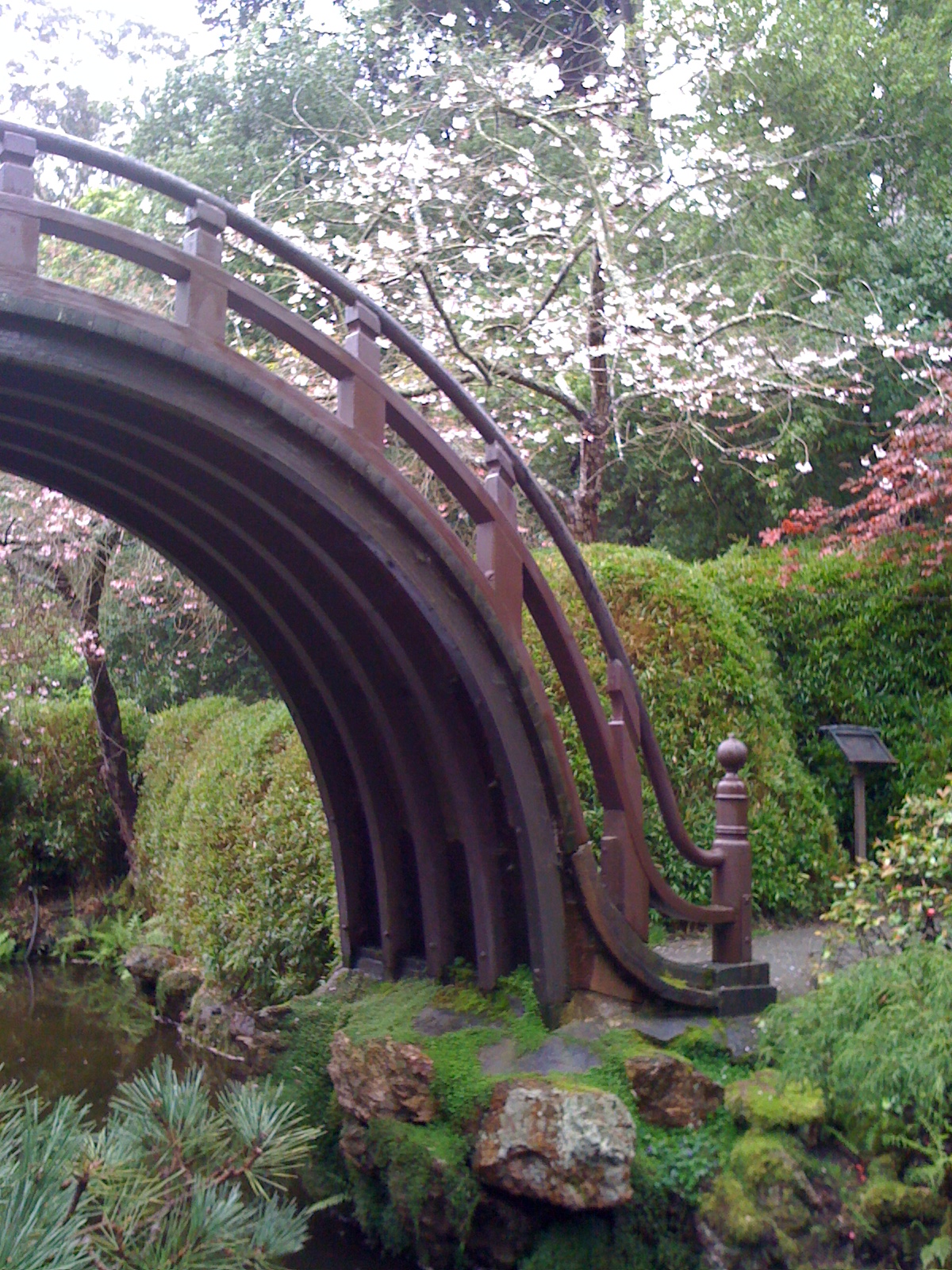
Japanese Tea Garden (photo by Heath Massey)

Japanese Tea Garden (photo by Heath Massey)

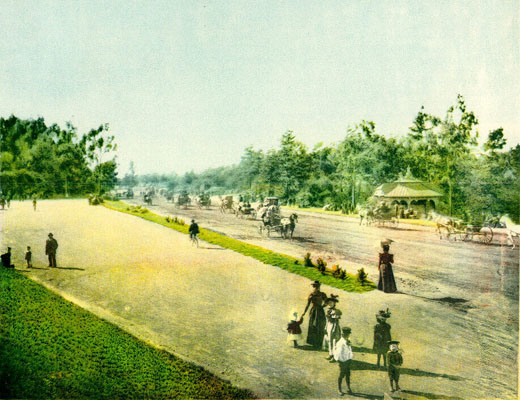
“I have bicycled through some grand public parks of the world — the Parmenio Pinero in Buenos Aires, the Bois de Boulogne in Paris, the Westpark in Munich, the Parc de la Granges in Geneva. None have been grander than the Golden Gate Park.

It all began five decades ago at the end of a road trip in a Chevy convertible from Boston to San Francisco with a dark-eyed, dashing lover, a king of romance and surprises. Before entering the historic City by the Bay, which I had never seen, he blindfolded me and drove to the highest peak. As the blindfold flew off, I could scarcely breathe. It was love at first sight; the pastel city, with her Victorian houses draped in soft powder blues and creamy whites, surrounded by the silver sheen of ocean and bay. High-spanned bridges glittered in the morning sun like necklaces tossed across the water. The emerald city’s golden park shimmered below us with five lakes and 1,000 acres of forests, meadows and flower-filled gardens that spilled for miles eastward from the ocean. At that moment, my life turned from black and white into technicolor.

This wild introduction to the new city of my dreams was only beginning. My pied piper had more tricks up his sleeve. From our wrap-around hilltop view, he whisked me down to the Golden Gate Park. After renting bicycles, we began an all-day magic carpet ride through a lovers paradise. O Fortuna, to be introduced to this city sanctuary on a clear, sunny day in April!Our bike tour began amid a Cirque du Soleil cast of bicyclists, roller skaters, parents with strollers, street musicians and bench warmers. For an East Coast girl used to drab, grey skies, who had never laid eyes on a eucalyptus, redwood or date palm tree, I was dizzy with pungent smells and vibrant colors. “We’re not in Boston anymore, Toto.”

Our first stop was at the Japanese Tea Garden. We sipped jasmine tea served by geishas in red silk kimonos in an open-air teahouse. We breathed in the scents of pink cherry blossoms and white magnolias while crossing arched bridges over curving ponds with golden fish.Next, a ride on a turn-of-the-centurey carousel with old fashioned organ grinder music and fanciful ponies handpainted with metallic blues and golds. Later, a picnic on the lush green grounds of the glass Conservatory of Flowers amid a sweep of 10,000 gold poppies, lavender primroses, scarlet azaleas and white rhododendrons.

If I could bestow a gift to city dwellers everywhere, I would travel the world like Johnny Appleseed and cast seeds for public parks. Then, I would seek out master gardeners like John McClaren, the original landscaper for the Golden Gate Park, who dedicated 70 years of his life as the first superintendent to bring the park to its full glory.My dark-eyed, dashing lover is long gone, but 50 years later I still bicycle in the Golden Gate Park every week. Who says that a love affair has to come in human form?”

via How it is: A 50-year love affair continues – Marin Independent Journal.

Posted in history, people, recreation | Tagged , , , | Leave a comment

pedestrian underpass in Golden Gate Park avoids cars and serves as impromtu bandshell

The underpass from Conservatory Valley to the Rockery and Fern Dell (sketch by Heath Massey)

The underpass from Conservatory Valley to the Rockery and Fern Dell (sketch by Heath Massey)

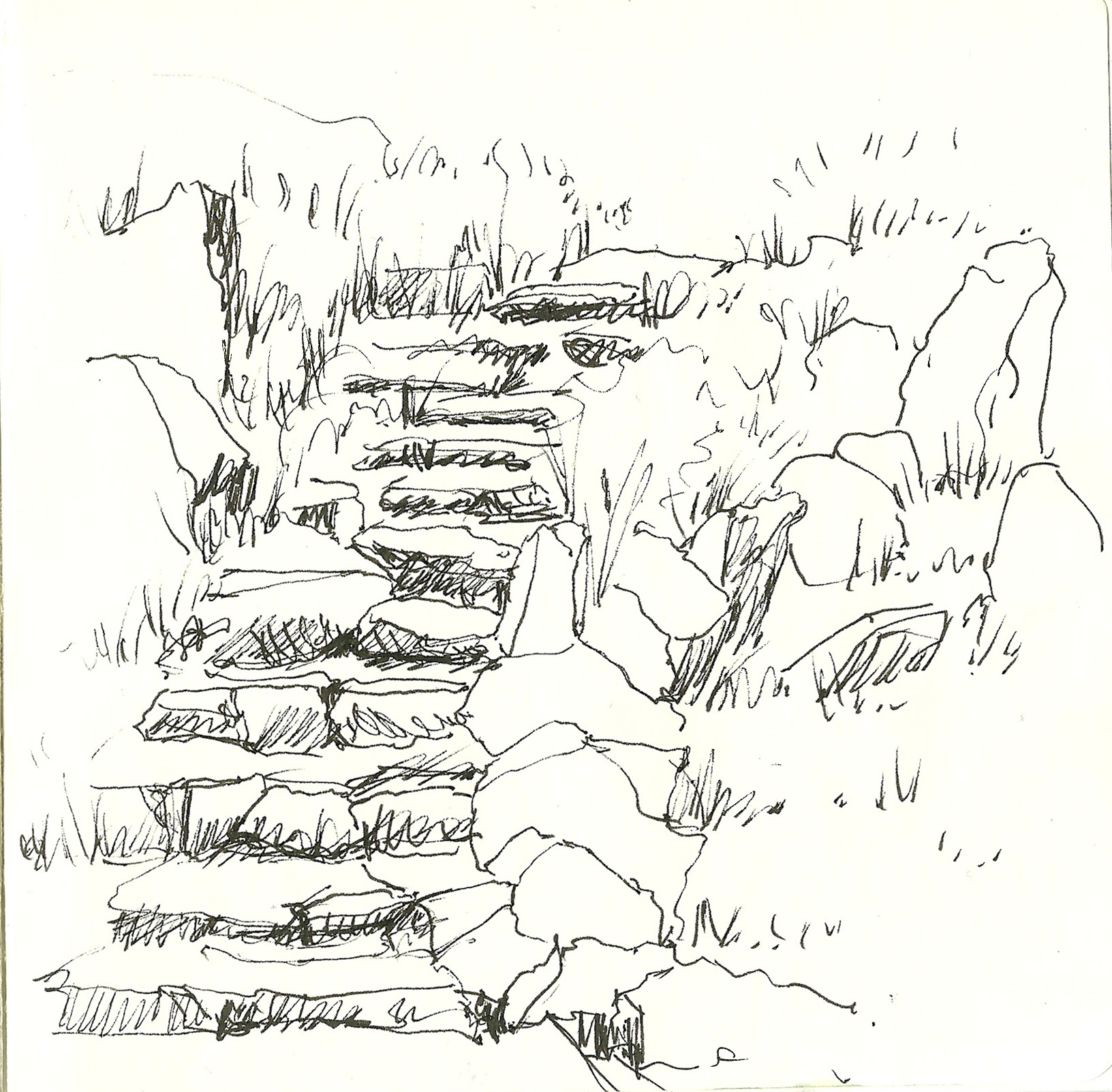
A pedestrian underpass beckons like an intriguing cave opposite the Conservatory of Flowers in Golden Gate Park, offering a vehicle-free means of traversing JFK Drive.  On a sunny day, the sunlit steps on the other side are an invitation to enter and the reward is the Rockery, with it rustic stone steps leading up the hillside to the back of the Rhodendron Dell.

The Rockery (sketch by Heath Massey)

The Rockery (sketch by Heath Massey)

On an overcast day the underpass is a little more foreboding and you may choose to brave the traffic up above instead of entering such a shadowy grotto.  Unless, of course, it’s a weekend, when music issuing from the darkness is an irresistible lure.  This impromptu bandshell is a favorite of local musicians because of the lovely acoustics.

Actually the underpasses in Golden Gate Park were probably inspired by those in Central Park, New York, on which Golden Gate Park was closely modeled.  The design of Central Park relied heavily on the concept of separating vehicular and pedestrian traffic via under and overpasses, as the concept for that park was a seamless “Greensward” uninterrupted by cross-town traffic.

Calvert Vaux's design for Playmate's Arch below 65th St Transverse Rd. in Central Park (Avery Architectural and Fine Arts Library, Columbia University)

Calvert Vaux’s design for Playmate’s Arch below 65th St Transverse Rd. in Central Park (Avery Architectural and Fine Arts Library, Columbia University)

William Hammond Hall, in his 1871 submittal of the original plan of Golden Gate Park to the park commissioners wrote that, ” it is to be regretted that these crossings could not have been arranged so that the traffic and the pleasure travel would be kept separate, by the crossings for the former being carried over, or under, the avenue roads and walks.”  Although not part of the initial plan for Golden Gate Park, pedestrian underpasses like this one in Conservatory Valley were added later, including one leading to the tennis courts from the Rockery (under Middle Drive), one to the Music Concourse from the north playground (under JFK Drive) and one from Alvord Lake to Mothers’ Meadow (under Kezar Drive).  They may be piecemeal in terms of traffic management, but I think they add to the mystique of the park.  And the music wafting out over Conservatory Valley may not be what its designer had in mind, but is definitely a plus.

Posted in arts, concerts, history, infrastructure | Tagged , , , , | 2 Comments

the conservatory of flowers in golden gate park

The Conservatory of Flowers in Golden Gate Park (sketch by Heath Massey)

The Conservatory of Flowers in Golden Gate Park (sketch by Heath Massey)

The Conservatory of Flowers is the emblem and pride of Golden Gate Park.  With its elegant symmetry, white-washed glass panes and delicate wooden fretwork it commands an imposing prospect overlooking formal flowerbeds and gracious green lawns.  More than anything else, the Conservatory establishes the park’s nineteenth century pedigree, its pretensions of grandeur and continental style.  It’s easy to imagine ladies in long dresses with parasols and gentlemen in top hats strolling there.   So romantic!  I notice that couples seem particularly drawn to it, many pushing strollers or chasing toddlers.

Although a magnificent sight on a sunny day, brilliantly white against a saturated blue sky, I think the best time to visit the Conservatory is on a typical damp, gray, foggy San Francisco day.  On such a day stepping through those doors into steamy, thick air that smells like peat and moss,  visually accosted by greens, looking up into that magnificent dome  .  .  .  I always feel like a time traveler or as if I had stepped through the wardrobe, instantly transported from a dreary present to the tropics and adventure.

Thank you James Lick (!) and the group of wealthy tycoons who got together after his death to purchase his still-crated greenhouse and donate it to the park.  With the help of funds appropriated by the state legislature it was erected at its present site and opened to the public in 1878.

The 1848 Palm House of the Royal Botanic Gardens at Kew in England is often cited as inspiration, probably because of a certain likeness in form.  The Kew Greenhouse, designed by Richard Turner and Decimus Burton,  is famously an early example of the iron and glass construction that made glass conservatories of this type so much more efficient to manufacture and maintain in the second half of the nineteenth century.  But, curiously, the Conservatory in Golden Gate Park, although built thirty years later, is made of wood and glass.

In fact, mystery pervades the history of this revered landmark.  Nobody actually seems to know where it originated.  Although legend holds that it was shipped in crates around the Horn, no record of this shipment has been found.  Furthermore, tests conducted on it in 1997 found that two-thirds of the wood used in it was redwood.  This large amount of redwood cannot be accounted for solely by various restoration efforts over the years, so it seems likely that it was manufactured on the west coast, not the east coast or England.

In any case, the wood framing has made it more susceptible to fire and hastened its aging.  In 1883, only five years after it opened, fire purportedly caused by a faulty heater severely damaged the original dome.  It reopened with a slightly taller dome in 1884 and survived the 1906 earthquake, but age, poor maintenance and winter storms led to severe damage and necessitated its closing in 1995.  In 2003 (eight long years later!) it reopened with about 45% of the original wood replaced and the rest treated with rot-retardant chemicals.  Let’s hope sufficient funds are currently allocated to its upkeep.

Posted in Conservatory of Flowers, history, infrastructure | Tagged , , | 6 Comments

primordial tree fern dell in golden gate park

tree fern dell sketch

Tree Fern Dell in Golden Gate Park (sketch by Heath Massey)

The shady Tree Fern Dell in Golden Gate Park is so different in mood from the sunny, flower-filled Conservatory Valley on the other side of JFK Drive.  But this jungly dell well represents the flip side of the Victorian sensibility, a fascination with the exotic and the primordial, with far-flung adventure and voyages of exploration, places where evolution took a different course.

The historic origins of this collection are somewhat murky;  it seems likely that it grew over time, under the direction of John McLaren, perhaps enhanced by planting from the Panama-Pacific Exposition in 1915 and further amended in 1939 in when the Conservatory Valley was redesigned.

Most of the trees in this grove are Tasmanian tree ferns (Dicksonia antarctica),  native to Tasmania as well as Eastern Australia (from Queensland south to Victoria).  According to the Encyclopedia Britannica:  “Tree ferns have a lengthy fossil record stretching back to the Triassic Period (251 to 199.6 million years ago). Members of  .  .  .  Dicksoniaceae appear to have been diverse and relatively common during the succeeding Jurassic Period (199.6 to 145.5 million years ago) and Cretaceous Period(145.5 to 65.5 million years ago). However, the modern genera only become evident during the early Cenozoic (65.5 to 2.6 million years ago). Thus, the tree ferns apparently were affected by the mass extinction event recorded across nearly all groups of organisms at the close of the Cretaceous Period.”  In other words, many of them went the way of the dinosaurs.  But unlike the dinosaurs, they made a comeback, exploiting new ecological niches in subsequent eras.

Adding to the other-worldly imagery in this corner of the park is the out-sized Chilean rhubarb (Gunnera tictoria), which forms a dark green, impenetrable thicket around the base of the tree ferns.  No doubt the mix of continents enhances the outlandish effect, as the huge Gunnera leaves play off the shaggy, mottled trunks sprouting enormous fern fronds out the top.  This weird forest plays havoc with a conventional sense of scale as well as time.

Small wonder that the final scene of Star Trek II:  The Wrath of Kahn was apparently shot here;  the scene in which Spock’s casket ends up on the Genesis planet.  What more fitting setting for that scene than this primeval forest, smoke wafting from unseen smoke machines as Nimoy’s monologue suggests that Spock may live again.

Posted in arts, gardens, plants, trees/urban forest | Tagged , , , | 10 Comments

“The Ball Thrower” in Golden Gate Park

Ballthrower sketch

The Ball Thrower by Douglas Tilden (sketch by Heath Massey)

“The Ball Thrower,” a bronze statue on the south side of JFK Drive across from the Conservatory of Flowers, is one of my favorites among the many sculptures scattered throughout Golden Gate Park.  Not only is it a delightful character study of a young, sinewy, mustached, super-confident, nineteenth-century baseball player, but it has such an interesting backstory.  The California-born sculptor, Douglas Tilden, created it while studying in Paris in the years leading up to the 1889 International Exposition commemorating the French revolution.  He originally entitled the sculpture “The National Game,” and submitted it to the American section of the 1889 Exposition, assuming it would appeal particularly to Americans.  Surprised but apparently undaunted when it was rejected by that jury, he resubmitted it to the more prestigious Salon des Artistes Francais, where to his delight it was accepted, launching his career as a sculptor of public monuments.

How the statue came to reside in Golden Gate Park is another story.  It seems that Douglas Tilden was deaf and mute as a result of having scarlet fever at age five.   Educated at the Asylum for the Deaf, Dumb and Blind in Berkeley, he took up sculpture and showed much early promise.  His studies in Paris were sponsored by William E. Brown, the Southern Pacific railroad magnate and a family friend, who was impressed by his talent.  When the statue was selected for the Salon at the Exposition, from a field of 2,460 competitors, and awarded first prize in its class, Brown realized that he had backed a winner.  He funded Tilden to cast the sculpture in bronze and after the Exposition in Paris it traveled to New York, where it was shown at the National Academy of Design and won more praise.  Tilden’s American career was launched and meanwhile he had created another large sculpture, “The Tired Boxer.”  He requested funding from Brown to cast that in bronze as well.  At this point Brown proposed to the San Francisco Board of Park Commissioners that they acquire “The Ball Thrower” for Golden Gate Park.  The commission had been routinely refusing proposals for statuary in the park for a number of years, but Tilden’s personal story of talent and hard work overcoming hardship, recounted in a letter by Brown, apparently moved them to make an exception to the no-statues rule.

Baseball grew into an American passion in the 1880s and 1890s, with amateur teams springing up in every town and the major leagues becoming firmly established.  Tilden’s original title for the sculpture reflects his belief that baseball encapsulated something of the American spirit in the 1890s:  passion, youth, vigor,  athleticism.  We’ve come a long way since then.

Sources:  http://chroniclingamerica.loc.gov/lccn/sn82015104/1891-04-10/ed-1/seq-6/ and Baseball and the American Dream:  Race, Class, and Gender and the National Pastime, “Prologue” by Rachel Ward

Posted in arts, history, people | Tagged , , , , | 2 Comments

Pastels of Golden Gate Park

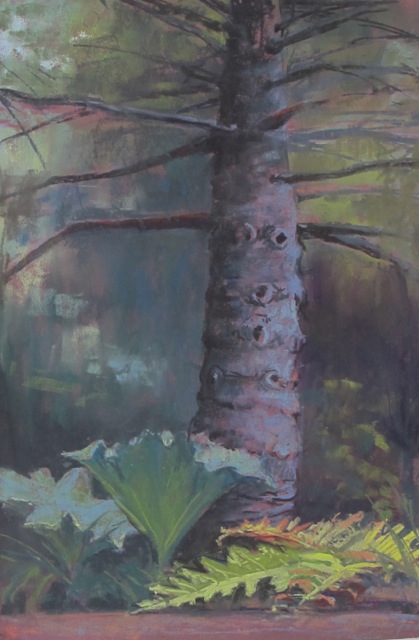
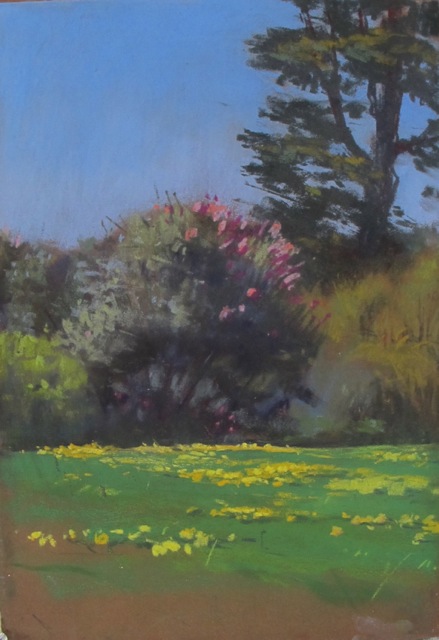
Here are two gorgeous pastel drawings of Golden Gate Park, by San Francisco artist Diane Olivier, who is also a legendary drawing teacher at San Francisco City College.  Two different days, very different light in the park!  Both drawings were done in the Botanical Garden, near the north gate.  To see more beautiful drawings by this artist, visit her web page:  http://www.dianeolivier.com

Mist in the Trees (Golden Gate Park).  pastel on sandpaper. 15 x 18".  Diane Olivier

Mist in the Trees (Golden Gate Park). pastel on sandpaper. 15 x 18″. Diane Olivier


Yellow Field. pastel on sandpaper. 15x18". Diane Olivier

Yellow Field (Golden Gate Park). pastel on sandpaper. 15×18″. Diane Olivier

Posted in arts, plants, san francisco botanical garden | Tagged , | 2 Comments

Golden Gate Park aquifer to augment Hetch Hetchy water

MIKE KOOZMIN/THE S.F. EXAMINER One of The City’s four new wells will be located near the Murphy Windmill in Golden Gate Park. The wells are slated to open in 2016.

One of The City’s four new wells will be located near the Murphy Windmill in Golden Gate Park. The wells are slated to open in 2016. (Photo: MIKE KOOZMIN/THE S.F. EXAMINER)

Here’s an interesting article about the aquifer that underlies Golden Gate Park:

“The ongoing California drought and the constant threat of earthquake have driven home the need for The City, which draws 85 percent of its water from the Tuolumne River in Yosemite National Park, to have a local supply on standby.  In 2016, the SFPUC expects to begin delivering a mixture of Hetch Hetchy water and groundwater pumped from the underground aquifer that stretches from Golden Gate Park south past Lake Merced and beyond the San Mateo County line.

About two-thirds of The City will receive the new blend of water.  Eventually, groundwater pumped from six wells could provide as much as 5 percent of The City’s daily water needs and also provide a 30-day emergency backup supply in case the Hetch Hetchy flow is cut off.

But the local groundwater is not as clean as the legendary Sierra Nevada snowmelt that is touted as some of the best drinking water in the U.S.  Thanks to leaks from sewer mains and runoff from fertilized parks, local groundwater contains levels of nitrate and coliform bacteria “that exceed U.S. Environmental Protection Agency’s drinking-water standards,” according to a review conducted by the U.S. Geological Survey in 1990.

Untreated and unblended, the local groundwater is “suitable for irrigation and other nonpotable uses,” but not for drinking, the USGS wrote.  However, when blended with Hetch Hetchy water — at about a 10 percent groundwater to 90 percent Hetch Hetchy ratio — the water meets national safety standards, according to Steven Ritchie, the SFPUC’s assistant general manager for water.

“This is perfectly safe water,” he recently told a Board of Supervisors committee, adding that in preliminary taste tests, most residents could not tell the difference.  Most of the western side of The City would receive the blended water, according to the SFPUC.

Water is considered unsafe to drink at nitrate concentrations of more than 10 milligrams per liter, and harmful to infants at over 20 milligrams per liter.  During tests during the past decade, nitrate levels of up to 55 milligrams per liter were detected from test wells near Golden Gate Park and near Lake Merced, according to the Groundwater Supply Project’s environmental impact review.

Four wells — one in Golden Gate Park, one near Lake Merced and two in the Sunset — are slated to be dug beginning in August. Later stages call for two wells in Golden Gate Park that pump water for irrigation to be converted to pump drinking water. San Bruno, Daly City and the California Water Service Co. — a privately held utility based in San Jose — all draw drinking water from the same groundwater basin.

Cal Water uses a 60-40 blend — 60 percent Hetch Hetchy purchased from the SFPUC and 40 percent groundwater — that’s also filtered onsite to meet water quality standards, said Tony Carrasco, a district manager for the agency.

The SFPUC’s blend planned for future use isn’t going to go through a filtration process before it hits taps and toilets. However, according to SFPUC spokesman Tyrone Jue, it will be chlorinated slightly to kill coliform bacteria.  But even without the chlorine step, the mixture is perfectly acceptable, according to professor Jason Gurdak, a hydrogeologist at San Francisco State University.

Most California cities draw from local groundwater tables into which sewage and agricultural runoff seep, he said.  Mixing the groundwater with higher-quality water for a final product that meets quality standards is a routine practice.  A much bigger threat to local water quality is seawater, Gurdak noted.  Seawater, which has leeched into over-pumped groundwater tables in Santa Cruz and Monterey counties, would “defeat the purpose of the project,” Ritchie said.”

via Blending contaminated SF groundwater with Hetch Hetchy supply makes it safe to drink, experts say | Other News | San Francisco | San Francisco Examiner.

Posted in health and safety, infrastructure | Tagged , , , | Leave a comment

A Birder Visits Golden Gate Park, April 2014

Cormorant at Stow Lake (photo by Redgannet)

Cormorant at Stow Lake (photo by Redgannet)

A birder and photographer who goes by the name Redgannet visited Golden Gate Park this week and posted some lovely photographs of birds sighted, including this one of a Cormorant at Stow Lake.

“Bird list for Stow Lake:

Canada Goose 12, Mallard 25, Ring-necked Duck 25, Pied-billed Grebe 4, Double-crested Cormorant 6, Great Blue Heron 1, Red-tailed Hawk 2, American Coot 3, Western Gull 60, Eurasian Collared Dove 2, Mourning Dove 3, Ann’s Hummingbird 12, Allens’ Hummingbird 2, Black Phoebe 2, Steller’s Jay 5, American Crow 4, Common Raven 10, Northern Rough-winged Swaloow 3, Violet-green Swallow 25, Barn Swallow 6, Bushtit 2, Pygmy Nuthatch 1, American Robin 12, Cedar Waxwing 70, Yellow-rumped Warbler 2, California Towhee 2, Song Sparrow 6, Golden-crowned Sparrow 8, Dark-eyed Junco 8, Red-winged Blackbird 12, Brewer’s Blackbird 25, House Finch 6.”

Check out this blog for more fabulous photos of birds in Golden Gate Park seen in previous years.

http://redgannet.blogspot.com/2014/04/golden-gate-park-san-francisco-april.html

Posted in animals, birds, urban ecology, wildlife | Tagged , , , , | 1 Comment

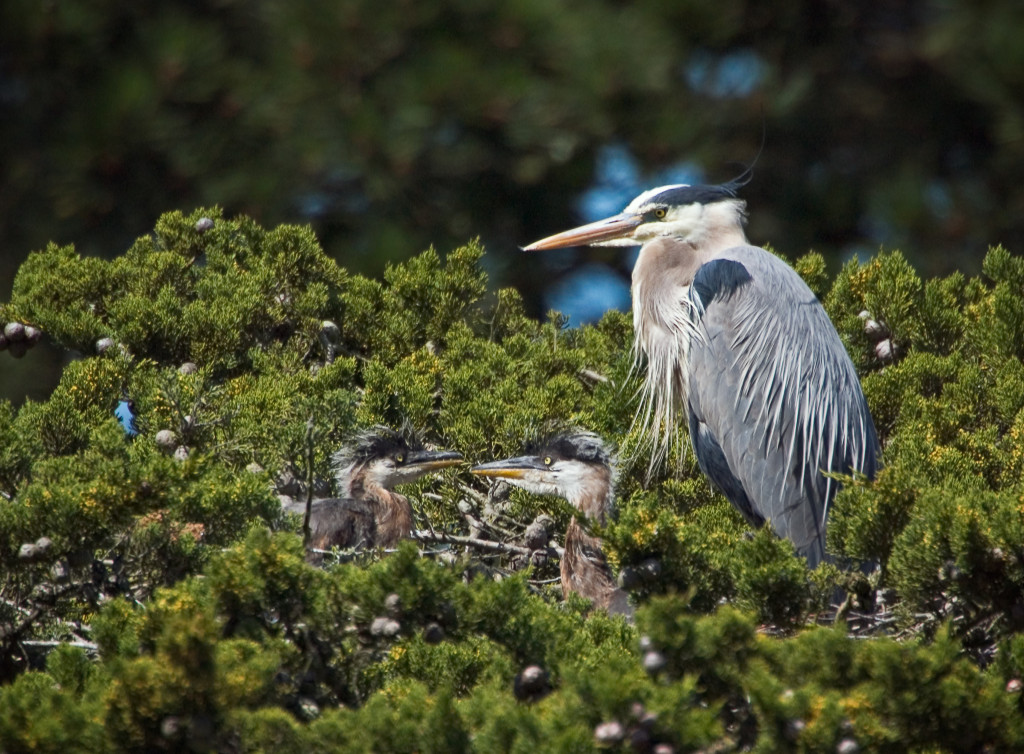
Blue Heron Cam at Stow Lake (Bay Nature)

Nancy DeStafanis with her herons at Stow Lake, San Francisco. Photo courtesy of DeStefanis.

A sign placed outside the Stow Lake Boathouse informs visitors of the variety of bird species that use the lake, such as the pied-billed grebe, Canadian goose, downy woodpecker and Allen’s hummingbird.

Yet although about 40 bird species live in Golden Gate Park, there is one that is the main attraction for Stow Lake: the great blue heron.

“Great Blue Herons are probably the most charismatic bird in America – people love them,” says Nancy DeStefanis, executive director of San Francisco Nature Education and a woman dedicated to Stow Lake’s local herons.

Nancy hands me a set of postcards with colorful photographs. She points to one showing a heron chick with a black Mohawk spreading its small and not-completely-feathered wings, and says with a smile, “See this is why I do this. Who couldn’t love these guys? I’m a sucker for them.”

Nancy has worked for 10 years to install a camera at Stow Lake so people can enjoy the birds from home and see the chicks as they grow.

“It takes money, will, and collaboration,” she says, and she is careful to mention the list of acknowledgements on the SF Nature Education website.  http://www.sfnature.org/LiveEx/live.html

Great blue heron on Stow Lake. Photo: Judy H/Flickr

Today, that hard work and collaboration is paying off, because the first official SF Nature Education Heron Cam is finally installed, and it represents the first camera on a heron colony in all of California.

The camera will act as a tool to help educate the public about the herons, especially children. On their website, SF Nature Education will provide activities targeted to 3rd to 5th grade teachers so children can learn about the heron’s biology and life-cycle, as well as the history of the colony. Nancy will also use recordings of the video to continue her 21-year monitoring and research of the colony.

Nancy first discovered herons nesting at Stow Lake in 1993.

“I was totally knocked out – to see a humongous bird fly in and two other humongous birds stand up,” she recalls.

Previously a community organizer and lawyer who often worked pro-bono cases for social justice causes, these nests were the beginning of a new phase in Nancy’s life.

Through SF Nature Education, she has led the popular and free Heron Watch program for the last 12 years. Both adults and children can look through scopes to see the herons up close and learn from volunteer naturalists about bird behavior. Children also get field journals to color in the 40 different bird species found at the Park.

Stow Lake sits near the center of Golden Gate Park. In the center of Stow Lake sits Strawberry Island — so big the lake almost seems like a river around it. Yet, a much smaller island finds space between the shore and Strawberry – “Heron Island,” as Nancy calls it.

Atop the tall Monterey cypresses on Heron Island, above all the other birds and high above the crowds, Nancy shows me a great blue heron sitting in a nest made of sticks about 5 feet wide. This bird is one of their veteran male herons – his tongue protrudes through his neck and this injury makes him recognizable. This is his fifth confirmed nesting year here. She tells me he has been sitting like that for days, indicating the nest is likely full of chicks.

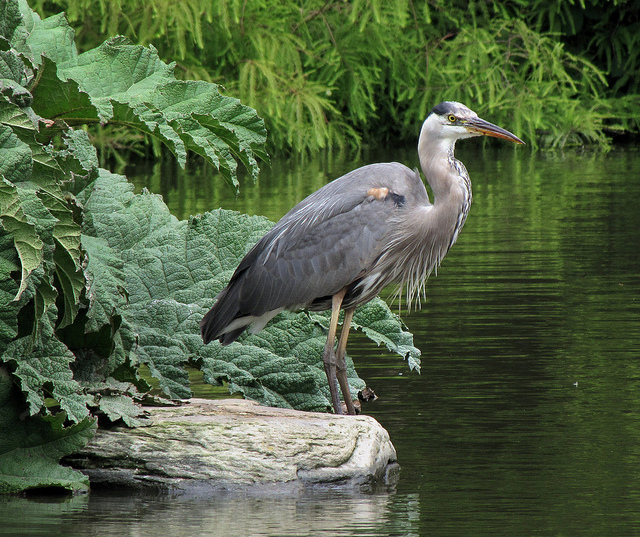
A great blue heron at Stow Lake. Photo courtesy of Nancy DeStefanis.

A great blue heron at Stow Lake. Photo courtesy of Nancy DeStefanis.

This year there are three heron nests, all in the same tree. Nancy thinks there may even be another “secret nest” in the back. According to Nancy, chicks should be visible very soon. She is hoping for the same numbers as last year: six, with two per nest. Around mid-May the chicks should start branch-hopping and taking their first flights. Once they start experimenting with flight, they’ll stay around the nest for about another two weeks before heading away from the colony. Nancy says they probably move to other parks in the Bay Area once they leave Stow Lake.

Based on the angle of light, the best time to see the nests through the heron cam will be anywhere from dawn until about 1pm, although it will be on all day. The video can be accessed at SF Nature Education’s website.

With public access postponed to the heronry at the Martin Griffin Preserve of Audubon Canyon Ranch, due to the colony failure last year, Stow Lake may be the best option for viewing herons in the Bay Area this nesting season.

While we talk, Nancy checks her email. “I think we’re on right now,” she says. We check a computer and see that the camera is live. She is thrilled.

“I’m so excited, I can’t tell you.” She lets out a happy laugh, “I’m such a happy camper. I’m going to remember this day.”

If You Go:

Heron Watch is free and will take place from 10:00 am to 1:00 pm on Saturdays from April 12 – May 17. Signs will be posted at the Stow Lake Boathouse to the observation site, where volunteers will show adult herons and chicks through scopes and talk about heron behavior. Bring binoculars and water; if you don’t have binoculars, you can borrow some from Heron Watch. Visitors will receive a checklist of the birds and children receive field journals and heron mobiles.

Volunteer-led Nature Tours to see the herons and other birds around Stow Lake and Strawberry Island are also available for $10 for

adults (children are free). Meet at same observation site from 10:30 am to noon on the same days as Heron Watch.

Autumn Sartain is a Bay Nature editorial intern.

via First Blue Heron Cam in California Set up at Stow Lake « Bay Nature.

Posted in animals, birds, people, wildlife | Tagged , , , | Leave a comment

Plants with a mean streak

Check out the new exhibit that just opened at the Conservatory of Flowers (and will be on view through mid October).

Darlingtonia_californica

Darlingtonia californica (photo: Wikipedia List of Carniverous Plants)

“San Francisco Conservatory of Flowers spokeswoman Nina Sazevich quips, “Chomp: They Came from the Swamp,” is bound to be The City’s “most fatal attraction” this year.

Though you may assume that mysterious meat-eaters would live only in far-off and exotic places, they’re quite common in the U.S., which boasts the widest variety of carnivorous plants in the world.

California has its own native species, like the cobra plant, with a bulbous green head, twisted red tongue and long, tubular pitchers. It baits its prey with nectar trails running up its exterior or along its tongue. Sun shining through a series of transparent light windows in the hood then draws them inside. Bad move. An inner collar traps the victim. After a struggle, the insect invariably tumbles down a tube to an interior lined with sharp, slippery hairs. At the bottom they drown in a pool of water secreted by the plant.

“These were the plants that really mesmerized Charles Darwin,” says [Peter] D’Amato, who established California Carnivores 25 years ago this month. “He claimed in a letter he wrote that he cared more about sundews than all of the origins of all the species of life on Earth. He joked with his wife that he thought they were disguised animals.”

In his newly revised book, “The Savage Garden,” regarded as the definitive guide to the cultivation of insectivorous plants, [D’Amato] is not kind in his description of how these “deceptively innocent looking plants with their delicate leaves sparkling with the promise of nectar,” do in their victims.

“The foolish insect curious enough to give a sundew the slightest touch will suddenly find itself caught in a living nightmare. Doomed to a horrible death, the insect may struggle for a blessed few minutes or suffer for untold hours as it tries to break free of ensnaring, suffocating glue, grasping tentacles and burning acids and enzymes; meanwhile, its precious bodily fluids are slowly sucked dry.”

Carnivorous plants are voracious.

“We do plant autopsies which always cause people to be amazed and scream,” said D’Amato. “When they are outdoors, they can catch thousands of insects. One trumpet can hold maybe 2,000 house-fly-sized bugs and they’ll produce a dozen or more trumpets.”

They grow in nutrient-poor soil in boggy areas. So in growing your own, put them in a something like sphagnum peat moss, sold in packages as a soil additive. Break it up and mix it with water until it resembles a soft, wet mud. Avoid any mosses that have fertilizers added. D’Amato maintains his plants in pots that include water low in dissolved mineral salts.

After a lifetime of studying, collecting and observing these ferocious plants, D’Amato’s heart has softened to their victims. Their appeal becomes not just their strange habits but their singular beauty.

“In my old age, I rescue little things all the time,” he confesses.

“When I was a little kid I got a kick out of feeding flies to them,” he said. “Now it unnerves me. If a pitcher has caught a lot of ants and then a little harmless house fly or moth falls in, it’s like a person falling into a greased well loaded with rats. I use my forceps and pull it out and pull the ants off and set it free.”

via Plants with a mean streak | The Press Democrat.

Posted in blooming, Conservatory of Flowers, gardens, plants, san francisco botanical garden | Tagged , | Leave a comment