
I have a copy of this small booklet published in 1973 by Elizabeth McClintock. She only identifies herself on the last page of the booklet, in a brief note explaining that this is the second edition; the original was published eight years earlier (1965?). In the note she lists some of the changes that occurred in the Panhandle during those eight years . . . trees that fell or were removed, some replaced and some not.
Elizabeth McClintock is still the major authority on the trees of the Panhandle and Golden Gate Park, although she died in 2004. Having studied botany as an undergraduate at UCLA and then earned her PhD at the University of Michigan, she became a curator in the botany department at the California Academy of Sciences in 1949 and remained there until she retired in 1977. Her specialty was plant taxonomy and she took a professional interest in the trees in Golden Gate Park throughout her career, documenting the various species found in the park, adding specimens from the park to the Academy’s herbarium and writing many articles about the park’s trees in the Journal of the California Horticultural Society (later the California Horticultural Journal) and in Pacific Horticulture, where she was associate editor for twenty-five years. Her articles have been edited and collected in: The Trees of Golden Gate Park and San Francisco, by Elizabeth McClintock, edited and arranged by Richard G. Turner Jr. ( Heyday Books/Clapperstick Institute, Berkeley, California in collaboration with Pacific Horticultural Foundation, Strybing Arboretum Society, Friends of Recreation and Parks, Friends of the Urban Forest and the San Francisco Tree Advisory Board; 2001).
So, some thirty-seven years years later, as I enter the Panhandle at the corner of Baker and Oak Streets with McClintock’s booklet in hand, I feel like I have the most authoritative guide at my shoulder! My goal is to see how many of the trees documented in this booklet are still standing today, what condition they are in, how they have aged or changed. The booklet divides the Panhandle into four sections and pinpoints the major trees in each section, with numbers on the plan keyed to a plant list.
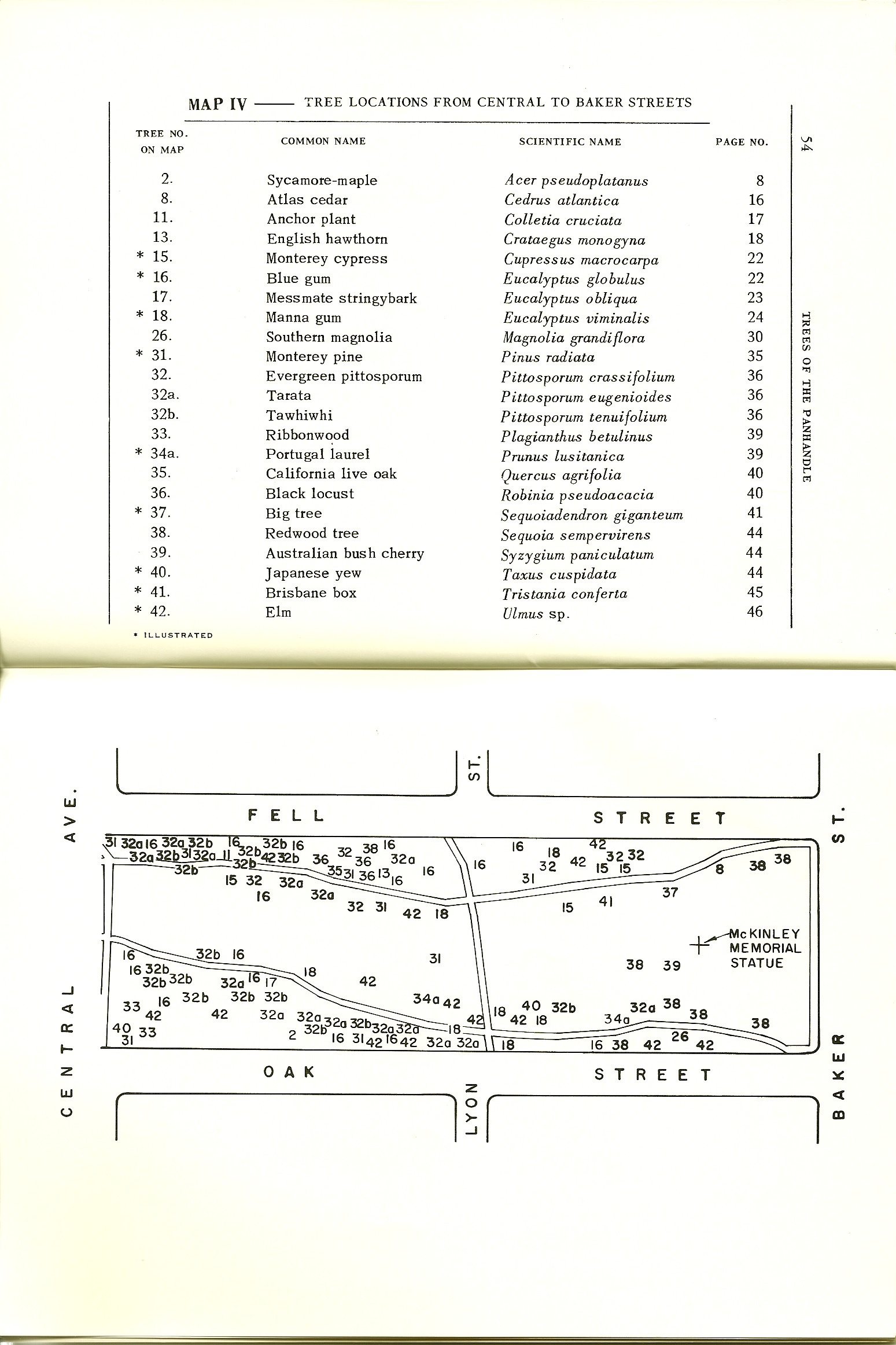
map iv -- trees of the panhandle
I circle the big ones, the ones that, through strength in numbers and great size, make the Panhandle so magnificent. I only make it through the first section (from Baker St. to Central Ave.), but it’s enough to get a sense that many (most!) of the trees identified in the booklet are, in fact, still there: thick groves of redwoods . . . magnificent elms . . . monterey cypresses . . . eucalyptus of various shades and shapes . . . all contorted by time and weather and many looking somewhat the worse for wear and age (unkempt, ungainly), but collectively what a window to the past!
There are some holes, but for now the fabric is holding up. In some places saplings have been planted to fill in potential gaps. They seem dwarfed by their surroundings; how long will it take for these little ones to reach sufficient size to replace the grand, old trees as they die? I will come back another time with an arborist; someone who can read these trees better than I can, diagnose their age and condition, tell me about the plan to preserve and regenerate this venerable urban forest!
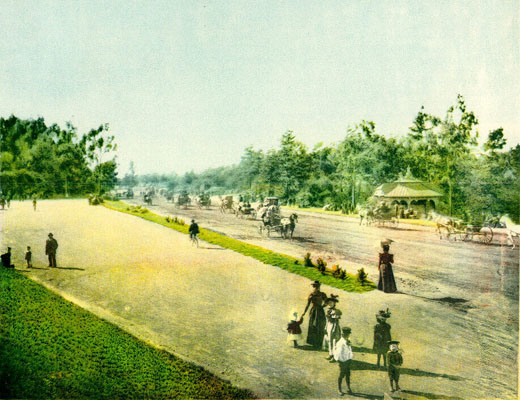
 golden gate park: views from the thicket